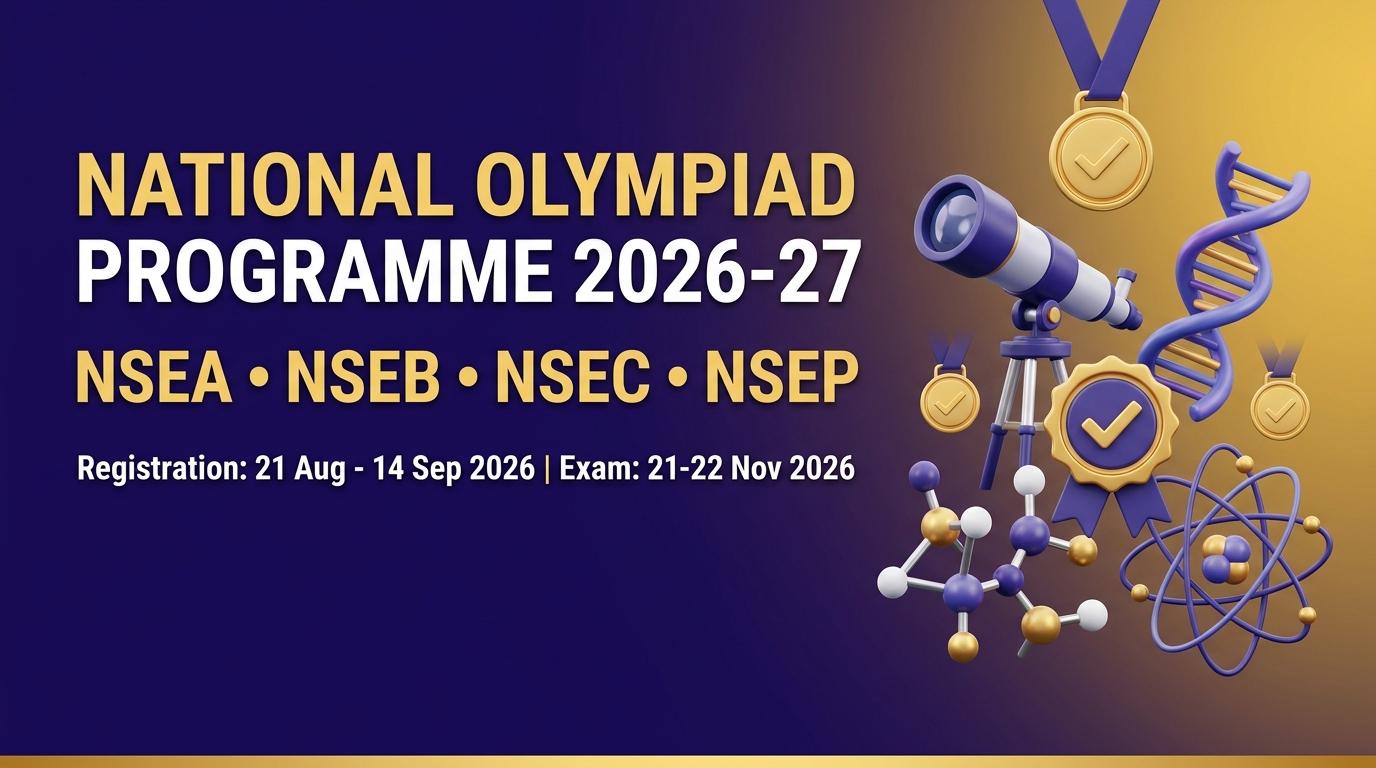
National Olympiad Programme 2026-27: The Indian Association of Physics Teachers (IAPT) in collaboration with the Homi Bhabha Centre for Science Education (HBCSE - TIFR) has announced the official schedule for the National Olympiad Programme 2026-27. This prestigious five-stage science talent search selects India's finest pre-university students in Astronomy (NSEA), Biology (NSEB), Chemistry (NSEC), and Physics (NSEP) to represent the nation at the International Olympiads 2027.
The journey begins with Stage-I: National Standard Examinations (NSE 2026), scheduled to be conducted nationwide on 21 and 22 November 2026. Eligible school and college students studying in Classes X, XI, and XII can enrol through their registered institutions or directly with IAPT between 21 August and 14 September 2026 with an enrolment fee of ₹300 per subject.
Quick Summary: National Olympiad Programme 2026-27: Check NSEA, NSEB, NSEC, NSEP eligibility, registration dates, ₹300 fee, exam dates, Syllabus, exam pattern and selection process.
Listen to this Article
National Olympiad Programme 2026-27 • Quick audio summary (~1–2 min)National Olympiad Programme 2026-27: Key Highlights
Official Brochure 2026-27What is the National Olympiad Programme?
The National Olympiad Programme is India's most recognized academic talent search in foundational sciences. Organized jointly by the Indian Association of Physics Teachers (IAPT) and the Homi Bhabha Centre for Science Education (HBCSE - TIFR), the programme aims to promote excellence in science among pre-university students and select official Indian delegations for the annual International Olympiads in Astronomy, Biology, Chemistry, and Physics.
Unlike regular competitive tests or commercial scholarship exams, the Olympiads assess deep conceptual understanding, analytical thinking, mathematical modeling, and rigorous laboratory skills across a structured multi-tier selection process.
NSEA, NSEB, NSEC and NSEP Explained
Stage-I consists of four distinct subject examinations conducted by IAPT:
NSEA (Astronomy)
National Standard Examination in Astronomy
Focuses on Physics, Mathematics, and elementary Astronomy for students aspiring to participate in the International Olympiad on Astronomy and Astrophysics (IOAA).
NSEB (Biology)
National Standard Examination in Biology
Tests advanced biological concepts, genetics, ecology, and experimental physiology leading to the International Biology Olympiad (IBO).
NSEC (Chemistry)
National Standard Examination in Chemistry
Assesses physical, organic, and inorganic chemistry problem-solving leading to the International Chemistry Olympiad (IChO).
NSEP (Physics)
National Standard Examination in Physics
Tests deep theoretical and conceptual problem-solving in mechanics, electromagnetism, and optics leading to the International Physics Olympiad (IPhO).
Detailed Eligibility Criteria (Brochure 2026-27)
To enrol and appear in NSEA, NSEB, NSEC, or NSEP 2026, candidates must satisfy all of the following criteria:
- Nationality & Passport: Candidate must be eligible to hold an Indian passport.
- Date of Birth Window: Candidate must be born between 1 July 2007 and 30 June 2012, both dates inclusive.
- Indian Schooling / Residency Requirement: Candidate must have been residing and studying in India since 30 November 2024 or earlier, OR must have been studying in an Indian school system since 30 November 2024 or earlier.
- Academic Class: Candidate must be studying in Class X, XI, or XII at the time of enrolment.
- Board Completion Status: Candidate must not have passed or be scheduled to complete Class XII board examinations earlier than 30 November 2026.
- University Studies Restriction: Candidate must not have commenced or be planning to commence university or equivalent higher studies by 1 June 2027.
- NSEJS Restriction: Candidate must not be appearing in the National Standard Examination in Junior Science (NSEJS 2026).
Important Dates Schedule (2026-27)
| Event / Stage | Date | Status |
|---|---|---|
| NSE Centre Registration (Institutions) | 1 August – 20 August 2026 | Completed |
| Student Enrolment Window | 21 August – 14 September 2026 | Active Soon |
| NSEA 2026 Examination (Astronomy) | 21 November 2026 (Saturday) | 2:30 PM – 4:30 PM |
| NSEP 2026 Examination (Physics) | 22 November 2026 (Sunday) | 8:30 AM – 10:30 AM |
| NSEC 2026 Examination (Chemistry) | 22 November 2026 (Sunday) | 11:30 AM – 1:30 PM |
| NSEB 2026 Examination (Biology) | 22 November 2026 (Sunday) | 2:30 PM – 4:30 PM |
| INO 2027 Selection List Declaration | By 15 January 2027 | Upcoming |
| Indian National Olympiads (Stage-II INO) | 30–31 January 2027 | Upcoming |
| Orientation-Cum-Selection Camps (OCSC Stage-III) | Dates TBA by 15 January 2027 | Upcoming |
| International Olympiads (Stage-V) | July – September 2027 | Upcoming |
Stage-I (NSE 2026) Exam Timetable
| Subject Code | Examination Name | Exam Date | Time Slot |
|---|---|---|---|
| NSEA | National Standard Examination in Astronomy | 21 November 2026 | 2:30 PM – 4:30 PM |
| NSEP | National Standard Examination in Physics | 22 November 2026 | 8:30 AM – 10:30 AM |
| NSEC | National Standard Examination in Chemistry | 22 November 2026 | 11:30 AM – 1:30 PM |
| NSEB | National Standard Examination in Biology | 22 November 2026 | 2:30 PM – 4:30 PM |
Note: The schedule allows candidates to appear for multiple subjects (e.g., Physics in morning, Chemistry in noon, and Biology or Astronomy in afternoon).
Application & Enrolment Fee Structure
The official enrolment fee is ₹300 per student per subject. Candidates can choose 1, 2, 3, or all 4 subjects according to their eligibility and timetable slots:
₹300
₹600
₹900
₹1,200
NSE 2026 Examination Pattern & Marking Scheme
The Stage-I question paper for NSEA, NSEB, NSEC, and NSEP consists of 60 questions divided into two distinct sections:
Part A (48 MCQs – Single Correct)
- Total Questions: 48 Multiple Choice Questions
- Options: Single correct alternative out of 4 options
- Marking Scheme: +3 Marks for correct answer
- Negative Marking: -1 Mark for incorrect answer
- Subtotal Score: 144 Marks
Part B (12 MCQs – Multiple Correct)
- Total Questions: 12 Multiple Choice Questions
- Options: One or more correct alternatives
- Marking Scheme: +6 Marks for full correct selection
- Rule: Full marks awarded ONLY if ALL correct options and NO incorrect options are chosen.
- Negative Marking: 0 Marks (No negative marking in Part B)
- Subtotal Score: 72 Marks
| Total Questions | Maximum Marks | Total Duration | Medium of Exam |
|---|---|---|---|
| 60 Questions | 216 Marks | 120 Minutes (2.0 Hours) | English & Hindi (plus Regional languages where opted) |
Official Syllabus Breakdown & Topic Map
The syllabus for the National Standard Examinations is broadly equivalent to the senior secondary level (up to Class XII) of CBSE India:
NSEA (Astronomy) Syllabus
Senior secondary level Physics and Mathematics up to Class XII CBSE, along with foundational principles of basic observational and elementary Astronomy. High emphasis on analytical kinematics, gravity, and optics.
NSEB (Biology) Syllabus
Senior secondary level Biology up to Class XII CBSE. Covers Cell Biology, Molecular Genetics, Plant Physiology, Animal Anatomy & Physiology, Ecology, Evolution, and Ethology with emphasis on data-driven reasoning.
NSEC (Chemistry) Syllabus
Senior secondary level Chemistry up to Class XII CBSE. Covers Physical Chemistry (Thermodynamics, Chemical Kinetics, Equilibrium), Organic reaction mechanisms, and Inorganic Coordination Chemistry.
NSEP (Physics) Syllabus
Senior secondary level Physics up to Class XII CBSE. Covers Classical Mechanics, Thermodynamics & Fluid Dynamics, Electromagnetism, Wave Optics, and Modern Physics with multi-concept numerical rigor.
Want Chapter-Wise Topic Maps & 90-Day Study Plan?
Explore our dedicated National Olympiad Syllabus 2026-27 page featuring detailed Class XI–XII CBSE preparation maps, elementary Astronomy breakdown, practical laboratory skills guide, and an interactive student progress tracker.
Five-Stage Selection Process (The Olympiad Journey)
The road to the International Olympiads spans five rigorous competitive stages:
Stage 1: National Standard Examination (NSE 2026)
Conducted nationwide by IAPT across hundreds of school/college test centres in November 2026. Qualifies top ~300-500 students per subject to Stage-II.
Stage 2: Indian National Olympiad (INO 2027)
Conducted by HBCSE (INAO, INBO, INChO, INPhO) in late January 2027 at ~17 national centres. Qualifies top ~35-50 students per subject to OCSC.
Stage 3: Orientation-Cum-Selection Camp (OCSC)
Held at HBCSE Mumbai. Intensive 2–3 weeks residential training involving theoretical and experimental tests to select the official 4–5 member Indian team.
Stage 4: Pre-Departure Training of Indian Teams (PDT)
Rigorous training and experimental labs at HBCSE before flying out to the host countries.
Stage 5: International Olympiads 2027
Indian national teams compete globally against student delegations from 80+ nations.
Stage-II: Indian National Olympiads (INO 2027)
| Olympiad Code | Full Name | Exam Date | Exam Time Slot |
|---|---|---|---|
| INAO 2027 | Indian National Astronomy Olympiad | 30 January 2027 (Saturday) | 9:00 AM – 12:00 PM |
| INChO 2027 | Indian National Chemistry Olympiad | 30 January 2027 (Saturday) | 1:30 PM – 4:30 PM |
| INPhO 2027 | Indian National Physics Olympiad | 31 January 2027 (Sunday) | 9:00 AM – 12:00 PM |
| INBO 2027 | Indian National Biology Olympiad | 31 January 2027 (Sunday) | 1:30 PM – 3:30 PM |
Official Stage-II Examination Venues (17 Cities):
OCSC & Merit Awards
The Orientation-Cum-Selection Camps (OCSC) are residential camps hosted at HBCSE Mumbai. Selected students undergo rigorous experimental problem-solving and theoretical masterclasses:
Merit Awards & Special Prizes:
As specified in the official brochure, students selected for and participating in OCSC receive merit awards in the form of books and cash awards, along with special prizes recognizing top theoretical and experimental performances. Merit awards and prize allocations are governed strictly by the official programme guidelines.
International Olympiads 2027 Schedule & Host Nations
| Subject Stream | Indian Team Size | Host Nation / Destination | Tentative Schedule |
|---|---|---|---|
| Physics (IPhO 2027) | 5 Students | Saudi Arabia | July 2027 |
| Chemistry (IChO 2027) | 4 Students | Chinese Taipei | July 2027 |
| Biology (IBO 2027) | 4 Students | Poland | July 2027 |
| Astronomy (IOAA 2027) | 5 Students | Venue TBA | August / September 2027 |
How to Enrol for NSE 2026
Eligible students can register for NSE 2026 through one of two official channels:
Through Student's School / College (NSE Centre)
If your school/college is a registered NSE centre, approach your science teacher or the Olympiad coordinator to enrol by paying the ₹300 fee per subject before 14 September 2026.
Direct Enrolment via IAPT Portal
If your school is not a registered NSE centre, students can register directly on the official IAPT student enrolment portal (iapt.org.in) and choose the nearest available examination centre.
10 Practical Preparation Tips for Science Olympiads
- Build Strong Class X–XII Fundamentals: Master NCERT core textbooks thoroughly before moving to advanced problem collections.
- Understand Concepts Over Formulas: Olympiad problems test the "why" and "how", demanding conceptual derivation rather than memorization.
- Solve Past Olympiad Papers: Practice past 10 years' NSE and INO question papers from HBCSE archives to gauge question style and difficulty.
- Sharpen Mathematical Skills: Numerical problem-solving with calculus, coordinate geometry, and approximations is vital for Physics and Chemistry.
- Practice Multi-Concept Problems: Train on problems connecting multiple disciplines (e.g., thermodynamics with chemical kinetics).
- Strengthen Experimental Thinking: Understand laboratory procedures, error analysis, significant figures, and experimental graphs.
- For Astronomy (NSEA): Solidify mechanics, optics, gravitation, trigonometry, and basic celestial coordinate systems.
- Master Time Management: Simulate 2-hour Mock Test with negative marking to optimize question selection.
- Track Official Updates: Check the official IAPT and HBCSE portals weekly for Admit Card and notifications.
- Avoid Rote Learning: Rely on standard university-level reference textbooks (Halliday-Resnick for Physics, Campbell for Biology, Atkins/Clayden for Chemistry) alongside school curriculum.
Official Links & Resources
| Official Resource | Direct Link |
|---|---|
| IAPT Official Website (Stage-I NSE) | Visit iapt.org.in |
| HBCSE Official Olympiad Portal | Visit HBCSE Portal |
| HBCSE Past Olympiad Question Papers | View Past Papers |
Frequently Asked Questions (FAQ) – National Olympiads 2026-27
Official Advisory & Final Note
Students and parents should verify the latest notification, eligibility rules, and enrolment instructions on the official IAPT (iapt.org.in) and HBCSE (olympiads.hbcse.tifr.res.in) websites before submitting an application.