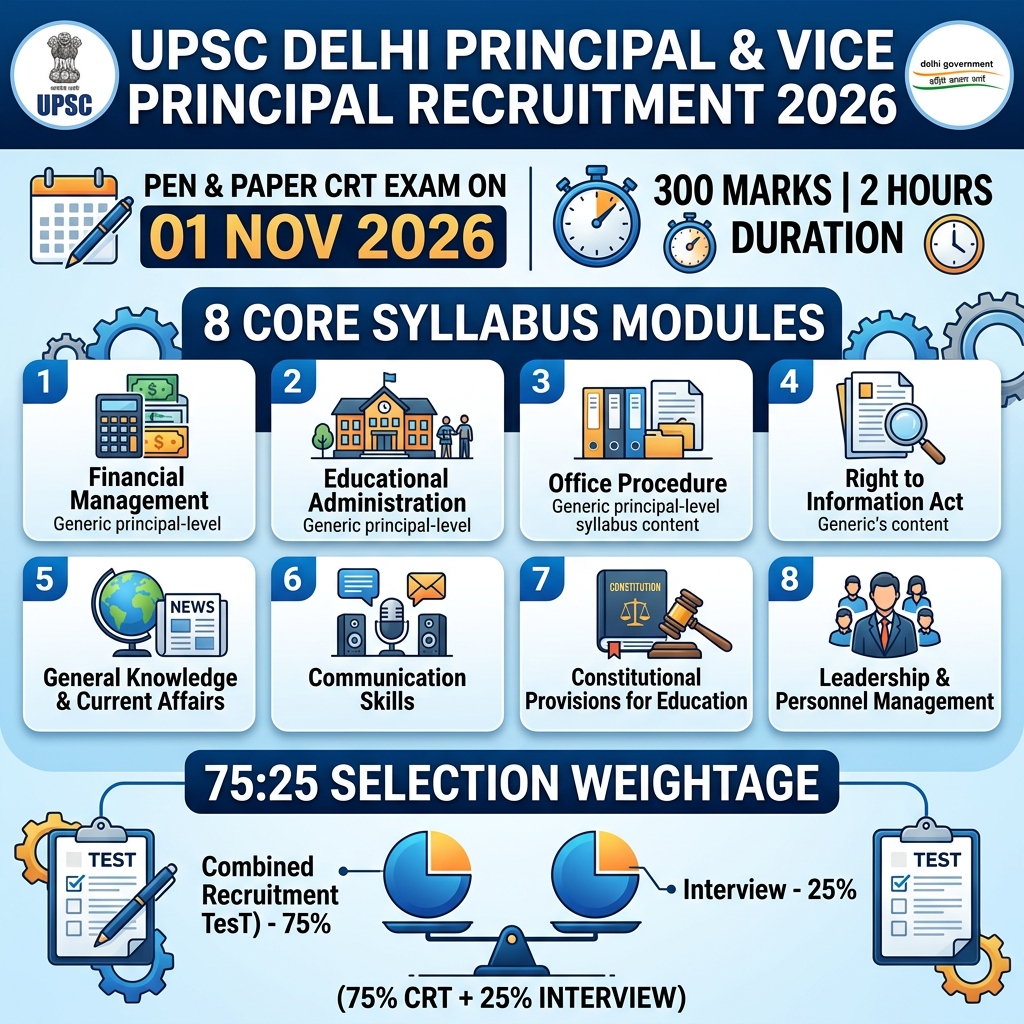
1. UPSC Delhi Principal & Vice Principal Syllabus 2026: Key Highlights
Below is the official summary of the examination scheme and selection process prescribed by UPSC for Delhi Principal and Vice Principal Recruitment 2026:
| Recruitment Body | Union Public Service Commission (UPSC / संघ लोक सेवा आयोग) |
|---|---|
| User Department | Directorate of Education, Government of NCT of Delhi |
| Posts Name | Principal (Group-A Gazetted) & Vice Principal (Group-A Gazetted) |
| Total Vacancies | 828 Posts (Principal: 124 | Vice Principal: 704) |
| Examination Name | Combined Recruitment Test (CRT) |
| Exam Mode & Type | Offline / Computer Based Objective Test (Multiple Choice Questions) |
| Maximum Marks | 300 Marks |
| Exam Duration | 2 Hours (120 Minutes) |
| Medium of Examination | Bilingual (English & Hindi) |
| Negative Marking | 1/3rd (0.33) Marks deducted per wrong answer |
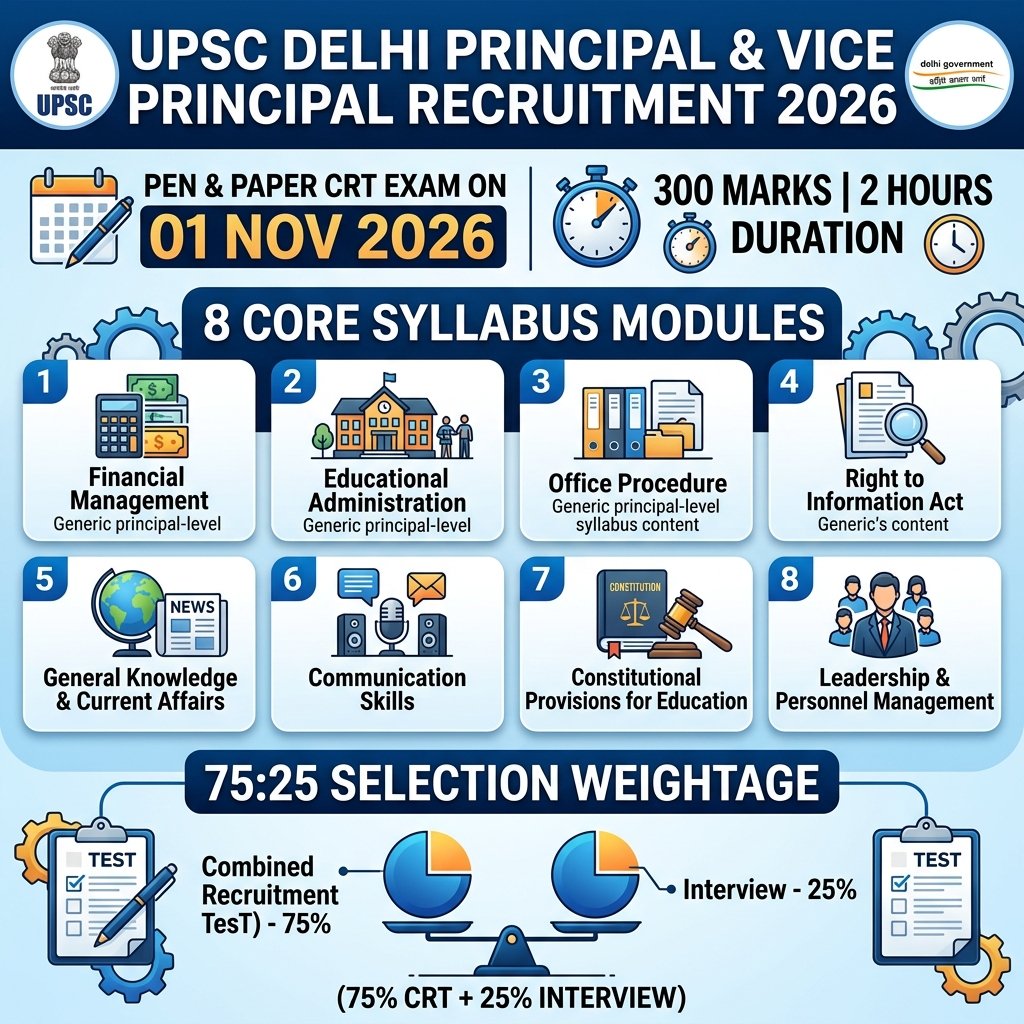
| Final Selection Ratio | 75% Weightage for CRT Marks + 25% Weightage for UPSC Interview |
| Official Website | upsconline.nic.in / upsc.gov.in |
2. UPSC Combined Recruitment Test (CRT) Exam Pattern 2026
The UPSC CRT for Delhi Principal & Vice Principal posts is structured as follows:
| Exam Feature | Official Prescribed Specification |
|---|---|
| Examination Name | Combined Recruitment Test (CRT) 2026 |
| Question Type | Objective Type Multiple Choice Questions (MCQs) |
| Total Maximum Marks | 300 Marks |
| Total Duration | 2 Hours (120 Minutes) |
| Medium of Questions | Bilingual — English and Hindi (except language questions) |
| Marks per Question | All questions carry equal marks |
| Negative Marking Penalty | -1/3rd (33.33%) of assigned mark for wrong response |
| Unattempted Question | No penalty (0 Marks) |
3. UPSC Principal & Vice Principal Syllabus: 8 Core Areas
The official syllabus prescribed by UPSC for the CRT consists of eight major domain areas:
General Knowledge
Social, Economic & Cultural Current Affairs, History, Geography, Polity, Economy & Govt Schemes.
Language Skills
English & Hindi Grammar, Reading Comprehension, Vocabulary, Sentence Correction & Usage.
Reasoning & Quant
Logical Reasoning, Analytical Thinking, Arithmetic, Data Interpretation & Numerical Ability.
Educational Policies
NEP 2020, NCF, Educational Measurement, Evaluation, Continuous Assessment & Exam Reforms.
Management & Finance
School Leadership, Educational Management, General Financial Rules (GFR), Budget & Accounting.
Office Procedure
Official Correspondence, File Movement, Drafting & Noting, Service Rules & RTI Procedures.
Pedagogy in Education
Teaching-Learning Theories, Learner-Centred Methods, Bloom's Taxonomy & Inclusive Education.
Digital Literacy
Computer Fundamentals, MS Office, E-Governance, Cyber Security & Digital Education Tools.
4. Section 1: General Knowledge & Contemporary Issues
This section tests current affairs with special emphasis on social, economic, and cultural developments in India:
- National & International Current Affairs: Major national events, summits, international conventions, bilateral agreements, awards, and honors.
- Education-Related Developments: New government schemes in education, school infrastructure programs, national literacy missions, and educational rankings.
- Indian History & Culture: Freedom Movement, Cultural Heritage, Art Forms, Monuments, and Social Reform Movements in India.
- Indian Polity & Governance: Indian Constitution, Preamble, Fundamental Rights & Duties, Directive Principles, Parliamentary system, Local Self-Government, and Constitutional Bodies.
- Indian Economy: Economic Planning, NITI Aayog, Inflation, National Income, Fiscal & Monetary Policies, Union Budget highlights, and Poverty Alleviation schemes.
- Geography & Environment: Physical Geography of India, Rivers, Climate, Natural Resources, Biodiversity, Environmental Conservation, and Climate Change initiatives.
- Science & Technology: Recent developments in Indian Space Program (ISRO), Defense R&D (DRDO), Artificial Intelligence, Digital India initiatives, and Health Science.
5. Section 2: English and Hindi Language Skills
Language proficiency in English and Hindi evaluates grammar, comprehension, vocabulary, and administrative drafting ability:
English Language Skills
- Reading Comprehension (Passages & Inference questions)
- Grammar (Parts of Speech, Tenses, Articles, Prepositions)
- Vocabulary (Synonyms, Antonyms, One-Word Substitutions)
- Sentence Correction & Error Spotting
- Idioms & Phrases, Word Usage in Context
- Active & Passive Voice, Direct & Indirect Speech
- Sentence Rearrangement & Para Jumbles
- Spelling Check & Fill in the Blanks
Hindi Language Skills (हिंदी भाषा कौशल)
- हिंदी व्याकरण (संज्ञा, सर्वनाम, विशेषण, क्रिया, काल)
- संधि एवं संधि विच्छेद, समास (भेद व विग्रह)
- उपसर्ग एवं प्रत्यय, शब्द रचना
- पर्यायवाची शब्द, विलोम शब्द, अनेकार्थी शब्द
- मुहावरे और लोकोक्तियाँ (अर्थ एवं प्रयोग)
- वाक्य शुद्धि एवं शब्द शुद्धि (वर्तनी सुधार)
- अपठित गद्यांश (Comprehension Passages)
- पारिभाषिक शब्दावली (राजभाषा व प्रशासनिक शब्द)
6. Section 3: Reasoning Ability & Quantitative Aptitude
Evaluates logical deduction, analytical problem solving, and basic numerical aptitude:
Reasoning Ability
- Analogy, Classification & Coding-Decoding
- Number & Alphabet Series
- Blood Relations & Direction Sense
- Syllogism & Venn Diagrams
- Logical Reasoning: Statement & Conclusion / Assumption
- Data Sufficiency & Order-Ranking
- Puzzles & Seating Arrangements
- Non-Verbal Reasoning (Pattern Completion, Paper Folding)
Quantitative Aptitude
- Number System, HCF & LCM, Fractions & Decimals
- Simplification & Approximation
- Percentage, Average, Ratio & Proportion
- Profit, Loss & Discount
- Simple Interest & Compound Interest
- Time & Work, Pipes & Cisterns
- Time, Speed & Distance, Problems on Ages
- Mensuration (Area, Volume 2D & 3D) & Data Interpretation (Tables, Bar Charts, Line Graphs, Pie Charts)
7. Section 4: Educational Policies, Measurement & Evaluation (NEP 2020)
This specialized section holds maximum importance for administrative posts in school education:
- National Education Policy (NEP) 2020: Core vision, 5+3+3+4 Curricular structure, Foundational Literacy and Numeracy (FLN), PARAKH, Multilingualism, Vocational Education integration, Teacher Education (ITEP), and Higher Education reforms.
- National Curriculum Framework (NCF): NCF for School Education (NCF-SE), NCF for Foundational Stage (NCF-FS), and Competency-Based Learning frameworks.
- Educational Policies & Acts: Right to Education (RTE) Act 2009 & Amendments, Sarva Shiksha Abhiyan (Samagra Shiksha Abhiyan), PM SHRI Schools Scheme, Vocational & Skill Development policies.
- Educational Measurement & Evaluation: Formative Assessment (FA), Summative Assessment (SA), Continuous and Comprehensive Evaluation (CCE), Criterion-Referenced vs Norm-Referenced Tests.
- Assessment & Examination Reforms: Learning Outcomes (LOs), Rubrics development, Diagnostic Testing, Remedial Teaching, Item Analysis, and Competency-Based Assessment tools.
- Inclusive Education: RPwD Act 2016 provisions in schools, Gifted and Learning-Disabled children support, Inclusive Classroom Strategies, and Gender Sensitization in schools.
8. Section 5: School Management & Financial Administration (GFR)
Focuses on institutional leadership, school governance, personnel administration, and government accounting rules:
School Management & Leadership
- Institutional Planning & Development Plan (IDP)
- Leadership Styles (Transformational, Instructional, Distributed)
- School Management Committees (SMC) & PTA functioning
- Human Resource Management & Staff Performance Review
- Time Management, Delegation & Decision Making
- Conflict Management, Team Building & Crisis Management
Financial Administration & GFR
- General Financial Rules (GFR 2017) basics
- School Budget Preparation, Allocations & Control
- Government Grants Utilization & Cash Book maintenance
- GeM (Government e-Marketplace) Procurement procedures
- Audit of Accounts, Stock Register Verification & Financial Discipline
- VMS & PFMS (Public Financial Management System) basics
9. Section 6: Office Procedure & Official Correspondence
Administrative workflow procedures applicable to Delhi Government Educational Institutions:
- Central Secretariat Manual of Office Procedure (CSMOP): Receipt and Dispatch of Dak, File Movement, Noting and Drafting standards.
- Forms of Official Communication: Office Memorandum (OM), Official Letter, Demi-Official (DO) Letter, Endorsement, Circular, and Notification.
- Maintenance of Official Records: Service Books of teachers and staff, Leave Records, Performance Appraisal Reports (APAR/ACR), Personal Files, and Stock Registers.
- Right to Information (RTI) Act 2005: Basic duties of Public Information Officer (PIO), First Appellate Authority, RTI timelines, and exemptions under Section 8.
- Conduct & Disciplinary Rules: CCS (Conduct) Rules, CCS (CCA) Rules basic awareness, Disciplinary Proceedings, Suspension, and Minor/Major Penalties.
10. Section 7: Pedagogy in Education & Teaching-Learning
Core pedagogical concepts, learning theories, and modern classroom practices:
- Child Development & Educational Psychology: Stages of Child Development (Cognitive, Emotional, Social), Piaget, Vygotsky, and Kohlberg theories.
- Teaching-Learning Methods: Constructivist Approach, Experiential Learning, Project-Based Learning, Activity-Based Learning, and Problem-Solving Methods.
- Bloom's Taxonomy: Cognitive, Affective, and Psychomotor Domains of Learning Objectives.
- Classroom Management & Guidance: Classroom Climate, Student Discipline, Peer Learning, Guidance & Counselling in Schools.
- ICT in Pedagogy: Flipped Classroom, Blended Learning, Digital Learning Tools (DIKSHA, SWAYAM, PM e-VIDYA).
11. Section 8: Digital Literacy & Educational Technology
Computer awareness, office productivity tools, digital security, and e-governance in schools:
- Computer Fundamentals: CPU, Memory (RAM/ROM), Input/Output devices, Operating Systems (Windows, Linux).
- Office Productivity Suites: MS Word (Drafting letters, Mail Merge), MS Excel (Formulae, Data Analysis, Student Marks Tabulation), MS PowerPoint (Presentations).
- Internet & Communication: Web Browsers, Search Engines, Email protocols, Video Conferencing tools (Zoom, Google Meet, MS Teams).
- Cyber Security & Data Privacy: Password hygiene, Phishing attacks, Malware/Viruses, Firewalls, Two-Factor Authentication (2FA), and IT Act basics.
- Digital Education & E-Governance: Student Information Systems (SIS), Unified District Information System for Education (UDISE+), E-Office, Digital Payments (UPI, Net Banking), and Cloud Storage concepts.
12. UPSC CRT Negative Marking Rules & Calculation
The Combined Recruitment Test includes negative marking for wrong choices:
| Candidate Response | Marks Effect | Explanation |
|---|---|---|
| Correct Answer | + Full Assigned Marks | Full credit for selecting correct option |
| Wrong Answer | - 1/3rd (33.33%) Marks | One-third of marks assigned to question deducted |
| Unattempted Question | 0 Marks | No penalty or deduction for leaving blank |
13. Selection Scheme: 75:25 Weightage & Interview Suitability Standards
The final merit list for Principal and Vice Principal posts is determined by combining CRT and Interview performance:
A. Final Merit Weightage Ratio
| Selection Phase | Weightage |
|---|---|
| Combined Recruitment Test (CRT) | 75% |
| UPSC Personal Interview | 25% |
| TOTAL WEIGHTAGE | 100% |
B. Interview Suitability Standards
| Category | Minimum Marks Standard |
|---|---|
| General (UR) / EWS | 50 and above |
| OBC (NCL) | 45 and above (Relaxed) |
| SC / ST | 40 and above (Relaxed) |
14. How to Prepare for UPSC Principal & Vice Principal CRT 2026
Focus on Specialized Education Modules
Give extra time to NEP 2020, GFR 2017, Educational Measurement, Pedagogy, and School Administration. These specialized sections carry decisive weightage in the CRT.
Time Management & Speed Practice
You have 120 minutes for 300 marks worth of questions. Solve full-length Mock Test strictly under a 2-hour timer to build speed and accuracy.