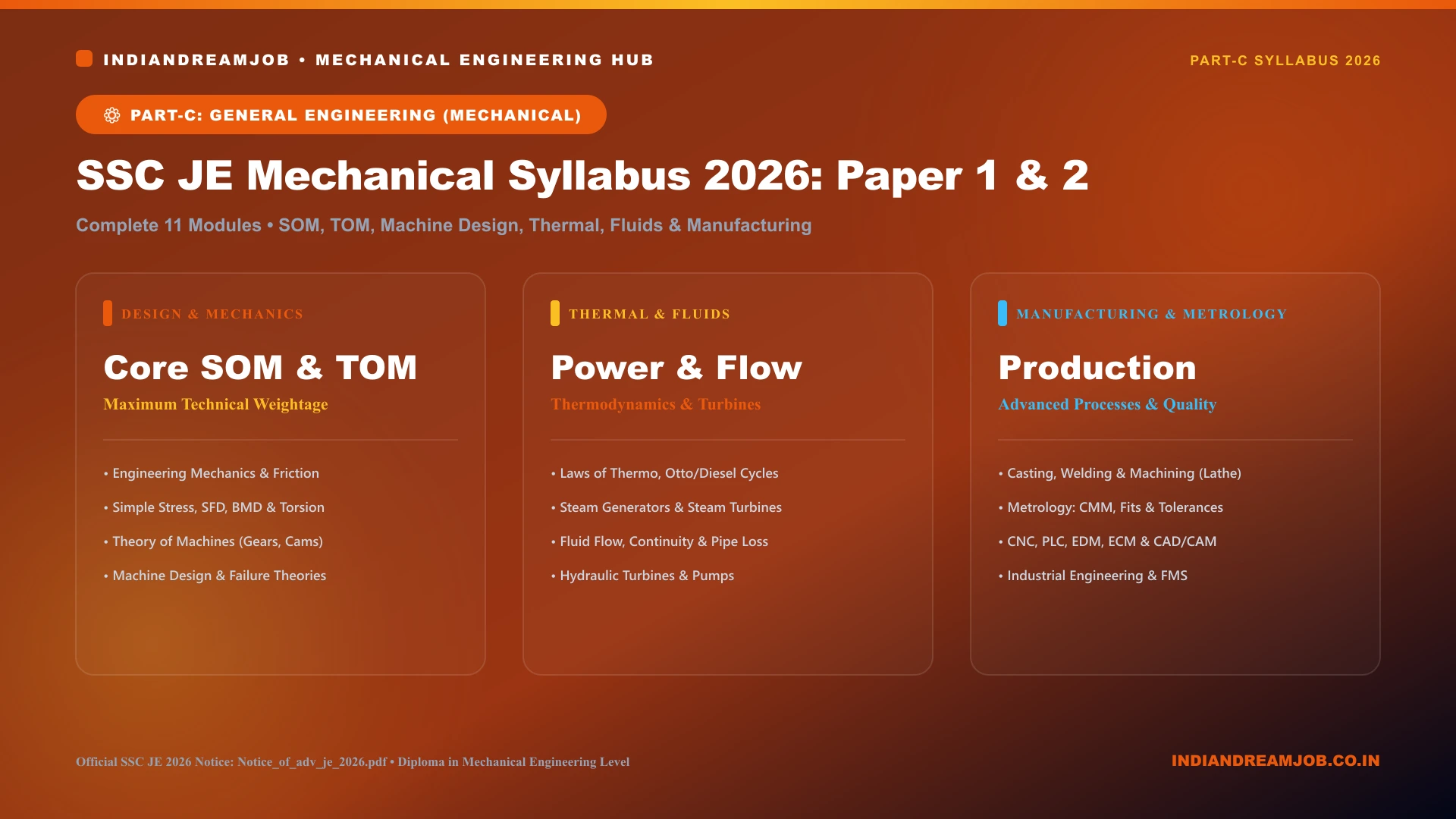
SSC JE Mechanical Syllabus 2026: The Staff Selection Commission (SSC) has officially released the detailed curriculum for Mechanical Engineering under the Junior Engineer Examination, 2026 (Notice No. F. No. HQ-C-3019/1/2026-C-3 dated 2 September 2026). For candidates applying for Junior Engineer (Mechanical) and Junior Engineer (Electrical & Mechanical) posts across Central Water Commission (CWC), Military Engineer Services (MES), and Directorate General of Quality Assurance (DGQA-NAVAL), Mechanical Engineering is officially designated as Part-C: General Engineering (Mechanical).
The Mechanical Engineering curriculum is tested across both Computer-Based Examination stages: Paper-I (100 questions for 100 marks alongside Reasoning and General Awareness) and Paper-II (100 questions for 300 marks dedicated exclusively to Part-C Mechanical Engineering). According to the official SSC notification, questions in Part-C are set approximately at the Diploma in Mechanical Engineering level.
Because normalized Paper-II scores determine 100% of final merit rankings and department allocation, technical mastery in Strength of Materials, Theory of Machines, Thermodynamics, Fluid Machinery, and Manufacturing is pivotal for achieving a top ranking.
Read This Mechanical Syllabus Guide in Your Language
Select your preferred language to switch versions instantly:
📌 SSC JE Mechanical Syllabus 2026 – Overview
Below is the verified structural overview of the Mechanical Engineering curriculum framework announced by the Staff Selection Commission for the 2026 examination cycle:
| Curriculum Dimension | Details / Prescribed Standards |
|---|---|
| Recruiting Body | Staff Selection Commission (SSC) |
| Examination Name | Junior Engineer Examination, 2026 |
| Designated Technical Part | Part-C: General Engineering (Mechanical) |
| Target Cadres | Junior Engineer (Mechanical), JE (E&M) in CWC, MES, and DGQA-NAVAL |
| Syllabus Academic Level | Approximately equivalent to Diploma in Mechanical Engineering |
| Paper-I Mechanical Questions | 100 Questions (100 Marks) — Objective Computer-Based Test |
| Paper-II Mechanical Questions | 100 Questions (300 Marks) — Objective Computer-Based Test |
| Testing Duration | 2 Hours (120 Minutes) per paper; 2h 40m for PwBD scribes |
| Negative Marking Penalty | −0.25 Mark in Paper-I | −1.00 Mark in Paper-II |
| Selection Weightage | Paper-I is qualifying/shortlisting; Paper-II determines 100% final merit |
| Virtual Calculator | Integrated on-screen scientific calculator available on testing console |
| Official Notification Document | Notice_of_adv_je_2026.pdf |
⚙️ SSC JE Mechanical Exam Pattern 2026 (Paper-I & Paper-II)
Candidates opting for Mechanical Engineering are evaluated across two successive computer-based test tiers:
Paper-I Marking Scheme (CBE)
| Section Subject | Questions | Maximum Marks | Duration |
|---|---|---|---|
| (i) General Intelligence & Reasoning | 50 Questions | 50 Marks | 2 Hours (2h 40m for scribes) |
| (ii) General Awareness | 50 Questions | 50 Marks | |
| (iii) Part-C: Mechanical Engineering | 100 Questions | 100 Marks | |
| Total Comprehensive Paper-I | 200 Questions | 200 Marks |
Paper-II Marking Scheme (CBE – Merit Determining)
| Subject | Questions | Maximum Marks | Duration |
|---|---|---|---|
| Part-C: General Engineering (Mechanical) | 100 Questions | 300 Marks | 2 Hours (+3 Marks Correct, −1 Mark Wrong) |

📖 SSC JE Mechanical Syllabus 2026 – Complete Topic-Wise
The official SSC 2026 notification organizes Part-C Mechanical Engineering into 11 comprehensive syllabus areas:
1. Engineering Mechanics
Fundamental force interactions, static equilibrium, and geometric properties:
- Free Body Diagrams (FBD): Identification of forces, resolving coplanar and concurrent forces, drawing FBDs for complex mechanisms.
- Equilibrium: Conditions of static equilibrium, equations of equilibrium, moment of forces, Varignon's theorem, and Lami's Theorem for coplanar concurrent forces.
- Friction: Laws of dry Coulomb friction, angle of friction, angle of repose, limiting friction, coefficient of friction (μ), sliding friction, rolling friction, and friction on inclined planes.
- Centroid & Centre of Gravity: Centroid of plane geometrical figures (rectangles, triangles, circles, T-sections, I-sections) and Centre of Gravity (CG) of simple solids (cylinders, spheres, cones).
2. Strength of Materials (SOM)
Elastic deformation, stress-strain behavior, and beam design under external loading:
- Stress & Strain: Direct tensile, compressive, and shear stress; Hooke's Law, modulus of elasticity (E), modulus of rigidity (G), bulk modulus (K), Poisson's ratio (ν), elastic constants relationships, thermal stresses, and strain energy.
- Shear Force & Bending Moment: Types of beams (cantilever, simply supported, overhanging), types of loads (point, UDL, UVL), Shear Force Diagrams (SFD), Bending Moment Diagrams (BMD), point of contraflexure, and maximum bending moment.
- Simple Bending: Theory of pure bending, bending equation (M/I = σ/y = E/R), neutral axis, section modulus (Z), and flexural rigidity.
- Deflection of Beams: Double integration method, Macaulay's method, and standard deflection formulas for cantilevers and simply supported beams under point and distributed loads.
- Torsion of Shafts: Pure torsion equation (T/J = τ/r = Gθ/L), polar section modulus, polar moment of inertia, power transmitted by solid and hollow circular shafts (P = 2πNT/60).
- Thin Cylindrical Shells: Internal fluid pressure, circumferential (hoop) stress (σ_h = pd/2t), longitudinal stress (σ_l = pd/4t), and volumetric strain.
3. Theory of Machines (TOM)
Kinematics and dynamics of mechanisms, power transmission, and speed regulation:
- Cams & Followers: Classification of cams and followers (knife-edge, roller, flat-faced), follower motions (uniform velocity, SHM, uniform acceleration/retardation), and cam profile parameters (base circle, pitch curve, pressure angle).
- Power Transmission Drives: Flat and V-belt drives, velocity ratio, slip, creep, length of open/cross belts, centrifugal tension, maximum power transmission conditions, chain drives, and rope drives.
- Gears & Gear Trains: Law of gearing, involute and cycloidal tooth profiles, path of contact, arc of contact, interference and undercutting, minimum number of teeth on pinion; Simple, compound, reverted, and epicyclic gear trains.
- Flywheels & Governors: Coefficient of fluctuation of speed, coefficient of fluctuation of energy, flywheel sizing for punching press/engines; Centrifugal governors (Watt, Porter, Proell, Hartnell), sensitivity, stability, isochronism, and hunting.
- Balancing & Vibrations: Balancing of single and multiple rotating masses in same and different planes; Free, damped, and forced longitudinal/transverse vibrations, critical/whirling speed of shafts.
- Brakes, Dynamometers & Clutches: Block/shoe brakes, band brakes, internal expanding brakes; Absorption and transmission dynamometers (Prony brake, rope brake); Single-plate, multi-plate, and centrifugal friction clutches.
- Bearings: Sliding contact bearings (journal, hydrodynamic lubrication, Petroff's equation) and rolling contact bearings (ball and roller bearings, deep-groove, life rating).
4. Machine Design
Design methodologies against static and dynamic failures, standardized mechanical fasteners, and machine elements:
- Design Concepts: Factor of safety, stress concentration factors, notch sensitivity, creep deformation, and fatigue failure (S-N curve, endurance limit, Soderberg and Goodman criteria).
- Theories of Failure: Maximum Principal Stress theory (Rankine), Maximum Shear Stress theory (Guest/Tresca), and Maximum Distortion Energy theory (von Mises).
- Machine Joints: Design of cotter joints with sleeve/spigot, knuckle joints, levers, and engine cranks.
- Fasteners & Connections: Screw fasteners, power screws (square, acme threads, self-locking condition, efficiency), bolted joints under eccentric loading, and welded joints (fillet and butt welds).
- Shafts, Keys & Couplings: Design of transmission shafts subjected to combined bending and twisting moments (equivalent torque and equivalent bending moment), sunk keys (parallel, taper, woodruff), rigid flanged couplings, and flexible bushed pin couplings.
- Springs & Gears: Helical springs (stiffness, shear stress, Wahl's factor), leaf springs, and design fundamentals of spur gears (Lewis beam strength equation).
5. Materials Science and Engineering
Crystal structure, phase equilibrium, heat treatment, and engineering alloy classification:
- Crystal Structures: Unit cells, BCC, FCC, and HCP crystal lattices, atomic packing factors, and metallic bonds.
- Iron-Carbon Equilibrium Diagram: Ferrite, austenite, cementite, pearlite, martensite, and bainite; eutectic, eutectoid (0.8% C), and peritectic reactions; lower and upper critical temperatures.
- Heat Treatment of Steel: Annealing, normalizing, hardening, tempering, austempering, martempering, and surface case hardening (carburizing, nitriding, cyaniding, flame and induction hardening).
- Cast Irons & Steels: White, grey, malleable, and nodular (ductile) cast irons; plain carbon steels, alloy steels, stainless steels, and High-Speed Steels (HSS 18:4:1).
- Non-Ferrous & Bearing Alloys: Aluminium alloys (Duralumin), copper alloys (brasses and bronzes), nickel alloys (Monel, Inconel), and babbitt bearing metals.
- Testing & Corrosion: Tensile test (stress-strain curve), hardness tests (Brinell, Vickers, Rockwell), impact tests (Izod, Charpy), Non-Destructive Testing (NDT: radiography, ultrasonic, dye-penetrant, magnetic particle), and corrosion prevention.
6. Thermal Engineering & Power Plants
Thermodynamic laws, power cycles, internal combustion engines, steam power equipment, and heat transfer:
- Laws of Thermodynamics: Zeroth Law (temperature concept), First Law (energy conservation, non-flow and steady-flow energy equations - SFEE), Second Law (Kelvin-Planck and Clausius statements), Carnot cycle, reversible/irreversible processes, entropy, and availability.
- Air Standard Cycles: Otto cycle (spark ignition), Diesel cycle (compression ignition), and Dual combustion cycle; P-V and T-S diagrams, thermal efficiency formulas, compression ratios, and mean effective pressure (MEP).
- IC Engines: 2-stroke vs 4-stroke engines, petrol vs diesel engines, valve timing diagrams, carburetor, fuel injectors, MPFI, knocking and detonation, octane and cetane numbers, indicated power, brake power, Morse test, and engine heat balance sheet.
- Steam Generators & Properties: Steam formation, dryness fraction, wet/dry saturated/superheated steam, Mollier diagram, steam tables; Boilers (fire-tube: Lancashire, Cochran; water-tube: Babcock & Wilcox), boiler mountings, and accessories (economizer, superheater, air pre-heater).
- Steam Turbines & Nozzles: Steam expansion in convergent-divergent nozzles, critical pressure ratio; Impulse turbines (De Laval, velocity compounding - Curtis, pressure compounding - Rateau) and Reaction turbines (Parson's turbine), blade efficiency, and reheat factor.
- Thermal Power Plant Cycles: Rankine cycle, reheat cycle, regenerative feed heating cycle, condensers (surface and jet condensers), cooling towers, and overall thermal efficiency.
- Air Compressors & Gas Turbines: Single-stage and multi-stage reciprocating compressors, intercooling, volumetric efficiency; Brayton cycle for open/closed gas turbines, and jet propulsion principles (turbojet, turboprop, ramjet).
- Refrigeration & Air Conditioning: Vapor Compression Refrigeration System (VCRS), components, P-h and T-s charts, Coefficient of Performance (COP), refrigerants and environmental impact; psychrometric properties, psychrometric chart, summer and winter air conditioning systems.
- Heat Transfer: Conduction (Fourier's Law, thermal conductivity, compound walls, critical radius of insulation), Convection (Newton's Law of cooling, free and forced convection, dimensional numbers - Nusselt, Reynolds, Prandtl), Radiation (Stefan-Boltzmann Law, emissivity, Kirchhoff's Law, Wien's Law), and Heat Exchangers (LMTD method, parallel and counter-flow exchangers).
7. Fluid Mechanics and Hydraulic Machinery
Fluid properties, fluid statics/kinematics, flow equations, hydraulic turbines, and pumps:
- Fluid Properties: Mass density, specific weight, specific gravity, dynamic and kinematic viscosity (Newton's Law of viscosity), surface tension, and capillarity.
- Fluid Statics & Kinematics: Pressure at a point (Pascal's Law), hydrostatic law, manometers, total pressure and center of pressure on submerged surfaces, buoyancy, and metacenter; Types of fluid flow (steady, unsteady, uniform, laminar, turbulent, rotational), stream lines, streak lines, and continuity equation.
- Fluid Dynamics: Euler's equation of motion, Bernoulli's equation and its applications (venturimeter, orifice meter, pitot tube).
- Flow Through Pipes: Darcy-Weisbach equation for major head loss (h_f = 4fLv^2/2gd), Chezy's formula, minor losses (sudden enlargement, contraction, bend), hydraulic gradient line (HGL), and total energy line (TEL).
- Impact of Jets: Force exerted by a fluid jet on fixed and moving flat plates, and curved vanes; work done and efficiency.
- Hydraulic Turbines: Pelton wheel (tangential flow impulse turbine, bucket design, governing), Francis turbine (inward radial reaction turbine), Kaplan turbine (axial flow reaction turbine), specific speed of turbines, unit quantities, and cavitation.
- Pumps: Centrifugal pumps (working principle, impeller types, manometric head, manometric efficiency, priming, minimum starting speed) and Reciprocating pumps (single and double-acting, slip, negative slip, air vessels).
8. Industrial Engineering & Management
Plant layout, work study, operations scheduling, quality control, and inventory models:
- Site Selection & Plant Layout: Factors influencing plant location, types of layouts (product, process, fixed-position, cellular layout), and material handling systems.
- Work Study & Work Measurement: Method study (process charts, micro-motion study, therbligs, principles of motion economy) and Time study (stop-watch time study, rating factor, normal time, allowances, standard time).
- Production Planning & Control (PPC): Routing, loading, scheduling (Gantt chart), dispatching, and expediting.
- Statistical Quality Control (SQC): Control charts for variables (X-bar and R charts) and attributes (p-chart, c-chart), sampling inspection, and acceptance sampling.
- Inventory Control: Economic Order Quantity (EOQ model with and without shortage), ABC analysis, VED analysis, and lead time management.
9. Manufacturing Engineering
Traditional manufacturing processes, metal casting, welding technologies, and machine tools:
- Pattern Making & Casting: Pattern types, pattern allowances (shrinkage, draft, machining, distortion), moulding sand properties (permeability, green strength), gating system design (sprue, runner, riser), casting defects, and special casting processes (die casting, centrifugal casting, investment casting).
- Metal Forming: Hot and cold working, rolling (angle of bite), forging (drop, press forging), extrusion (direct, indirect), wire drawing, and deep drawing.
- Welding Processes: Gas welding (oxy-acetylene flames: neutral, oxidizing, carburizing), shielded metal arc welding (SMAW), TIG welding, MIG welding, submerged arc welding (SAW), resistance welding (spot, seam, projection), brazing, soldering, and weld defects.
- Machine Tools & Operations: Lathe (parts, specifications, operations: turning, facing, taper turning, thread cutting), drilling machine, boring, shaping, planning, slotting, milling machines (up-milling, down-milling, indexing), broaching, grinding machines, and surface finishing processes (lapping, honing, superfinishing).
- Press Working: Punching, blanking, piercing, bending, clearance calculation, and progressive dies.
10. Metrology and Measurement
Standards of length, precision inspection, form measurements, and tolerance standards:
- Measurement Fundamentals: Precision, accuracy, sensitivity, repeatability, reproducibility, range, errors in measurement (systematic and random), and calibration procedures.
- Linear & Angular Measurements: Vernier callipers, micrometers, slip gauges (gauge blocks, wringing phenomenon), sine bar, angle gauges, bevel protractor, and autocollimator.
- Comparators: Mechanical, optical, electrical, electronic, and pneumatic comparators (Solex pneumatic comparator).
- Form & Surface Finish: Measurement of screw threads (effective diameter by two-wire and three-wire methods, pitch error), gear tooth measurement; Surface roughness parameters (Ra, Rz, RMS values), and profilometers.
- Coordinate Measuring Machines (CMM): Construction, probes, and 3D dimensional measurement applications.
- Limits, Fits & Tolerances: Basic size, nominal size, tolerance, clearance fit, transition fit, interference fit, hole basis system, shaft basis system, and Indian Standard (IS 919) limit gauges (Taylor's principle for GO and NO-GO gauges).
11. Advanced Manufacturing Processes
Non-traditional machining, CNC automation, industrial robotics, and computer-integrated manufacturing:
- Jigs & Fixtures: Differences between jigs and fixtures, 3-2-1 locating principle, clamping devices, and drill jigs.
- CNC Machining & Machining Centres: Computer Numerical Control (CNC) milling and lathe machines, coordinate axes, G-codes (preparatory) and M-codes (miscellaneous), canned cycles, and Automatic Tool Changers (ATC).
- Programmable Logic Controllers (PLC): Architecture, input/output modules, ladder logic programming, and automated assembly line control.
- Non-Traditional Machining:
- Electrical Discharge Machining (EDM): Spark erosion principle, dielectric fluid, and RC relaxation circuit.
- Electrochemical Machining (ECM): Faraday's laws of electrolysis, electrolyte, and zero tool wear.
- Abrasive Jet Machining (AJM) & Water Jet Machining (WJM): Material removal by high-velocity abrasive particles.
- Laser Beam Machining (LBM) & Electron Beam Machining (EBM): High energy thermal cutting and micro-drilling.
- CAD/CAM & Robotics: Computer-Aided Design (geometric modeling: wireframe, surface, solid modeling), Computer-Aided Manufacturing, industrial robot configurations (Cartesian, Cylindrical, Spherical, SCARA, Articulated), and degrees of freedom.
- Flexible Manufacturing Systems (FMS): Workstations, automated guided vehicles (AGV), Automated Storage and Retrieval Systems (ASRS), and computer control architecture.
📊 SSC JE Mechanical Syllabus 2026 – Quick Revision Table
| No. | Curriculum Module | Core Key Concepts for Rapid Revision |
|---|---|---|
| 1 | Engineering Mechanics | FBD, Lami's theorem, laws of friction, angle of repose, centroid, centre of gravity. |
| 2 | Strength of Materials (SOM) | Stress, strain, Hooke's law, elastic constants, SFD, BMD, pure bending, torsion equation, thin cylinders. |
| 3 | Theory of Machines (TOM) | Cams, gears, epicyclic gear trains, belt drives, flywheels, governors, balancing, brakes, bearings. |
| 4 | Machine Design | Theories of failure (Rankine, Tresca, von Mises), fatigue (Goodman/Soderberg), shafts, keys, couplings, springs. |
| 5 | Materials Science | Iron-carbon phase diagram, heat treatment (annealing, tempering), cast irons, alloy steels, NDT methods. |
| 6 | Thermal Engineering | Laws of thermodynamics, Otto/Diesel cycles, IC engines, steam tables, boilers, steam turbines, heat transfer. |
| 7 | Fluid Mechanics & Machinery | Fluid properties, continuity, Bernoulli's equation, pipe losses, Pelton, Francis, Kaplan turbines, centrifugal pumps. |
| 8 | Industrial Engineering | Plant layouts, method study, time study (standard time), PPC scheduling, control charts, EOQ model. |
| 9 | Manufacturing Engineering | Pattern allowances, moulding sand, gating, gas/arc/resistance welding, lathe operations, milling, press working. |
| 10 | Metrology & Measurement | Precision vs accuracy, slip gauges, sine bar, comparators, surface roughness (Ra), limits, fits, tolerances. |
| 11 | Advanced Manufacturing | Jigs & fixtures (3-2-1), CNC (G/M codes), PLC, EDM, ECM, AJM, LBM, CAD/CAM, industrial robots, FMS. |
⚖️ SSC JE Mechanical Syllabus – Paper-I vs Paper-II Role
While both tiers test the same Part-C Mechanical Engineering syllabus, their examination structure and role in selection differ decisively:
| Testing Dimension | Paper-I (CBE) | Paper-II (CBE) |
|---|---|---|
| Technical Engineering Scope | 100 Questions (Part-C Mechanical) | 100 Questions (Part-C Mechanical Exclusively) |
| Non-Technical Sections | 50 Reasoning + 50 General Awareness | None (100% Technical) |
| Technical Marks Allotted | 100 Marks (1 mark/question) | 300 Marks (3 marks/question) |
| Total Paper Marks | 200 Marks | 300 Marks |
| Negative Marking Penalty | −0.25 Mark per wrong answer | −1.00 Mark per wrong answer |
| Functional Selection Role | Qualifying & Shortlisting for Paper-II | Determines 100% Final Merit & Department Allocation |
🎯 Which SSC JE Mechanical Topics Should You Study First?
To structure your preparation efficiently, complete the 11 syllabus modules in this tested sequence based on mark weightage and conceptual hierarchy:
| Priority Stage | Subject Modules | Strategic Study Rationale |
|---|---|---|
| Priority 1 (Core Foundation) | Strength of Materials (SOM) | Direct stress, SFD/BMD, pure bending, and torsion account for 15–20% of technical questions. |
| Priority 2 (Dynamics & Mechanisms) | Theory of Machines (TOM) | Focus on gears, epicyclic gear trains, flywheels, governors, and dynamic balancing. |
| Priority 3 (Heavy Thermal Weightage) | Thermal Engineering & Power Plants | Largest module in the exam. Covers thermodynamics, Otto/Diesel cycles, IC engines, steam boilers, and heat transfer. |
| Priority 4 (Hydraulics Backbone) | Fluid Mechanics & Hydraulic Machinery | High numerical yield in fluid properties, pipe friction losses, Pelton wheels, and centrifugal pumps. |
| Priority 5 (Component Design) | Machine Design & Mechanics | Direct application of SOM in failure theories, fatigue limits, shaft design, and keys/couplings. |
| Priority 6 (Shop Floor Technology) | Manufacturing Engineering & Materials | Casting, welding flame types, lathe operations, iron-carbon equilibrium diagram, and heat treatments. |
| Priority 7 (Precision & Tolerances) | Metrology & Measurement | Straightforward theoretical questions on limits, fits, tolerances, slip gauges, and surface roughness. |
| Priority 8 (Modern Automation) | Advanced Manufacturing & Industrial Engg | CNC G/M codes, EDM/ECM working principles, CAD/CAM modeling, work study, and EOQ formulas. |
💡 SSC JE Mechanical Preparation Strategy 2026 (6-Step Plan)
- Step 1: Thorough Syllabus Mapping: Print out the official Part-C syllabus from the notification PDF. Verify every listed topic rather than relying on unverified short summaries.
- Step 2: Understand Cross-Subject Linkages: Connect foundational concepts across domains: Engineering Mechanics → SOM → Machine Design and Thermodynamics → IC Engines → Power Plants.
- Step 3: Build a Comprehensive Formula Pocketbook: Compile all key formulas (deflection equations, torsion, Carnot/Otto/Diesel efficiencies, Darcy's equation, Lewis equation) for rapid daily review.
- Step 4: Solve 10 Years of Topic-Wise PYQs: Practice previous-year questions after finishing each subject to identify recurring question patterns and numerical depths.
- Step 5: Master On-Screen Virtual Calculator: Because Paper-II numerical questions involve logarithmic, trigonometric, and root calculations, practice navigating the digital calculator interface.
- Step 6: Full-Length Timed Mocks: Simulate real exam conditions for Paper-I (200 questions / 2 hours) and Paper-II (100 questions / 2 hours) to eliminate careless errors under strict negative marking.
✅ SSC JE Mechanical Syllabus 2026 – Final Checklist
| Check | Core Subject Checkpoint to Verify Before the Examination | Status |
|---|---|---|
| ☑ | Free body diagrams, conditions of equilibrium, Lami's theorem & friction laws | [ Ready ] |
| ☑ | Direct stress-strain, elastic constants (E, G, K, ν), SFD & BMD for beams | [ Ready ] |
| ☑ | Bending equation, section modulus, beam deflection & shaft torsion formula | [ Ready ] |
| ☑ | Thin cylindrical shells (hoop & longitudinal stress) | [ Ready ] |
| ☑ | Cams, followers, belt/rope drives & gear tooth terminology (interference) | [ Ready ] |
| ☑ | Flywheel fluctuation of speed/energy & centrifugal governors (Porter, Hartnell) | [ Ready ] |
| ☑ | Theories of failure (Rankine, Tresca, von Mises) & Goodman/Soderberg criteria | [ Ready ] |
| ☑ | Design of shafts, keys, couplings, helical springs & spur gears (Lewis formula) | [ Ready ] |
| ☑ | Iron-carbon phase diagram, heat treatment (annealing, tempering) & cast irons | [ Ready ] |
| ☑ | Laws of thermodynamics, SFEE, entropy & Carnot cycle efficiency | [ Ready ] |
| ☑ | Otto, Diesel & Dual air standard cycles, IC engine performance & Morse test | [ Ready ] |
| ☑ | Steam properties, Mollier chart, fire-tube/water-tube boilers & steam nozzles | [ Ready ] |
| ☑ | Impulse & reaction steam turbines, condensers & cooling towers | [ Ready ] |
| ☑ | Modes of heat transfer (conduction, convection, radiation) & LMTD heat exchangers | [ Ready ] |
| ☑ | Fluid properties, manometers, continuity & Bernoulli's equation | [ Ready ] |
| ☑ | Darcy-Weisbach pipe loss, jet impact on curved vanes, Pelton & Francis turbines | [ Ready ] |
| ☑ | Centrifugal & reciprocating pumps (priming, manometric head, slip) | [ Ready ] |
| ☑ | Plant layout types, method study, standard time calculations & EOQ formula | [ Ready ] |
| ☑ | Sand casting gating design, casting defects & welding flames (neutral, carburizing) | [ Ready ] |
| ☑ | Lathe operations, milling up/down methods, limits, fits, tolerances & slip gauges | [ Ready ] |
| ☑ | Jigs & fixtures (3-2-1), CNC G/M codes, EDM, ECM, AJM, CAD/CAM & FMS | [ Ready ] |
🔗 SSC JE Mechanical 2026 – Important Links Table
| Resource / Official Document | Direct Link & Official Action |
|---|---|
| Official Notification PDF Download | Notice_of_adv_je_2026.pdf |
| SSC Official Application Portal (Apply Online) | Apply Online at ssc.gov.in |
| SSC JE Master Syllabus 2026 (Parent Hub) | Complete Parts A to G Syllabus Guide → |
| SSC JE Electrical Syllabus 2026 | Part-B Electrical 13 Modules Guide → |
| SSC JE Exam Pattern 2026 (Post 5) | Paper-I & Paper-II Marking Scheme → |
| SSC JE Eligibility Criteria 2026 (Post 3) | Age Limit, Qualifications & Experience Matrix → |
| SSC JE Apply Online Guide 2026 (Post 4) | OTR, Fees & Step-by-Step Form Filling → |
| SSC JE Vacancy 2026 (Post 2) | 1,748 Posts & 13 Participating Departments → |
| SSC JE Notification 2026 (Post 1 Pillar) | Complete Notification, Dates & Overview → |
| Official SSC Website | Visit ssc.gov.in |
❓ Frequently Asked Questions – SSC JE Mechanical Syllabus 2026
1. What is the SSC JE Mechanical Syllabus 2026?
The syllabus consists of 11 core areas: Engineering Mechanics, Strength of Materials (SOM), Theory of Machines (TOM), Machine Design, Materials Science, Thermal Engineering, Fluid Mechanics & Hydraulic Machinery, Industrial Engineering, Manufacturing Engineering, Metrology & Measurement, and Advanced Manufacturing Processes.
2. Which technical part is Mechanical Engineering in SSC JE?
Mechanical Engineering is officially designated as Part-C: General Engineering (Mechanical).
3. How many Mechanical questions appear in Paper-I?
There are 100 Mechanical Engineering questions carrying 100 marks in Paper-I (accompanied by 50 Reasoning and 50 General Awareness questions).
4. How many Mechanical questions appear in Paper-II?
Paper-II contains 100 Mechanical Engineering questions carrying 300 marks (each question carries 3 marks).
5. What is the standard/academic level of the Mechanical syllabus?
Questions are set approximately at the Diploma in Mechanical Engineering level.
6. Is Mechanical Engineering tested in both papers?
Yes. Candidates choosing Part-C appear for Mechanical Engineering in both Paper-I (100 marks) and Paper-II (300 marks).
7. Which Mechanical topics carry the highest weightage?
Strength of Materials, Theory of Machines, Thermal Engineering, and Fluid Mechanics typically carry over 60–70% of total technical marks.
8. What is the negative marking penalty for Mechanical questions?
Paper-I has 0.25 mark deducted per incorrect answer, while Paper-II has 1.00 mark deducted per incorrect answer.
9. Is Paper-I considered in the final selection?
No. Paper-I is qualifying and used solely for shortlisting. Final selection and department allocation are based exclusively on normalized Paper-II marks.
10. Can I change my technical subject after application submission?
No. SSC states that the technical subject chosen in the online application cannot be altered under any circumstances.
11. Can a Mechanical candidate also apply for JE (Electrical & Mechanical)?
Yes. Candidates choosing Junior Engineer (Mechanical) are eligible for Junior Engineer (Electrical & Mechanical) in MES and border organizations, subject to meeting age and educational requirements.