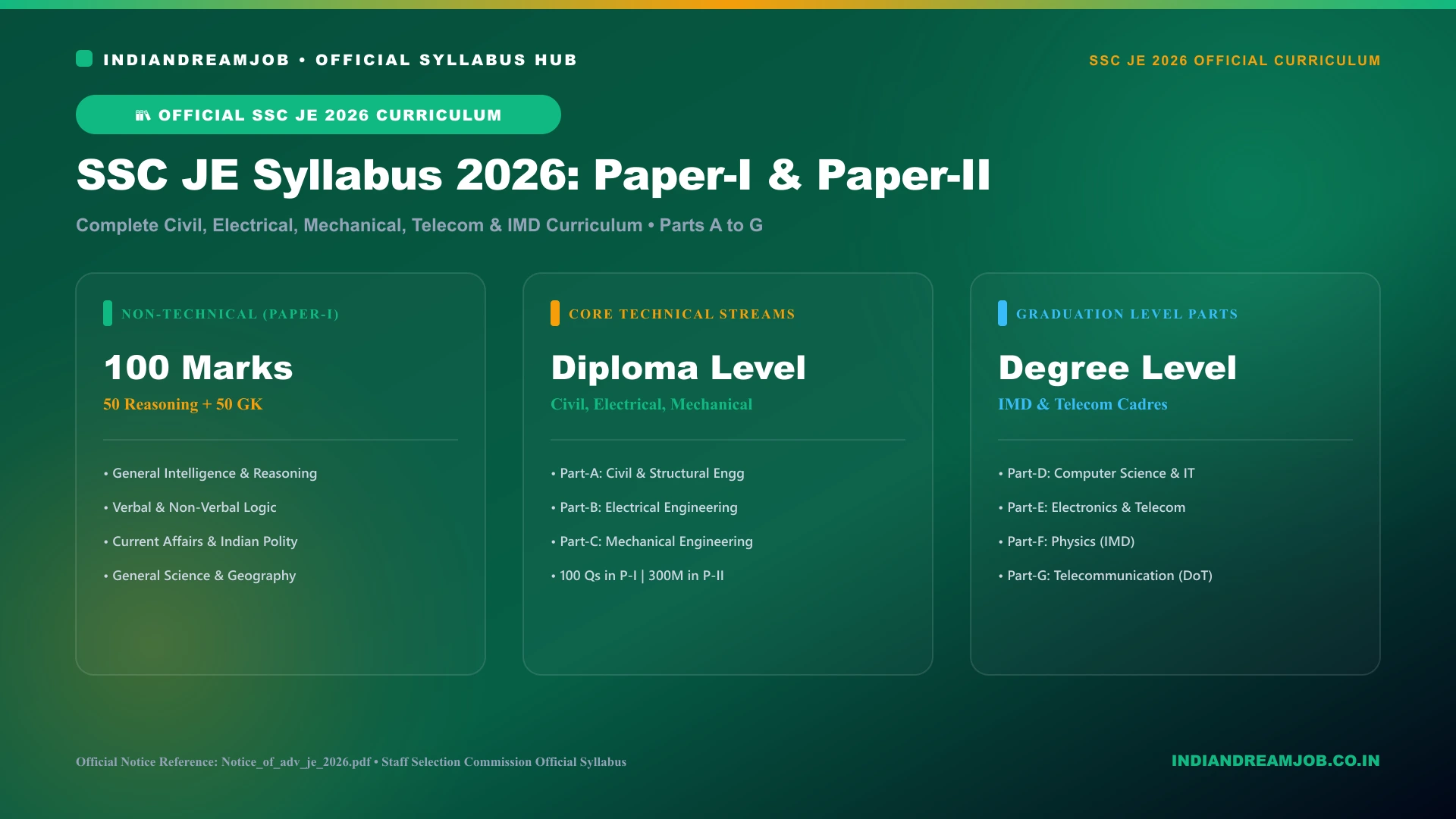
SSC JE Syllabus 2026: The Staff Selection Commission (SSC) has officially published the comprehensive curriculum and topic-wise Syllabus for the Junior Engineer Examination, 2026 under Notice Number F. No. HQ-C-3019/1/2026-C-3 dated 2 September 2026. The examination evaluates candidates across two progressive Computer-Based Examination (CBE) tiers: Paper-I (200 Marks, Qualifying & Shortlisting) and Paper-II (300 Marks, 100% Final Merit Determining).
The SSC JE 2026 technical curriculum is categorized into seven distinct functional parts: Part-A (Civil & Structural), Part-B (Electrical), Part-C (Mechanical), Part-D (Computer Science & IT), Part-E (Electronics & Telecommunication), Part-F (Physics), and Part-G (Telecommunication Engineering). Candidates applying for 1,748 tentative vacancies across 13 Central Ministries and attached defense organizations must prepare the non-technical sections alongside their specific technical engineering discipline.
Read This Complete Syllabus Guide in Your Language
Select your preferred language to switch versions instantly:
📌 SSC JE Syllabus 2026 – Overview
Below is the verified structural overview of the curriculum framework announced by the Staff Selection Commission for the 2026 recruitment cycle:
| Curriculum Dimension | SSC JE Paper-I (CBE) | SSC JE Paper-II (CBE) |
|---|---|---|
| Subject Components | Reasoning (50M) + GK (50M) + Technical (100M) | Core Technical Engineering Stream (300M) |
| Total Questions | 200 Questions | 100 Questions |
| Maximum Marks | 200 Marks | 300 Marks |
| Duration | 2 Hours (2h 40m for PwBD scribes) | 2 Hours (2h 40m for PwBD scribes) |
| Negative Marking | 0.25 Mark deducted per wrong answer | 1.00 Mark deducted per wrong answer |
| Syllabus Difficulty Standard | Diploma Level (Civil/Elect/Mech); Degree Level (IMD/Telecom) | Comprehensive Specialized Engineering Level |
| Functional Importance | Qualifying & Shortlisting Stage | Determines 100% Final Merit |
| Language Medium | Bilingual (English & Hindi) | Bilingual (English & Hindi) |
📝 SSC JE Paper-I Syllabus (Non-Technical & Technical)
Paper-I contains three compulsory sections designed to test non-technical analytical competencies alongside fundamental engineering knowledge:
🧠 1. General Intelligence & Reasoning Detailed Syllabus (50 Questions | 50 Marks)
The General Intelligence & Reasoning syllabus tests verbal and non-verbal reasoning abilities, assessing spatial visualization, pattern recognition, and logical deduction:
| Reasoning Segment | Core Topics Covered |
|---|---|
| Verbal Reasoning | Analogies, similarities and differences, problem solving, analysis, judgment, decision making, visual memory, discrimination, relationship concepts, blood relations, arithmetical reasoning, and verbal classification. |
| Non-Verbal & Spatial Reasoning | Space visualization, spatial orientation, figural classification, arithmetical number series, non-verbal series, abstract ideas and symbols and their relationships, arithmetical computations, and other analytical functions. |
| High-Yield Scoring Areas | Number & Alphabet Series, Coding-Decoding, Venn Diagrams, Syllogisms, Direction Sense, Seating Arrangement, and Statement-Conclusions. |
🌍 2. General Awareness Detailed Syllabus (50 Questions | 50 Marks)
Questions test the candidate's general awareness of the environment around them and its application to society, with particular emphasis on India and its neighbouring countries:
| Domain Subject | Notified Syllabus Topics |
|---|---|
| Current Affairs | National and international events, Government of India flagship infrastructure programs, summits, sports, and awards. |
| History & Culture | Ancient, Medieval, and Modern Indian History, Indian National Movement, heritage sites, monuments, art, and classical dance forms. |
| Geography | Physical and economic geography of India, river drainage systems, climate, natural resources, agriculture, and minerals. |
| Indian Polity & Governance | Constitution of India, Fundamental Rights, Directive Principles, Parliamentary structure, Panchayati Raj, Judiciary, and statutory bodies. |
| Economic Scene | Basic economic principles, national income, monetary policy, Union Budget, fiscal deficit, inflation, and infrastructure funding. |
| General Science & Research | Everyday scientific observations, physics, chemistry, biology in daily life, ISRO space missions, DRDO developments, and scientific inventions. |

🏗️ 3. Part-A: Civil & Structural Engineering Detailed Syllabus
The Civil Engineering syllabus applies to candidates appearing for Junior Engineer (Civil) across CPWD, BRO, MES, CWC, CWPRS, Farakka, and NTRO:
| Civil Engineering Module | Detailed Topics Prescribed by SSC |
|---|---|
| Engineering Mechanics | System of forces, free-body diagrams, equilibrium equations, internal forces in structures, friction and its applications, centre of mass, and moment of inertia. |
| Solid Mechanics (SOM) | Bending moment and shear force in statically determinate beams, simple stress and strain, simple bending theory, flexural and shear stresses, uniform torsion, buckling of columns, and combined/direct bending stresses. |
| Structural Analysis | Statically determinate and indeterminate structures, method of superposition, analysis of trusses, arches, beams, cables, and frames; slope deflection method, moment distribution method, and influence line diagrams (ILD). |
| Construction Materials & Management | Materials: Bricks, stones, timber, steel, cement, aggregates, plastics, polymers, glass, concrete, concrete mix design, and testing of concrete. Management: Types of construction projects, project planning, network analysis, PERT, and CPM. |
| Estimating, Costing & Valuation | Fundamentals of estimating, cost estimates, rate analysis, valuation, and preparation of detailed estimates. |
| Concrete Structures (RCC) | Working stress design, Limit State design, design of beams, slabs, columns, foundations, retaining walls, bond strength, and development length. |
| Steel Structures | Working stress and Limit State design, bolted connections, welded connections, tension members, compression members, beams, and plastic analysis of beams and frames. |
| Surveying | Principles of surveying, errors and adjustments, maps, scale, coordinate systems, distance and angle measurements, chain surveying, compass surveying, plane table surveying, levelling, trigonometric levelling, traversing, triangulation, total station, tacheometric surveying, and theodolite surveying. |
| Soil Mechanics / Geotechnical | Three-phase soil system, phase relationships, index properties, Unified and IS soil classifications, permeability, one-dimensional flow, seepage, flow nets, uplift pressure, piping, capillarity, effective stress, quicksand condition, compaction, consolidation, shear strength, Mohr's circle, and stress-strain behaviour of clays and sands. |
| Fluid Mechanics & Hydraulics | Properties of fluids, fluid statics, continuity, momentum, and energy equations; laminar and turbulent flow, flow through pipes, pipe networks, lift and drag, forces on immersed bodies, flow measurement, open channel flow, specific energy, critical flow, and hydraulic jumps. |
| Hydrology & Irrigation | Hydrologic cycle, precipitation, evaporation, evapotranspiration, watershed, infiltration, unit hydrographs, reservoir capacity, flood estimation, groundwater well hydraulics, Darcy's Law, irrigation systems, duty, delta, gravity dams, spillways, lined/unlined canals, and cross-drainage structures. |
| Environmental Engineering | Water quality standards, physical/chemical/biological parameters, Water Quality Index, water distribution, drinking water treatment, sewerage systems, domestic wastewater quantity, primary and secondary treatment, sludge disposal, air pollution types/control, Air Quality Index (AQI), and municipal solid waste management. |
| Transportation Engineering | Highway geometric design, sight distance, horizontal/vertical alignment; railway track geometry, speed, and cant; highway materials, properties and tests, flexible/rigid pavement design (IRC-based); traffic flow, speed studies, traffic signals (Webster's method), and intersections. |
⚡ 4. Part-B: Electrical Engineering Detailed Syllabus
The Electrical Engineering curriculum applies to Junior Engineer (Electrical) posts across CPWD, MES, CWPRS, Farakka Barrage, and DGQA:
| Electrical Engineering Module | Detailed Topics Prescribed by SSC |
|---|---|
| Fundamentals & Network Solution | Circuit elements (resistors, capacitors, inductors, batteries), voltage, current, power, energy, flux, units and quantities; Kirchhoff's Current Law (KCL), Kirchhoff's Voltage Law (KVL), node analysis, mesh analysis; Thevenin's, Norton's, Superposition, and Maximum Power Transfer theorems. |
| Magnetic Circuits & AC Fundamentals | Magnetic flux, reluctance, self and mutual inductance, magnetomotive force (MMF); RMS values, average values, AC waveforms, series/parallel AC circuits, resonance, balanced 3-phase circuits, star-delta transformation, complex power, and power factor. |
| Measurement & Measuring Instruments | Voltage, current, power, and power factor measurement; instrument errors, ammeter, voltmeter, wattmeter, Wheatstone bridge, Kelvin's double bridge, energy meters, Megger, Current Transformers (CT), and Potential Transformers (PT). |
| Electrical Machines | Single-phase and three-phase transformers, DC machines (types, characteristics, losses, efficiency, applications), 1-phase and 3-phase induction motors, motor starting, speed control, electrical braking, torque-speed curves, fractional horsepower motors, and servomotors. |
| Synchronous Generators & Power Systems | Armature reaction, parallel operation, synchronization; power station types, load factor, demand factor, diversity factor, transmission lines, distribution lines, Ferranti effect, corona effect, circuit breakers, and protection of generators/transformers. |
| Estimation, Costing & Utilization | Lighting scheme estimation, electrical machine installations, earthing practices, Indian Electricity (IE) Rules; illumination, electric heating, electric welding, electroplating, electric traction, and electric drives. |
| Basic & Power Electronics | P-N junction diodes, rectifiers, wave-shapers, clippers, clampers, BJT, FET, transistor amplifiers, oscillators; Thyristor V-I characteristics, firing/gating circuits, Buck, Boost, and Buck-Boost converters, single-phase half/full-controlled rectifiers. |
⚙️ 5. Part-C: Mechanical Engineering Detailed Syllabus
The Mechanical Engineering curriculum applies to Junior Engineer (Mechanical) posts across CWC, DGQA-NAVAL, and MES:
| Mechanical Engineering Module | Detailed Topics Prescribed by SSC |
|---|---|
| Engineering Mechanics & SOM | Free body diagrams, equilibrium, resultant forces, Lami's theorem, laws of friction, centroid, centre of gravity; simple stress and strain, shear force and bending moment in beams, beam deflections, torsion of shafts, and thin cylindrical shells. |
| Theory of Machines & Machine Design | Cams, belt/chain/rope drives, gear trains, flywheels, governors, balancing, vibrations, brakes, dynamometers, clutches, bearings; theories of failure, design of cotter/knuckle joints, levers, cranks, shafts, couplings, spur gears, springs, and power screws. |
| Materials Science & Metallurgy | Crystal structures, bonds, iron-carbon phase diagram, heat treatment of steels, cast iron, plain carbon steels, alloy steels, non-ferrous alloys, bearing alloys, and non-destructive testing (NDT). |
| Thermal Engineering & Power Plants | Laws of thermodynamics, heat engines, refrigerators, heat pumps, steam generators, impulse and reaction steam turbines, cooling towers; Otto, Diesel, and Dual air standard cycles, IC engines, air compressors, gas turbines, jet propulsion, steam properties, and conduction/convection/radiation heat transfer. |
| Fluid Mechanics & Hydraulic Machinery | Fluid properties, continuity equation, Bernoulli's equation, pipe flow, impact of jets on vanes, hydraulic turbines (Pelton, Francis, Kaplan), centrifugal pumps, reciprocating pumps, and hydraulic power systems. |
| Manufacturing, Metrology & Advanced Processes | Pattern making, casting, metal forming, gas/arc/resistance welding; lathe operations, drilling, milling, gear shaping, grinding; limits, fits, tolerances, linear/angular metrology, surface finish measurement; CNC machining, PLC, EDM, ECM, AJM, LBM, CAD/CAM, and FMS. |
🌦️ 6. Scientific Assistant (IMD) Technical Streams (Parts D, E, F)
Candidates applying for Scientific Assistant in the India Meteorological Department (IMD) select one of the following graduation-level specialized streams according to their academic degree:
💻 7. Part-D: Computer Science & Information Technology Syllabus
- Engineering Mathematics: Discrete mathematics (propositional logic, sets, relations, lattices, groups, graph coloring), linear algebra (matrices, determinants, eigenvalues), calculus, and probability/statistics.
- Digital Logic & Architecture: Boolean algebra, logic minimization, combinational/sequential circuits, computer arithmetic, instruction pipelining, cache memory hierarchy, interrupts, and DMA.
- Programming & Data Structures: C programming, recursion, arrays, stacks, queues, linked lists, trees, binary search trees, heaps, and graphs.
- Algorithms & Theory of Computation: Sorting, searching, hashing, greedy algorithms, dynamic programming, shortest paths, regular expressions, finite automata, context-free grammars, and Turing machines.
- Compiler Design & Operating Systems: Lexical analysis, parsing, syntax-directed translation, processes, threads, CPU scheduling, synchronization, deadlocks, and virtual memory.
- Databases & Computer Networks: ER models, relational algebra, SQL, normalization, transactions, concurrency control; OSI/TCP-IP models, routing algorithms, IPv4, TCP/UDP, and application protocols.
📡 8. Part-E: Electronics & Telecommunication Engineering Syllabus
- Electronic Devices & Circuits: Semiconductors, P-N junction diodes, Zener diodes, BJT, FET, MOSFET, multistage amplifiers, feedback, oscillators, and multivibrators.
- Network Theory & Digital Electronics: Circuit theorems (Thevenin, Norton, Superposition), AC resonance, logic gates, Boolean algebra, flip-flops, counters, shift registers, ADC, and DAC.
- Telecommunications & Antennas: Antenna radiation patterns, directivity, arrays, ground-wave/ionospheric propagation; AM, FM, pulse modulation, sampling theorem, PCM, digital modulations (ASK, PSK, FSK), optical fibers, and satellite communications.
🔬 9. Part-F: Physics Detailed Syllabus
- Mechanics & Properties of Matter: Kinematics, Newton's laws, Coriolis force, central-force motion, moment of inertia, elasticity, surface tension, viscosity, and Bernoulli's theorem.
- Oscillations, Waves & Optics: Simple harmonic motion, resonance, wave equation, sound waves, Doppler effect; Fermat's principle, interference, diffraction, diffraction gratings, and polarization.
- Electricity, Magnetism & EM Theory: Coulomb's law, Gauss's law, capacitors, Biot-Savart law, Ampere's law, Faraday's law, Maxwell's equations, and electromagnetic wave propagation.
- Thermodynamics & Modern Physics: Kinetic theory, laws of thermodynamics, Carnot cycle, entropy, Maxwell relations; special relativity, photoelectric effect, Compton effect, de Broglie hypothesis, Schrödinger equation, Bohr atom, and solid-state crystal lattices.
📞 10. Part-G: Telecommunication Engineering Detailed Syllabus
Prescribed for Junior Engineer (Telecom) under the Department of Telecommunications (DoT):
- Engineering Mathematics & Vector Calculus: Linear algebra, eigenvalues, multiple integrals, differential equations, Laplace transforms, complex analysis, and probability distributions.
- Networks, Signals & Systems: Two-port networks (Z, Y, h, ABCD), continuous/discrete-time Fourier transforms, Z-transforms, and LTI systems.
- Electronic Devices & Analog Circuits: Carrier transport, MOS capacitors, operational amplifiers, active filters, Schmitt triggers, and phase-locked loops (PLL).
- Digital Circuits & Control Systems: Combinational/sequential logic, finite-state machines, transfer functions, block diagram algebra, Bode plots, Nyquist criterion, and state-space equations.
- Communications & Electromagnetics: Information theory, channel capacity, pulse code modulation (PCM), QAM, error-correcting codes; Maxwell's equations, transmission lines, Smith charts, waveguides, and dipole antenna arrays.
⚖️ Paper-I vs Paper-II Syllabus Scope & Weightage
| Syllabus Dimension | Paper-I Scope | Paper-II Scope |
|---|---|---|
| General Intelligence & Reasoning | 50 Questions (50 Marks) | Not Tested |
| General Awareness & Current Affairs | 50 Questions (50 Marks) | Not Tested |
| Core Technical Engineering Subject | 100 Questions (100 Marks) | 100 Questions (300 Marks) |
| Question Difficulty Depth | Formula & Definition Based MCQs | In-depth Analytical & Numerical Problem Solving |
| Selection Role | Qualifying for Paper-II Shortlisting | Determines 100% Final Merit & Rank |
🔒 SSC JE Technical Subject Selection Rules
Immutable Subject Selection Policy:
Candidates must select their technical subject stream strictly matching their eligible engineering qualification during online registration at ssc.gov.in. The Commission explicitly mandates that the subject opted for during application submission cannot be modified at any subsequent stage. Attempting an unnotified or mismatched paper leads to summary disqualification.
💡 Strategic Preparation Plan for SSC JE Syllabus 2026
| Preparation Phase | Timeline & Strategic Focus | Target Deliverables |
|---|---|---|
| Phase 1: Syllabus Mapping | Weeks 1–4: Deep concept coverage of high-weightage engineering modules | Complete core textbooks and handwritten summary sheets |
| Phase 2: Reasoning Drills | Daily 1 hour: 50 reasoning MCQs with speed timing | Target 45+ marks in under 35 minutes |
| Phase 3: Current Affairs & GK | Daily 45 minutes: National infrastructure news, polity, and general science | Revise past 6 months' current events digest |
| Phase 4: Numerical Problem Solving | Weeks 5–8: Practice numerical problems with on-screen calculator simulator | Achieve high accuracy under 1-mark negative penalty |
| Phase 5: Full Mock Simulations | Final 4 weeks: Timed Paper-I (200Q/2h) and Paper-II (100Q/2h) tests | Analyze error logs and eliminate negative marks |
🎯 Subject-Wise Mock Test Practice Recommendations
- Civil Engineering: Focus topic tests on Building Materials, RCC Limit State Design, Soil Mechanics index properties, and Fluid Mechanics pipe flow.
- Electrical Engineering: Focus tests on AC circuit theorems, DC and Induction Machines, Power System protection, and Basic Electronics rectifiers.
- Mechanical Engineering: Practice numerical sets in Thermodynamics Otto/Diesel cycles, SOM deflection formulas, and Fluid Machinery turbines.
- Telecom & IMD: Solve degree-level questions on Maxwell's equations, digital communication line codes, and circuit logic.
📅 Important Examination Dates & Schedule
| Recruitment Milestone | Official Date / Schedule |
|---|---|
| Notification Published | 2 September 2026 |
| Online Application Window | 2 September to 22 September 2026 |
| Fee Payment Deadline | 23 September 2026 |
| Application Correction Window | 28 to 30 September 2026 |
| Paper-I Computer Based Exam | October / November 2026 (Tentative) |
| Paper-II Computer Based Exam | December 2026 (Tentative) |
🔗 SSC JE Syllabus 2026 – Important Links Table
| Resource / Official Document | Direct Link & Status |
|---|---|
| Official Notification PDF Download | Notice_of_adv_je_2026.pdf |
| SSC Official Application Portal (Apply Online) | Apply Online at ssc.gov.in |
| SSC JE Notification 2026 (Post 1 Pillar) | Complete Notification, Dates & Vacancies → |
| SSC JE Vacancy 2026 (Post 2 Pillar) | 1,748 Posts & 13 Participating Departments → |
| SSC JE Eligibility Criteria 2026 (Post 3 Pillar) | Age Limit, Qualifications & Experience Matrix → |
| SSC JE Apply Online Guide 2026 (Post 4) | OTR, Fees & Step-by-Step Application Guide → |
| SSC JE Exam Pattern 2026 (Post 5) | Paper-I & Paper-II Marking Scheme → |
| Official SSC Website | Visit ssc.gov.in |
❓ Frequently Asked Questions – SSC JE Syllabus 2026
1. What subjects are included in the SSC JE 2026 syllabus?
Paper-I covers General Intelligence & Reasoning (50M), General Awareness (50M), and General Engineering (100M). Paper-II consists exclusively of the candidate's chosen technical engineering subject (300M).
2. How many technical parts are available in the SSC JE syllabus?
There are seven parts: Part-A (Civil), Part-B (Electrical), Part-C (Mechanical), Part-D (CS/IT), Part-E (Electronics & Telecom), Part-F (Physics), and Part-G (Telecommunication).
3. What is the standard/level of questions in SSC JE?
Civil, Electrical, and Mechanical engineering questions are approximately at the Diploma in Engineering level. Computer Science, Electronics, Physics, and Telecom questions are approximately at the Graduation level.
4. Which subjects can IMD Scientific Assistant candidates choose?
Scientific Assistant aspirants can select one of three subjects: Part-D (Computer Science & IT), Part-E (Electronics & Telecommunication), or Part-F (Physics), matching their educational qualification.
5. Can I change my technical subject after submitting the application form?
No. The Commission states that the technical subject stream chosen in the online form cannot be modified subsequently under any circumstances.
6. Is the syllabus same for Paper-I and Paper-II?
The core technical syllabus topics are identical, but Paper-I tests broad conceptual fundamentals (100 questions, 100 marks), while Paper-II tests advanced numerical problem-solving depth (100 questions, 300 marks).
7. What is the negative marking for SSC JE 2026?
Paper-I deducts 0.25 mark per incorrect answer, while Paper-II deducts 1.00 mark per incorrect answer.
8. Is a scientific calculator provided during the examination?
Yes. An interactive virtual scientific calculator is accessible on the candidate's computer console throughout the CBT exam.