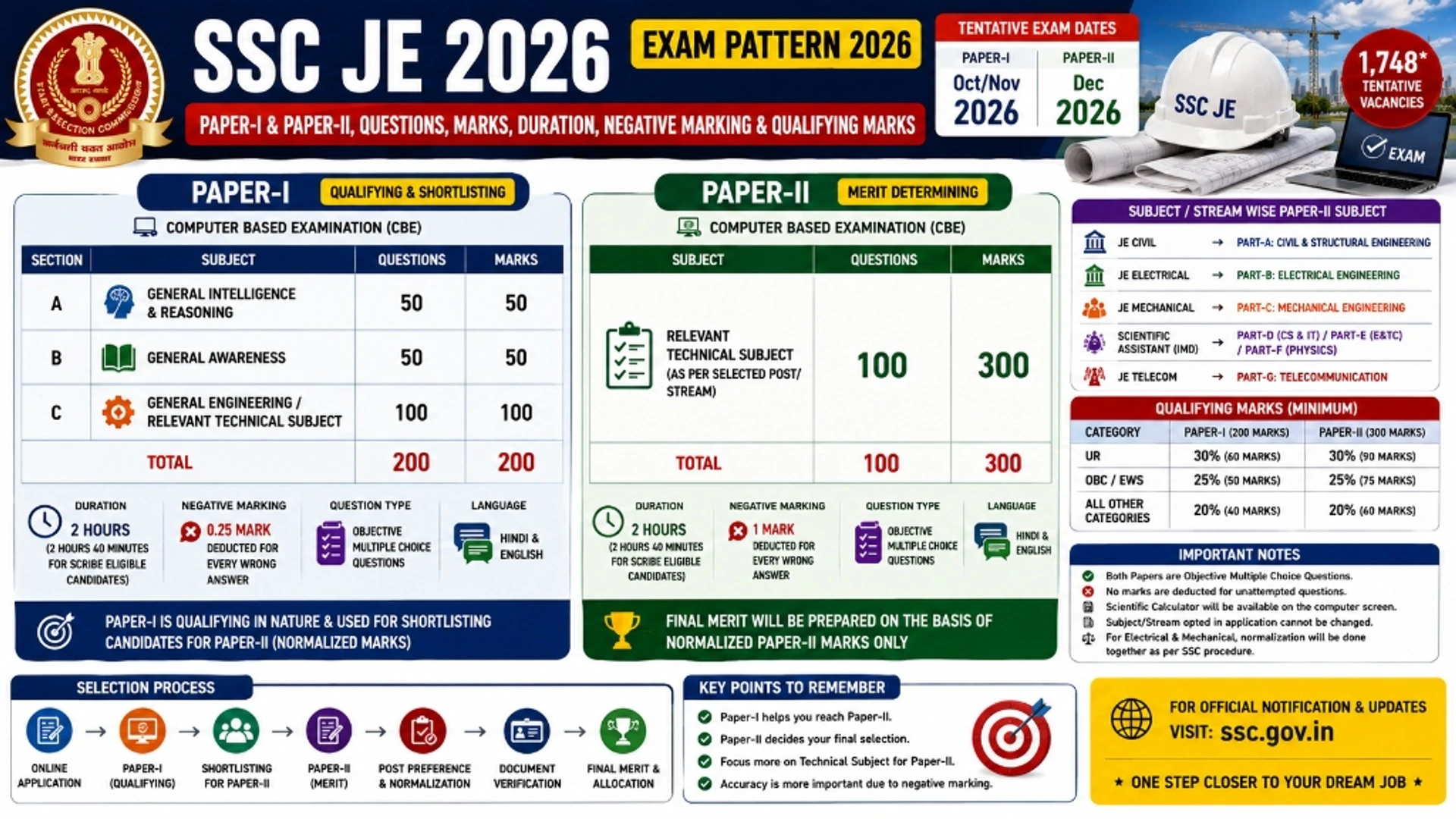
SSC JE Exam Pattern 2026: The Staff Selection Commission (SSC) has officially announced the structural scheme and marking blueprint for the Junior Engineer Examination, 2026 under Notice Number F. No. HQ-C-3019/1/2026-C-3 released on 2 September 2026. The entire recruitment assessment is conducted through two separate Computer-Based Examination (CBE) stages: Paper-I and Paper-II.
The decisive paradigm shift for SSC JE 2026 is the functional role of the two papers: Paper-I is qualifying and shortlisting in nature, while only the normalized marks of Paper-II determine the final All India Merit List and departmental cadre allocations. Candidates must secure the prescribed minimum qualifying cut-offs in Paper-I to advance, but their Paper-I marks are not added to their final merit ranking.
The examination covers technical posts across Civil, Electrical, Mechanical, Electrical & Mechanical, and Telecom disciplines, along with Scientific Assistant in the India Meteorological Department (IMD), competing for 1,748 tentative vacancies. The tentative schedule places Paper-I in October/November 2026 and Paper-II in December 2026.
Read This Exam Pattern Guide in Your Language
Select your preferred language to switch versions instantly:
📌 SSC JE Exam Pattern 2026 – Overview
Below is the verified comparative framework of Paper-I and Paper-II as prescribed in the official 2026 notification:
| Exam Parameter | SSC JE Paper-I (CBT) | SSC JE Paper-II (CBT) |
|---|---|---|
| Examination Mode | Computer-Based Examination (Online) | Computer-Based Examination (Online) |
| Question Format | Objective Multiple Choice Questions (MCQs) | Objective Multiple Choice Questions (MCQs) |
| Total Questions | 200 Questions | 100 Questions |
| Maximum Total Marks | 200 Marks | 300 Marks |
| Marks per Correct Question | +1 Mark | +3 Marks |
| Negative Marking | 0.25 Mark deducted per wrong answer | 1.00 Mark deducted per wrong answer |
| Exam Duration | 2 Hours (120 Minutes) | 2 Hours (120 Minutes) |
| Compensatory Time (Scribe Candidates) | 2 Hours 40 Minutes (160 Minutes) | 2 Hours 40 Minutes (160 Minutes) |
| Functional Role | Qualifying + Shortlisting Stage | Final Merit Determining Stage |
| Languages Available | Bilingual (English & Hindi) | Bilingual (English & Hindi) |
| Virtual Calculator | Available on screen (Calculator icon) | Available on screen (Calculator icon) |
📝 SSC JE Paper-I Exam Pattern & Marking Scheme
Paper-I evaluates candidate abilities across reasoning, general awareness, and foundation engineering disciplines through three structured components:
| Section / Test Subject | Number of Questions | Maximum Marks | Allotted Duration |
|---|---|---|---|
| (i) General Intelligence & Reasoning | 50 Questions | 50 Marks | 2 Hours (2h 40m for PwBD scribes) |
| (ii) General Awareness | 50 Questions | 50 Marks | |
| (iii) General Engineering (Part-A / B / C / D / E / F / G) | 100 Questions | 100 Marks | |
| Total Comprehensive Paper-I | 200 Questions | 200 Marks |
🎯 Is Paper-I Qualifying in SSC JE 2026?
Yes. Paper-I is strictly qualifying and shortlisting in nature.
However, calling it "qualifying" does not mean you only need the baseline pass percentage. Candidates must clear two levels of screening:
- Statutory Minimum Qualifying Marks: 30% for UR (60 marks), 25% for OBC/EWS (50 marks), and 20% for SC/ST/PwBD (40 marks).
- Competitive Shortlisting Cut-Off: The Commission normalizes Paper-I marks across shifts and shortlists candidates in a fixed ratio relative to available vacancies (typically 1:8 to 1:10) for appearance in Paper-II.
📚 SSC JE Paper-I Subjects Breakdown (Reasoning, GK & Tech)
The Syllabus for Paper-I encompasses both non-technical and technical domain competencies:
1. General Intelligence & Reasoning (50 Questions | 50 Marks)
Covers verbal and non-verbal reasoning methods to assess mental agility and spatial reasoning:
- Analogies, similarities and differences, spatial visualization, and spatial orientation.
- Problem solving, situational analysis, judgment, decision making, visual memory, and discrimination.
- Relationship concepts, blood relations, arithmetical reasoning, and figural classification.
- Arithmetic number series, non-verbal series, coding and decoding, statement-conclusion, and syllogistic reasoning.
2. General Awareness (50 Questions | 50 Marks)
Assesses awareness of contemporary national and international developments, testing everyday observation:
- Current Affairs: National events, central government infrastructure schemes, science and tech summits.
- India and Neighbouring Countries: History, culture, geography, international relations.
- Economic Scene: Indian economy, banking, budget, central fiscal policies.
- General Polity & Constitution: Fundamental rights, directive principles, governance structures, judiciary.
- Scientific Research: Discoveries, space missions (ISRO), physics, chemistry, biology in daily life.
3. General Engineering / Technical Subject (100 Questions | 100 Marks)
Contains 100 domain-specific questions matching the technical stream opted for in the candidate's online application.
⚙️ SSC JE 2026 Technical Parts (Part-A to Part-G)
Candidates must attempt only the specific technical part corresponding to their educational qualification:
| Part Designation | Technical Subject Stream | Applicable Junior Engineer Cadres |
|---|---|---|
| Part-A | Civil & Structural Engineering | Junior Engineer (Civil) across CPWD, BRO, MES, CWC, CWPRS, Farakka, NTRO |
| Part-B | Electrical Engineering | Junior Engineer (Electrical) across CPWD, MES, CWPRS, Farakka, DGQA |
| Part-C | Mechanical Engineering | Junior Engineer (Mechanical) across CWC, DGQA-NAVAL, MES |
| Part-D | Computer Science & Information Technology | Scientific Assistant (IMD) |
| Part-E | Electronics & Telecommunication Engineering | Scientific Assistant (IMD) |
| Part-F | Physics | Scientific Assistant (IMD) |
| Part-G | Telecommunication | Junior Engineer (Telecom) under Department of Telecommunications (DoT) |

🏆 SSC JE Paper-II Exam Pattern 2026 (Merit Determining)
Paper-II is the single most crucial milestone in the entire selection cycle. 100% of the final merit is determined solely by Paper-II normalized scores:
| Paper-II Parameter | Prescribed Examination Structure |
|---|---|
| Subject Content | Specialized Core Technical Engineering Stream (Part-A / B / C / D / E / F / G) |
| Mode of Examination | Computer-Based Examination (Online CBT) |
| Type of Questions | Objective Multiple Choice Questions (MCQs) |
| Total Questions | 100 Questions |
| Maximum Marks | 300 Marks |
| Weightage per Question | +3 Marks per correct answer |
| Negative Marking Penalty | −1.00 Mark deducted per incorrect response |
| Total Time Duration | 2 Hours (120 Minutes) |
| Scribe Candidate Duration | 2 Hours 40 Minutes (160 Minutes) |
| Electronic Aids Permitted | Virtual On-Screen Scientific Calculator & Reference Tables (IS 456 / Steam Table) |
🏗️ Paper-II Subject-Wise Cadre Breakdown
| Recruiting Stream | Mandatory Paper-II Subject | Technical Scope |
|---|---|---|
| JE Civil | Part-A: General Engineering (Civil & Structural) | Building Materials, Surveying, Estimating & Costing, Soil Mechanics, Hydraulics, Irrigation, Transportation, Environmental, Structural Theory, RCC Design, Steel Design. |
| JE Electrical | Part-B: General Engineering (Electrical) | Basic Circuit Law, Magnetic Circuits, AC Fundamentals, Measurement & Instruments, Electrical Machines, Generation, Transmission & Distribution, Utilization, Basic & Power Electronics. |
| JE Mechanical | Part-C: General Engineering (Mechanical) | Engineering Mechanics, Strength of Materials, Theory of Machines, Machine Design, Thermal Engineering (IC Engines, Steam Turbines), Fluid Mechanics & Machinery, Manufacturing & Metrology. |
| Scientific Assistant (IMD) | Part-D (CS/IT) / Part-E (Electronics) / Part-F (Physics) | Advanced degree-level curriculum according to the candidate's eligible stream. |
| JE Telecom | Part-G: Telecommunication | Network Theory, Signals & Systems, Electronic Devices, Digital/Analog Communications, Control Systems, Electromagnetics. |
⚠️ SSC JE Negative Marking 2026 (-0.25 vs -1 Mark)
Negative marking applies in both papers, but the severity of the penalty differs significantly:
| Exam Stage | Marks for Correct Answer | Penalty for Wrong Answer | Penalty Ratio |
|---|---|---|---|
| Paper-I (CBT) | +1.00 Mark | −0.25 Mark | 1/4th (25% penalty) |
| Paper-II (CBT) | +3.00 Marks | −1.00 Mark | 1/3rd (33.33% penalty) |
📊 Negative Marking Calculation Example (Paper-II):
Assume an aspirant attempts 90 out of 100 questions in Paper-II:
- 70 Correct Answers: 70 × 3 = +210 Marks
- 20 Incorrect Answers: 20 × (−1) = −20 Marks
- 10 Unattempted Questions: 0 Marks
- Net Score: 210 − 20 = 190 Marks out of 300
Strategy Takeaway: Because each wrong answer in Paper-II deducts a full 1 mark, wild guessing is dangerous and can quickly destroy your merit standing.
🎯 SSC JE Minimum Qualifying Marks 2026
SSC mandates minimum qualifying benchmark scores for both examination tiers:
| Candidate Category | Minimum Qualifying Percentage | Paper-I Cut-off (Out of 200) | Paper-II Cut-off (Out of 300) |
|---|---|---|---|
| Unreserved (UR) | 30% | 60 Marks | 90 Marks |
| OBC / EWS | 25% | 50 Marks | 75 Marks |
| SC / ST / PwBD / ESM | 20% | 40 Marks | 60 Marks |
⚖️ Is Paper-I Counted in Final SSC JE Merit?
No. Paper-I marks are not included in the final merit calculation.
The selection architecture operates sequentially:
SSC JE 2026 Selection Hierarchy:
Paper-I Score (Normalized) → Shortlists candidates for Paper-II
↓
Paper-II Score (Normalized) → Determines 100% of Final Merit Ranking
↓
Department Preferences & Document Verification → Final Ministry Allocation
📈 SSC JE Normalization Formula & Multi-Shift Rules
Because the Computer-Based Examination is administered across multiple dates and shifts with varying difficulty coefficients, the Commission applies its standard mathematical normalization formula:
- Normalized marks are computed based on the distribution of marks across all exam shifts to ensure fairness.
- Inter-Branch Normalization for E&M: Because Electrical and Mechanical candidates take distinct question papers but compete for common vacancies in BRO and MES, their marks are normalized against each other.
- IMD Normalization: Different optional subject papers for Scientific Assistant (CS/IT, Electronics, Physics) are normalized treating the subjects as different shifts.
🌐 Exam Language & Medium (English / Hindi)
Both Paper-I and Paper-II question sets are presented bilingually in English and Hindi. Candidates can toggle between languages during the live computer-based test, except for language-specific evaluation. In the event of any linguistic discrepancy in a technical question, the English version prevails as per standard SSC rules.
💻 Scientific Calculator & Screen Reference Tables
Candidates are provided digital calculation tools directly within the testing software console:
| Tool / Resource | Availability Status | Operational Guidelines |
|---|---|---|
| Virtual Scientific Calculator | Available on screen throughout the exam | Accessed via the calculator icon on the computer console. Physical handheld calculators are strictly prohibited inside the lab. |
| IS 456:2000 Design Tables | Accessible digitally for Civil Engineering | Provided on console for reference during structural concrete questions. |
| Steam Tables | Accessible digitally for Mechanical Engineering | Provided on console for thermodynamic and power plant calculations. |
📐 Branch-Specific Exam Pattern (Civil, Electrical, Mech, Telecom, IMD)
| Engineering Branch | Paper-I Structure | Paper-II Structure | Core Focus Areas |
|---|---|---|---|
| Civil Engineering | 50 Reasoning + 50 GK + 100 Civil (200M) | 100 Civil & Structural (300M) | Building materials, surveying, soil mechanics, fluid mechanics, RCC, steel design, estimation. |
| Electrical Engineering | 50 Reasoning + 50 GK + 100 Electrical (200M) | 100 Electrical Engg (300M) | Network laws, AC circuits, electrical machines, power systems, measurements, power electronics. |
| Mechanical Engineering | 50 Reasoning + 50 GK + 100 Mechanical (200M) | 100 Mechanical Engg (300M) | Thermodynamics, IC engines, fluid mechanics, strength of materials, theory of machines, production. |
| Telecom Engineering | 50 Reasoning + 50 GK + 100 Telecom (200M) | 100 Telecom Engg (300M) | Signals & systems, analog/digital communications, antenna propagation, control systems. |
| Scientific Assistant (IMD) | 50 Reasoning + 50 GK + 100 Optional (200M) | 100 Optional Domain (300M) | CS/IT or Electronics & Telecom or Physics (degree level). |
⚖️ Comprehensive Paper-I vs Paper-II Comparison
| Dimension | Paper-I (CBE) | Paper-II (CBE) |
|---|---|---|
| Total Questions | 200 Questions | 100 Questions |
| Maximum Marks | 200 Marks | 300 Marks |
| Marks Per Question | +1.00 Mark | +3.00 Marks |
| Negative Marking | −0.25 Mark (1/4th) | −1.00 Mark (1/3rd) |
| Testing Duration | 2 Hours | 2 Hours |
| Reasoning Section | Yes (50 Questions) | No (Technical Only) |
| General Awareness | Yes (50 Questions) | No (Technical Only) |
| Technical Subject | Yes (100 Questions) | Yes (100 Questions) |
| Exam Significance | Qualifying for Paper-II | Determines 100% Final Merit |
🔄 What Has Changed in SSC JE Exam Pattern 2026?
- Decisive Merit Weight on Paper-II: Unlike earlier conventions where Paper-I and Paper-II scores were aggregated, 2026 confirms Paper-I as purely shortlisting and Paper-II as 100% merit-determining.
- Heavy Negative Marking in Paper-II: Each incorrect answer in Paper-II carries a stiff penalty of −1 mark (out of 3 marks), punishing reckless guesswork.
- On-Screen Calculator Standardized: The interactive console virtual calculator is fully integrated, eliminating reliance on manual approximations.
- Multi-Discipline IMD Integration: Scientific Assistant recruitment seamlessly merged into the JE testing framework with Parts D, E, and F.
💡 Strategic Exam Preparation Strategy Based on Pattern
| Preparation Phase | Key Objectives | Daily Time Allocation |
|---|---|---|
| Core Technical Mastery | Master high-yield engineering topics, structural mechanics, circuit laws, thermodynamics. | 60% of daily study hours |
| Reasoning Accuracy | Solve 50 reasoning MCQs daily to achieve a 45+ score target in under 35 minutes. | 20% of daily study hours |
| General Awareness Drills | Revise past 6 months' current affairs, constitutional articles, and general science. | 10% of daily study hours |
| Full Mock Test Simulations | Take timed 2-hour CBE Mock Test to calibrate speed and practice negative marking restraint. | 10% of daily study hours |
📅 Important Examination Dates & Schedule
| Recruitment Phase | Notified Date / Schedule |
|---|---|
| Notification Published | 2 September 2026 |
| Online Application Window | 2 September to 22 September 2026 |
| Online Fee Payment Deadline | 23 September 2026 |
| Application Correction Window | 28 to 30 September 2026 |
| Paper-I Exam Date (CBE) | October / November 2026 (Tentative) |
| Paper-II Exam Date (CBE) | December 2026 (Tentative) |
🔄 Complete 7-Stage Selection Architecture
- Stage 1: Online Application Submission on ssc.gov.in (02–22 Sept 2026).
- Stage 2: Paper-I Computer-Based Examination (200 Questions, 200 Marks).
- Stage 3: Paper-I Normalized Evaluation & Category-Wise Shortlisting.
- Stage 4: Paper-II Computer-Based Examination for Shortlisted Candidates (100 Questions, 300 Marks).
- Stage 5: Normalization of Paper-II Marks and All-India Rank Generation.
- Stage 6: Online Post and Department Option Preference Collection.
- Stage 7: Physical Document Verification & Final Departmental Appointment.
🛑 Essential Exam-Day Guidelines
- Both Paper-I and Paper-II are strictly objective multiple-choice computer tests.
- Carry your printed Admit Card along with 2 recent passport-size photographs and an original valid photo ID proof (Aadhaar, Voter ID, PAN).
- Physical calculators, mobile phones, Bluetooth devices, smart watches, and books are strictly prohibited.
- Use the on-screen virtual scientific calculator provided on your testing console for numerical calculations.
- Maintain strict discipline regarding negative marking (−0.25 in Paper-I, −1.00 in Paper-II).
🔗 SSC JE Exam Pattern 2026 – Important Links Table
| Resource / Official Document | Direct Link & Status |
|---|---|
| Official Notification PDF Download | Notice_of_adv_je_2026.pdf |
| SSC Official Application Portal (Apply Online) | Apply Online at ssc.gov.in |
| SSC JE Notification 2026 (Post 1 Pillar) | Complete Notification, Dates & Vacancies → |
| SSC JE Vacancy 2026 (Post 2 Pillar) | 1,748 Posts & 13 Participating Departments → |
| SSC JE Eligibility Criteria 2026 (Post 3 Pillar) | Age Limit, Qualifications & Experience Matrix → |
| SSC JE Apply Online Guide 2026 (Post 4) | OTR, Fee & Step-by-Step Application Guide → |
| SSC JE Syllabus 2026 (Post 6) | Complete Subject-Wise Technical Syllabus → |
| Official SSC Website | Visit ssc.gov.in |
❓ Frequently Asked Questions – SSC JE Exam Pattern 2026
1. How many papers are conducted in SSC JE 2026?
There are two papers: Paper-I (Objective 200 Marks) and Paper-II (Objective 300 Marks). Both are Computer-Based Examinations.
2. How many questions are in SSC JE Paper-I?
Paper-I contains 200 questions: 50 General Intelligence & Reasoning, 50 General Awareness, and 100 General Engineering.
3. How many questions are in SSC JE Paper-II?
Paper-II contains 100 core technical questions carrying 300 marks (each question carries 3 marks).
4. What is the duration of SSC JE Paper-I and Paper-II?
Both papers have an individual duration of 2 hours (120 minutes), with 2 hours 40 minutes for scribe-eligible candidates.
5. Is there negative marking in SSC JE 2026?
Yes. Paper-I deducts 0.25 mark per wrong answer, while Paper-II deducts 1.00 mark per wrong answer.
6. Are Paper-I marks added to the final merit?
No. Paper-I is qualifying and shortlisting in nature. Final merit is prepared solely on the basis of normalized Paper-II marks.
7. What are the minimum qualifying marks in SSC JE 2026?
Minimum qualifying percentages are: UR: 30% (60M in P-I / 90M in P-II), OBC/EWS: 25% (50M in P-I / 75M in P-II), and Other Categories: 20% (40M in P-I / 60M in P-II).
8. Is a scientific calculator allowed in SSC JE?
A virtual scientific calculator is provided on the computer console during the examination. Physical handheld calculators are strictly barred.
9. Can I change my chosen engineering subject after submitting the application?
No. The engineering stream opted for in the application form is final and cannot be modified later.
10. What languages are the questions set in?
Questions in both Paper-I and Paper-II are presented bilingually in English and Hindi.
11. How are marks normalized across shifts?
SSC applies its standard mathematical normalization formula to account for variation in question paper difficulty across different testing dates.
12. Which paper should I prioritize for top ranking?
While Paper-I is mandatory to clear shortlisting, Paper-II directly determines your final ranking, post allocation, and department selection.