RIMC Entrance Exam 2026 Complete Preparation Hub
NTA Class 8 AdmissionPillar Exam & Guides
Practice Papers (Mock Set 1)
Practice Papers (Mock Set 2)
RIMC General Knowledge Mock Test 2 Overview (75 Marks)
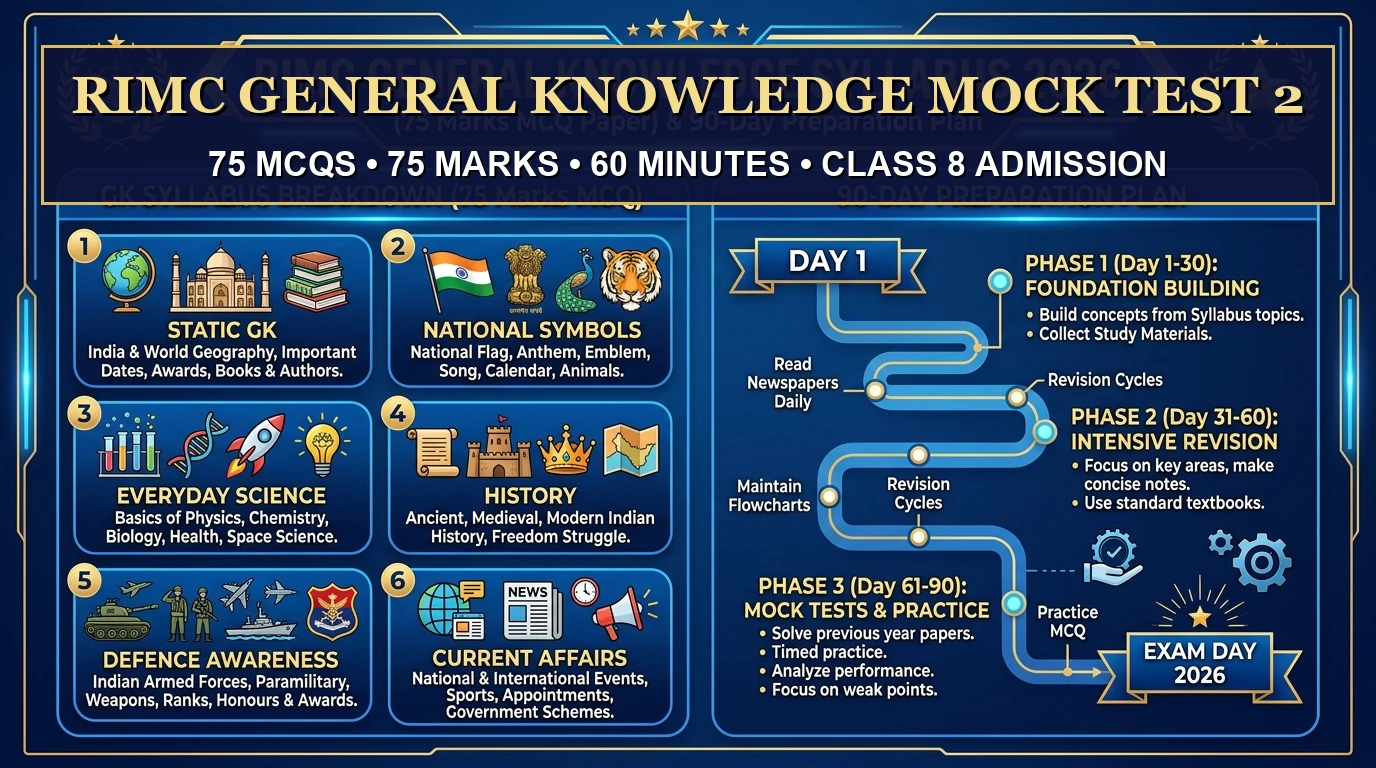
The Rashtriya Indian Military College (RIMC) Entrance Examination 2026 General Knowledge paper is a 75-mark objective MCQ test. This Mock Test 2 features fresh high-yield questions covering national symbols, Indian history, geography, basic physics/chemistry/biology, defence organizations, and sports & world GK.
SECTION A – Indian General Knowledge
Questions 1–15 | 1 Mark EachQ1. Which is the national fruit of India?
▶ View Answer & Explanation
Correct Answer: B. Mango
The Mango (Mangifera indica) is known as the 'King of Fruits' and is India's national fruit.
Q2. Which state is famous for the Gir National Park?
▶ View Answer & Explanation
Correct Answer: A. Gujarat
Gir National Park in Gujarat is the only natural habitat of Asiatic Lions in the world.
Q3. What is the capital of Maharashtra?
▶ View Answer & Explanation
Correct Answer: C. Mumbai
Mumbai is the capital city of Maharashtra and the financial capital of India.
Q4. Which Indian state is famous for Kaziranga National Park?
▶ View Answer & Explanation
Correct Answer: A. Assam
Kaziranga in Assam is a UNESCO World Heritage site famous for the Great Indian One-horned Rhinoceros.
Q5. Which is the highest civilian award of India?
▶ View Answer & Explanation
Correct Answer: C. Bharat Ratna
Bharat Ratna instituted in 1954 is India's highest civilian honor.
Q6. Which city is known as the Silicon Valley of India?
▶ View Answer & Explanation
Correct Answer: B. Bengaluru
Bengaluru (Bangalore) is known as the Silicon Valley of India due to its position as the leading IT exporter.
Q7. Which is the national reptile of India?
▶ View Answer & Explanation
Correct Answer: B. King Cobra
The King Cobra (Ophiophagus hannah) is the national reptile of India.
Q8. The Sanchi Stupa is located in:
▶ View Answer & Explanation
Correct Answer: B. Madhya Pradesh
The Buddhist monument Sanchi Stupa built under Emperor Ashoka is in Raisen district, Madhya Pradesh.
Q9. Which state is famous for the Hornbill Festival?
▶ View Answer & Explanation
Correct Answer: A. Nagaland
The annual Hornbill Festival celebrating Naga tribal culture takes place in Nagaland (1–10 December).
Q10. Which river is known as the “Sorrow of Bihar”?
▶ View Answer & Explanation
Correct Answer: B. Kosi
The Kosi River is called the 'Sorrow of Bihar' due to frequent severe flooding and course shifts.
Q11. Which Indian city is famous for the Charminar?
▶ View Answer & Explanation
Correct Answer: A. Hyderabad
The iconic Charminar mosque was built in 1591 by Muhammad Quli Qutb Shah in Hyderabad, Telangana.
Q12. Which is India's national heritage animal?
▶ View Answer & Explanation
Correct Answer: A. Asian Elephant
The Asian Elephant was officially declared India's National Heritage Animal in October 2010.
Q13. Which state is known as the “Spice Garden of India”?
▶ View Answer & Explanation
Correct Answer: A. Kerala
Kerala is famous worldwide for cultivating spices like cardamom, black pepper, and cinnamon.
Q14. The Konark Sun Temple is located in:
▶ View Answer & Explanation
Correct Answer: A. Odisha
The 13th-century Konark Sun Temple (Black Pagoda) built by King Narasimhadeva I is in Puri district, Odisha.
Q15. Which is the southernmost point of mainland India?
▶ View Answer & Explanation
Correct Answer: B. Kanyakumari
Kanyakumari (Cape Comorin) in Tamil Nadu is the southernmost tip of mainland India. (Indira Point is the southernmost point of Indian territory overall in Nicobar Islands).
SECTION B – Indian History & Culture
Questions 16–30 | 1 Mark EachQ16. Who founded the Mughal Empire in India?
▶ View Answer & Explanation
Correct Answer: B. Babur
Zahir-ud-din Muhammad Babur founded the Mughal dynasty after defeating Ibrahim Lodi at the First Battle of Panipat in 1526.
Q17. The Battle of Plassey was fought in:
▶ View Answer & Explanation
Correct Answer: A. 1757
The Battle of Plassey took place on 23 June 1757 between the East India Company under Robert Clive and Siraj-ud-Daulah, Nawab of Bengal.
Q18. Who gave the slogan “Jai Hind”?
▶ View Answer & Explanation
Correct Answer: A. Subhas Chandra Bose
Netaji Subhas Chandra Bose popularized 'Jai Hind' as the salutation for the Indian National Army (INA).
Q19. The Dandi March was associated with:
▶ View Answer & Explanation
Correct Answer: B. Salt Satyagraha
Mahatma Gandhi led the Dandi March in March–April 1930 to protest against British salt tax laws.
Q20. Who was known as the “Iron Man of India”?
▶ View Answer & Explanation
Correct Answer: B. Sardar Vallabhbhai Patel
Sardar Vallabhbhai Patel earned the title 'Iron Man of India' for integrating over 560 princely states into the Indian Union.
Q21. Who founded the Indian National Congress along with other early leaders?
▶ View Answer & Explanation
Correct Answer: A. A. O. Hume
Allan Octavian Hume, a retired British civil servant, co-founded the INC in Bombay in December 1885.
Q22. The ancient university of Nalanda was located in present-day:
▶ View Answer & Explanation
Correct Answer: A. Bihar
Nalanda Mahavihara was a renowned ancient seat of learning near Rajgir in Bihar.
Q23. Who was the first woman ruler of the Delhi Sultanate?
▶ View Answer & Explanation
Correct Answer: A. Razia Sultan
Razia Sultana, daughter of Iltutmish, ruled the Delhi Sultanate from 1236 to 1240.
Q24. The Quit India Movement was launched in:
▶ View Answer & Explanation
Correct Answer: C. 1942
Mahatma Gandhi launched the Quit India Movement ('Bharat Chhodo Andolan') on 8 August 1942 with the call 'Do or Die'.
Q25. Who wrote Ramcharitmanas?
▶ View Answer & Explanation
Correct Answer: A. Tulsidas
Goswami Tulsidas composed the epic poem Ramcharitmanas in the Awadhi dialect in the 16th century.
Q26. Kathakali is a classical dance-drama tradition associated with:
▶ View Answer & Explanation
Correct Answer: A. Kerala
Kathakali is a traditional classical dance-drama from Kerala known for elaborate face makeup and colorful costumes.
Q27. Ghoomar is a traditional dance associated with:
▶ View Answer & Explanation
Correct Answer: A. Rajasthan
Ghoomar is a traditional folk dance of Rajasthan performed by women wearing flowing ghagras.
Q28. The famous Khajuraho temples are located in:
▶ View Answer & Explanation
Correct Answer: A. Madhya Pradesh
The UNESCO World Heritage Khajuraho temples built by the Chandela dynasty are located in Chhatarpur district, Madhya Pradesh.
Q29. Which musical instrument is Pandit Ravi Shankar famous for playing?
▶ View Answer & Explanation
Correct Answer: B. Sitar
Bharat Ratna Pandit Ravi Shankar was a world-famous Indian Sitar virtuoso and composer.
Q30. Which festival is popularly known as the Festival of Lights?
▶ View Answer & Explanation
Correct Answer: B. Diwali
Diwali (Deepavali) is known as the Festival of Lights, symbolizing the victory of light over darkness.
SECTION C – Science
Questions 31–45 | 1 Mark EachQ31. Which planet is closest to the Sun?
▶ View Answer & Explanation
Correct Answer: B. Mercury
Mercury is the smallest planet and closest to the Sun in our Solar System.
Q32. Which planet is famous for its prominent rings?
▶ View Answer & Explanation
Correct Answer: C. Saturn
Saturn is renowned for its spectacular and complex ring system made of ice and rock particles.
Q33. What is the chemical formula of water?
▶ View Answer & Explanation
Correct Answer: B. H₂O
Each water molecule consists of two Hydrogen atoms covalently bonded to one Oxygen atom.
Q34. Which blood cells help fight infections?
▶ View Answer & Explanation
Correct Answer: B. White blood cells
White blood cells (Leukocytes) protect the body against pathogens and infectious diseases.
Q35. Which organ controls most activities of the human body?
▶ View Answer & Explanation
Correct Answer: B. Brain
The brain acts as the central control unit of the nervous system regulating thoughts, memory, and organ functions.
Q36. Which part of the human body helps us hear?
▶ View Answer & Explanation
Correct Answer: B. Ear
The ear detects sound vibrations and helps maintain body balance.
Q37. Which gas is released by plants during photosynthesis?
▶ View Answer & Explanation
Correct Answer: A. Oxygen
Oxygen (O₂) is released as a byproduct during photosynthesis.
Q38. Which of the following is a conductor of electricity?
▶ View Answer & Explanation
Correct Answer: C. Copper
Copper is a metal with free electrons that conducts electric current easily.
Q39. What is the SI unit of length?
▶ View Answer & Explanation
Correct Answer: B. Metre
The metre (m) is the base International System (SI) unit of length.
Q40. Which simple machine is commonly used to draw water from a well?
▶ View Answer & Explanation
Correct Answer: A. Pulley
A fixed pulley changes the direction of force required to lift a bucket of water from a well.
Q41. Which part of the plant performs most photosynthesis?
▶ View Answer & Explanation
Correct Answer: C. Leaf
Leaves contain green chloroplasts packed with chlorophyll that capture sunlight for photosynthesis.
Q42. Which disease is caused by a deficiency of Vitamin D?
▶ View Answer & Explanation
Correct Answer: B. Rickets
Vitamin D deficiency causes Rickets in children, resulting in soft, weak bones.
Q43. Which metal is liquid at ordinary room temperature?
▶ View Answer & Explanation
Correct Answer: C. Mercury
Mercury (Hg) is the only metallic element that remains liquid at standard room temperature.
Q44. Sound cannot travel through:
▶ View Answer & Explanation
Correct Answer: D. Vacuum
Sound is a mechanical wave requiring a material medium (solid, liquid, or gas) to travel and cannot propagate through a vacuum.
Q45. Which form of energy is produced by moving water in a hydroelectric power station?
▶ View Answer & Explanation
Correct Answer: A. Electrical energy
Kinetic energy of flowing water turns turbines to generate electrical energy.
SECTION D – Geography & Environment
Questions 46–55 | 1 Mark EachQ46. Which is the largest river basin in India?
▶ View Answer & Explanation
Correct Answer: A. Ganga Basin
The Ganga basin is the largest river basin in India, covering over 860,000 sq km.
Q47. Which mountain range separates the Indian subcontinent from much of Central Asia?
▶ View Answer & Explanation
Correct Answer: B. Himalayas
The Himalayan range forms a natural barrier separating the Indian subcontinent from the Tibetan Plateau and Central Asia.
Q48. Which Indian state has the Thar Desert?
▶ View Answer & Explanation
Correct Answer: A. Rajasthan
The Great Indian Desert (Thar Desert) is situated primarily in Rajasthan.
Q49. Which line divides Earth into the Northern and Southern Hemispheres?
▶ View Answer & Explanation
Correct Answer: B. Equator
The Equator (0° latitude) divides Earth into Northern and Southern Hemispheres.
Q50. The Prime Meridian passes through:
▶ View Answer & Explanation
Correct Answer: A. Greenwich
The Prime Meridian (0° longitude) passes through the Royal Observatory in Greenwich, London.
Q51. Which is the smallest continent?
▶ View Answer & Explanation
Correct Answer: B. Australia
Australia (Oceania continent) is the world's smallest continent by land area.
Q52. Which gas contributes significantly to the greenhouse effect?
▶ View Answer & Explanation
Correct Answer: A. Carbon dioxide
Carbon dioxide (CO₂) traps infrared radiation in Earth's atmosphere, driving global warming.
Q53. Planting trees helps to:
▶ View Answer & Explanation
Correct Answer: B. Reduce soil erosion
Tree roots bind the topsoil together, reducing soil erosion caused by wind and water.
Q54. Which is an example of a non-renewable resource?
▶ View Answer & Explanation
Correct Answer: C. Coal
Coal is a fossil fuel that takes millions of years to form and cannot be replenished once consumed.
Q55. Which natural disaster is measured using the Richter scale?
▶ View Answer & Explanation
Correct Answer: B. Earthquake
The Richter magnitude scale measures the seismic energy released by earthquakes.
SECTION E – Defence & National Security
Questions 56–65 | 1 Mark EachQ56. The supreme commander of India's Armed Forces is the:
▶ View Answer & Explanation
Correct Answer: B. President of India
Under Article 53(2) of the Constitution, Supreme Command of the Armed Forces is vested in the President of India.
Q57. Which force primarily protects India's territorial waters and maritime interests?
▶ View Answer & Explanation
Correct Answer: A. Indian Navy
The Indian Navy safeguards India's maritime boundaries and naval interests.
Q58. Which organisation is responsible for India's external intelligence?
▶ View Answer & Explanation
Correct Answer: A. RAW
Research and Analysis Wing (R&AW) is India's foreign intelligence agency.
Q59. The Border Security Force is commonly abbreviated as:
▶ View Answer & Explanation
Correct Answer: A. BSF
BSF stands for Border Security Force, raised on 1 December 1965.
Q60. The National Defence Academy is located at:
▶ View Answer & Explanation
Correct Answer: B. Khadakwasla
The National Defence Academy (NDA) tri-service training academy is located in Khadakwasla near Pune, Maharashtra.
Q61. The Indian Military Academy is located in:
▶ View Answer & Explanation
Correct Answer: A. Dehradun
The Indian Military Academy (IMA) for officer training is in Dehradun, Uttarakhand.
Q62. Which award is India's highest peacetime gallantry award?
▶ View Answer & Explanation
Correct Answer: B. Ashoka Chakra
Ashoka Chakra is the highest peacetime award for valor, courageous action or self-sacrifice away from the battlefield.
Q63. The Indian Air Force Day is observed on:
▶ View Answer & Explanation
Correct Answer: B. 8 October
Indian Air Force Day is celebrated on 8 October (established in 1932).
Q64. Indian Navy Day is observed on:
▶ View Answer & Explanation
Correct Answer: A. 4 December
Navy Day is celebrated on 4 December commemorating Operation Trident during the 1971 Indo-Pak war.
Q65. Army Day in India is observed on:
▶ View Answer & Explanation
Correct Answer: A. 15 January
Army Day is observed on 15 January marking Field Marshal K. M. Cariappa taking command as Commander-in-Chief in 1949.
SECTION F – Sports, Books, Organisations & World GK
Questions 66–75 | 1 Mark EachQ66. How many players are there in a football team on the field?
▶ View Answer & Explanation
Correct Answer: C. 11
A standard football (soccer) team fields 11 players including 1 goalkeeper.
Q67. The Thomas Cup is associated with:
▶ View Answer & Explanation
Correct Answer: A. Badminton
The Thomas Cup is the world men's team championship in badminton (India won in 2022).
Q68. The Davis Cup is associated with:
▶ View Answer & Explanation
Correct Answer: A. Tennis
The Davis Cup is the premier international team event in men's tennis.
Q69. Who wrote Malgudi Days?
▶ View Answer & Explanation
Correct Answer: A. R. K. Narayan
R. K. Narayan wrote 'Malgudi Days', a collection of short stories set in the fictional town of Malgudi.
Q70. Who wrote Wings of Fire?
▶ View Answer & Explanation
Correct Answer: A. A. P. J. Abdul Kalam and Arun Tiwari
'Wings of Fire' is the autobiography of former President and Missile Man Dr. A. P. J. Abdul Kalam, co-authored with Arun Tiwari.
Q71. Where is the headquarters of the World Health Organization?
▶ View Answer & Explanation
Correct Answer: B. Geneva
The World Health Organization (WHO) headquarters is located in Geneva, Switzerland.
Q72. UNICEF primarily works for:
▶ View Answer & Explanation
Correct Answer: A. Children
UNICEF (United Nations Children's Fund) provides humanitarian and developmental aid to children worldwide.
Q73. Which is the largest country in the world by area?
▶ View Answer & Explanation
Correct Answer: C. Russia
Russia is the largest country by land area, covering over 17.1 million sq km.
Q74. Which country is famous for the Great Wall?
▶ View Answer & Explanation
Correct Answer: B. China
The Great Wall of China is an ancient series of fortifications stretching across northern China.
Q75. Which is the deepest ocean in the world?
▶ View Answer & Explanation
Correct Answer: D. Pacific Ocean
The Pacific Ocean is the deepest ocean, housing the Mariana Trench (~10,994 m deep).
Full 75-Question Answer Key & Score Guidance
| Q | Ans | Q | Ans | Q | Ans |
|---|---|---|---|---|---|
| 1 | B | 26 | A | 51 | B |
| 2 | A | 27 | A | 52 | A |
| 3 | C | 28 | A | 53 | B |
| 4 | A | 29 | B | 54 | C |
| 5 | C | 30 | B | 55 | B |
| 6 | B | 31 | B | 56 | B |
| 7 | A | 32 | C | 57 | A |
| 8 | B | 33 | B | 58 | A |
| 9 | A | 34 | B | 59 | A |
| 10 | B | 35 | B | 60 | B |
| 11 | A | 36 | B | 61 | A |
| 12 | A | 37 | A | 62 | B |
| 13 | A | 38 | C | 63 | B |
| 14 | A | 39 | B | 64 | A |
| 15 | B | 40 | A | 65 | A |
| 16 | B | 41 | C | 66 | C |
| 17 | A | 42 | B | 67 | A |
| 18 | A | 43 | C | 68 | A |
| 19 | B | 44 | D | 69 | A |
| 20 | B | 45 | A | 70 | A |
| 21 | A | 46 | A | 71 | B |
| 22 | A | 47 | B | 72 | A |
| 23 | A | 48 | A | 73 | C |
| 24 | C | 49 | B | 74 | B |
| 25 | A | 50 | A | 75 | D |
Performance Band Guidance (75 Marks)
- 65–75 Marks: Excellent practice score. High accuracy across History, Geography, and Science.
- 50–64 Marks: Good performance. Minor revision recommended for Defence & World GK.
- 35–49 Marks: Needs more practice. Focus on fundamental Indian History and Science topics.
- Below 35 Marks: Requires comprehensive revision of basic General Knowledge.