RIMC Entrance Exam 2026 Complete Preparation Hub
NTA Class 8 AdmissionPillar Exam & Guides
Practice Papers (Mock Set 1)
Practice Papers (Mock Set 2)
RIMC General Knowledge Mock Test 1 Overview (75 Marks)
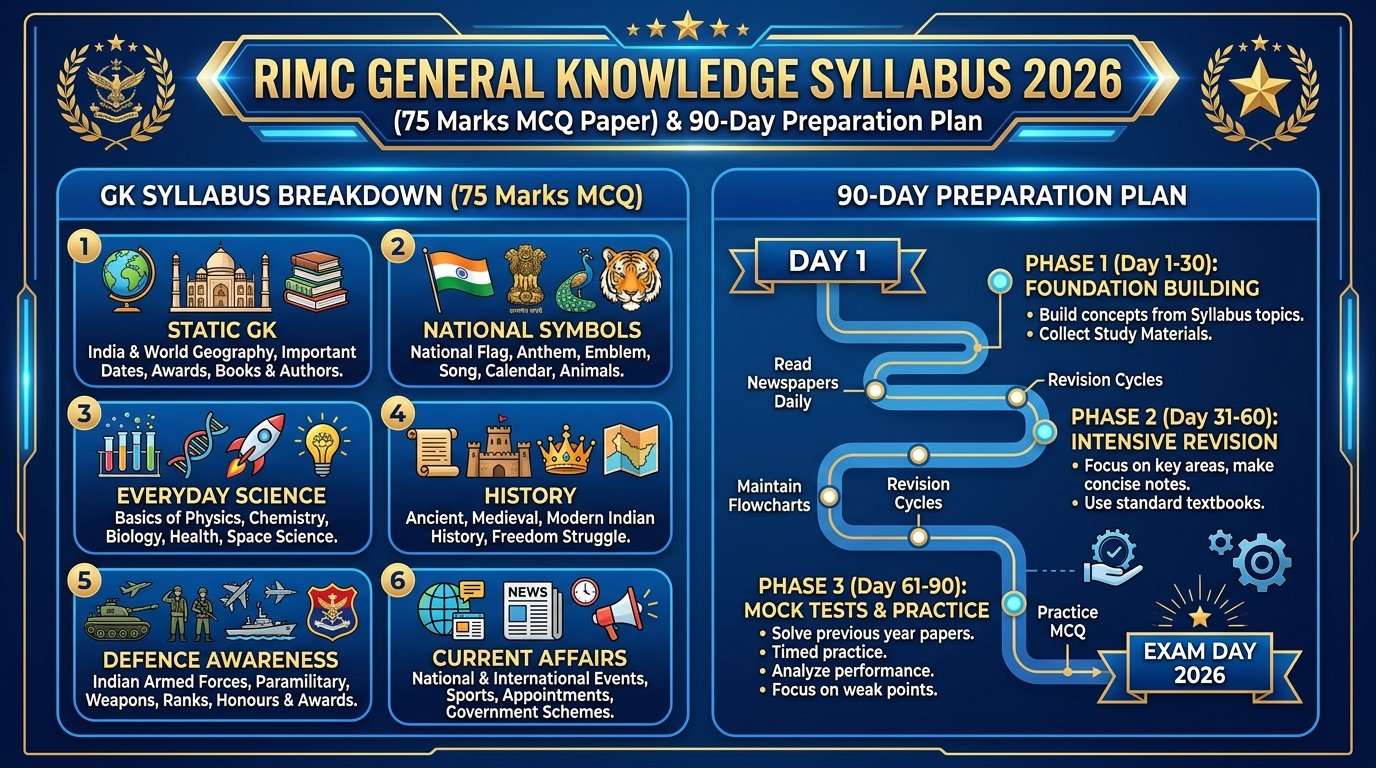
The Rashtriya Indian Military College (RIMC) Entrance Examination 2026 will feature General Knowledge (GK) as an objective MCQ-based paper carrying 75 maximum marks. To score high in the 06 December 2026 examination, aspirants must master Indian polity, history, geography, basic science, defence forces, current awareness, and world general knowledge.
SECTION A – India & General Awareness
Questions 1–15 | 1 Mark EachQ1. What is the capital of India?
▶ View Answer & Explanation
Correct Answer: B. New Delhi
New Delhi was officially declared the capital of India in 1911 during the Delhi Durbar.
Q2. What is the national animal of India?
▶ View Answer & Explanation
Correct Answer: C. Bengal Tiger
The Royal Bengal Tiger (Panthera tigris) was declared the national animal of India in April 1973 with Project Tiger.
Q3. What is the national bird of India?
▶ View Answer & Explanation
Correct Answer: A. Peacock
The Indian Peacock (Pavo cristatus) was recognized as the national bird of India in 1963.
Q4. Which is the largest state of India by area?
▶ View Answer & Explanation
Correct Answer: C. Rajasthan
Rajasthan covers an area of 342,239 sq km, making it India's largest state by geographic area.
Q5. Which is the smallest state of India by area?
▶ View Answer & Explanation
Correct Answer: A. Goa
Goa is India's smallest state by land area (3,702 sq km).
Q6. Which city is known as the Pink City?
▶ View Answer & Explanation
Correct Answer: A. Jaipur
Jaipur was painted pink in 1876 under Maharaja Ram Singh to welcome the Prince of Wales.
Q7. The national flower of India is:
▶ View Answer & Explanation
Correct Answer: B. Lotus
The Lotus (Nelumbo Nucifera Gaertn) symbolizes purity, achievement, and long life in Indian culture.
Q8. Which is the national tree of India?
▶ View Answer & Explanation
Correct Answer: B. Banyan
The Banyan Tree (Ficus benghalensis) is India's national tree, representing eternal life and strength.
Q9. Which Indian state is famous for the festival Onam?
▶ View Answer & Explanation
Correct Answer: A. Kerala
Onam is a major harvest festival celebrated in Kerala marking the homecoming of King Mahabali.
Q10. Which city is known as the City of Lakes?
▶ View Answer & Explanation
Correct Answer: B. Bhopal
Bhopal in Madhya Pradesh is famous as the 'City of Lakes' due to its various natural and artificial lakes (Upper Lake & Lower Lake).
Q11. The Indian national calendar is based on which era?
▶ View Answer & Explanation
Correct Answer: B. Saka Era
The Saka Era was adopted as India's national calendar on 22 March 1957, beginning in 78 AD.
Q12. Which is the national aquatic animal of India?
▶ View Answer & Explanation
Correct Answer: B. Ganges River Dolphin
The South Asian river dolphin (Platanista gangetica) was declared the National Aquatic Animal in 2009.
Q13. Which state is known as the “Land of Five Rivers”?
▶ View Answer & Explanation
Correct Answer: B. Punjab
Punjab derives its name from Persian 'Panj' (five) and 'Aab' (water), denoting the five rivers: Sutlej, Beas, Ravi, Chenab, and Jhelum.
Q14. Which Indian city is famous for the Gateway of India?
▶ View Answer & Explanation
Correct Answer: B. Mumbai
The Gateway of India was built in Apollo Bunder, Mumbai to commemorate the landing of King George V and Queen Mary in 1911.
Q15. Which state has the longest coastline in India?
▶ View Answer & Explanation
Correct Answer: A. Gujarat
Gujarat boasts the longest coastline among all Indian states, stretching over 1,600 km.
SECTION B – Indian History & Culture
Questions 16–30 | 1 Mark EachQ16. Who was known as the Father of the Nation in India?
▶ View Answer & Explanation
Correct Answer: C. Mahatma Gandhi
Mohandas Karamchand Gandhi was first addressed as 'Father of the Nation' by Netaji Subhas Chandra Bose in a Singapore radio address in 1944.
Q17. Who was the first Prime Minister of independent India?
▶ View Answer & Explanation
Correct Answer: B. Jawaharlal Nehru
Pandit Jawaharlal Nehru served as India's first Prime Minister from 15 August 1947 until 1964.
Q18. Who was the first President of India?
▶ View Answer & Explanation
Correct Answer: A. Dr. Rajendra Prasad
Dr. Rajendra Prasad was the first President of India, serving from 1950 to 1962.
Q19. The Taj Mahal was built by:
▶ View Answer & Explanation
Correct Answer: B. Shah Jahan
Mughal Emperor Shah Jahan commissioned the white marble mausoleum Taj Mahal in memory of Mumtaz Mahal.
Q20. The Red Fort is located in:
▶ View Answer & Explanation
Correct Answer: C. New Delhi
The historic Red Fort (Lal Qila) built by Shah Jahan is situated in Old Delhi (New Delhi capital region).
Q21. Who founded the Maurya Empire?
▶ View Answer & Explanation
Correct Answer: B. Chandragupta Maurya
Chandragupta Maurya founded the Mauryan dynasty in 322 BCE with guidance from Chanakya (Kautilya).
Q22. Which emperor embraced Buddhism after the Kalinga War?
▶ View Answer & Explanation
Correct Answer: C. Ashoka
Emperor Ashoka the Great converted to Buddhism after being moved by the bloodshed in the Kalinga War (261 BCE).
Q23. Who wrote the Indian national anthem?
▶ View Answer & Explanation
Correct Answer: B. Rabindranath Tagore
Rabindranath Tagore composed 'Jana Gana Mana', originally in Bengali in 1911.
Q24. “Vande Mataram” was written by:
▶ View Answer & Explanation
Correct Answer: B. Bankim Chandra Chattopadhyay
Bankim Chandra Chattopadhyay wrote 'Vande Mataram' in his 1882 novel Anandamath.
Q25. Which monument is located in Agra?
▶ View Answer & Explanation
Correct Answer: B. Taj Mahal
Taj Mahal is situated on the banks of the Yamuna river in Agra, Uttar Pradesh.
Q26. Bharatanatyam is a classical dance associated mainly with:
▶ View Answer & Explanation
Correct Answer: A. Tamil Nadu
Bharatanatyam is the oldest classical dance tradition of India originating from Tamil Nadu temples.
Q27. Kathak is a classical dance form traditionally associated with:
▶ View Answer & Explanation
Correct Answer: A. North India
Kathak originated from storytellers ('Kathakars') in Uttar Pradesh and North India.
Q28. Bihu is a major festival of:
▶ View Answer & Explanation
Correct Answer: A. Assam
Bihu (Rongali, Bhogali, and Kongali) is the primary cultural and harvest festival of Assam.
Q29. Which instrument is associated with Ustad Bismillah Khan?
▶ View Answer & Explanation
Correct Answer: C. Shehnai
Bharat Ratna Ustad Bismillah Khan was a legendary Shehnai maestro who popularized the instrument worldwide.
Q30. Ajanta Caves are located in:
▶ View Answer & Explanation
Correct Answer: A. Maharashtra
The UNESCO World Heritage Ajanta Caves featuring ancient Buddhist rock-cut monuments are in Chhatrapati Sambhajinagar (Aurangabad) district, Maharashtra.
SECTION C – Science
Questions 31–45 | 1 Mark EachQ31. Which planet is known as the Red Planet?
▶ View Answer & Explanation
Correct Answer: B. Mars
Mars appears red due to iron oxide (rust) present on its surface.
Q32. Which is the largest planet in our Solar System?
▶ View Answer & Explanation
Correct Answer: C. Jupiter
Jupiter is the largest planet in the Solar System, with a mass greater than twice all other planets combined.
Q33. What is the natural satellite of Earth?
▶ View Answer & Explanation
Correct Answer: B. Moon
The Moon is Earth's only natural satellite, orbiting at an average distance of ~384,400 km.
Q34. Which gas do humans need for respiration?
▶ View Answer & Explanation
Correct Answer: C. Oxygen
Oxygen (O₂) is essential for cellular respiration in humans to generate energy.
Q35. Which organ pumps blood throughout the human body?
▶ View Answer & Explanation
Correct Answer: C. Heart
The heart is a muscular organ that pumps oxygenated and deoxygenated blood through blood vessels.
Q36. Which organ is mainly responsible for breathing?
▶ View Answer & Explanation
Correct Answer: B. Lungs
Lungs perform gas exchange during inhalation and exhalation.
Q37. Plants prepare their food through:
▶ View Answer & Explanation
Correct Answer: B. Photosynthesis
Photosynthesis converts sunlight, water, and CO₂ into glucose and oxygen using chlorophyll.
Q38. Which part of a plant absorbs water from the soil?
▶ View Answer & Explanation
Correct Answer: C. Root
Root hairs absorb water and essential minerals from the soil via osmosis.
Q39. Which vitamin is mainly produced in the skin when exposed to sunlight?
▶ View Answer & Explanation
Correct Answer: D. Vitamin D
Ultraviolet-B (UVB) rays trigger Vitamin D synthesis in human skin cells.
Q40. Water boils at sea level at:
▶ View Answer & Explanation
Correct Answer: C. 100°C
Standard boiling point of pure water at 1 atm sea level pressure is 100°C (212°F).
Q41. Which is the hardest natural substance?
▶ View Answer & Explanation
Correct Answer: C. Diamond
Diamond is an allotrope of carbon with strong covalent bonds, rating 10 on the Mohs hardness scale.
Q42. Which force pulls objects towards Earth?
▶ View Answer & Explanation
Correct Answer: B. Gravitational force
Gravity attracts mass toward the center of Earth at an acceleration of approximately 9.8 m/s².
Q43. Which of the following is a renewable source of energy?
▶ View Answer & Explanation
Correct Answer: C. Solar energy
Solar energy is inexhaustible and naturally replenished, unlike fossil fuels (coal, oil, gas).
Q44. Which gas is present in the largest amount in Earth's atmosphere?
▶ View Answer & Explanation
Correct Answer: B. Nitrogen
Nitrogen constitutes approximately 78% of Earth's atmosphere, followed by Oxygen (~21%).
Q45. Which disease is commonly associated with deficiency of Vitamin C?
▶ View Answer & Explanation
Correct Answer: A. Scurvy
Vitamin C (ascorbic acid) deficiency leads to Scurvy, causing bleeding gums and skin spots.
SECTION D – Geography & Environment
Questions 46–55 | 1 Mark EachQ46. Which is the longest river in India?
▶ View Answer & Explanation
Correct Answer: B. Ganga
The Ganga is India's longest river, flowing over 2,525 km through India and Bangladesh.
Q47. Which is the highest mountain peak in the world?
▶ View Answer & Explanation
Correct Answer: B. Mount Everest
Mount Everest (8,848.86 m) in the Himalayas is Earth's highest peak above sea level.
Q48. The Sahara Desert is located in:
▶ View Answer & Explanation
Correct Answer: B. Africa
The Sahara is the world's largest hot desert, spanning North Africa.
Q49. Which ocean lies to the south of India?
▶ View Answer & Explanation
Correct Answer: C. Indian Ocean
India is bounded by the Arabian Sea to the west, Bay of Bengal to the east, and Indian Ocean to the south.
Q50. The Western Ghats are located along the:
▶ View Answer & Explanation
Correct Answer: B. Western side of India
The Western Ghats (Sahyadri) mountain range runs parallel to India's western coast.
Q51. Which is the largest ocean in the world?
▶ View Answer & Explanation
Correct Answer: C. Pacific Ocean
The Pacific Ocean is the largest ocean, covering more than 30% of Earth's total surface area.
Q52. Which layer protects Earth from much of the Sun's harmful ultraviolet radiation?
▶ View Answer & Explanation
Correct Answer: B. Ozone layer
The stratospheric Ozone layer (O₃) absorbs solar UV-B radiation.
Q53. Which of the following is a major cause of air pollution?
▶ View Answer & Explanation
Correct Answer: B. Vehicle emissions
Exhaust from automobiles releases nitrogen oxides, carbon monoxide, and particulate matter.
Q54. Which process converts water vapour into liquid water?
▶ View Answer & Explanation
Correct Answer: B. Condensation
Condensation is the physical phase change from gas/vapour back into liquid state.
Q55. Which practice helps conserve water?
▶ View Answer & Explanation
Correct Answer: B. Rainwater harvesting
Rainwater harvesting collects and stores runoff water for reuse and groundwater recharge.
SECTION E – Defence & Armed Forces
Questions 56–65 | 1 Mark EachQ56. The Indian Army, Navy and Air Force are collectively known as:
▶ View Answer & Explanation
Correct Answer: B. Armed Forces of India
The Indian Armed Forces comprise the Army, Navy, and Air Force under the Ministry of Defence.
Q57. The headquarters of the Indian Army is in:
▶ View Answer & Explanation
Correct Answer: B. New Delhi
Integrated Headquarters of Ministry of Defence (Army) is situated at South Block, New Delhi.
Q58. The Indian Navy primarily protects India's:
▶ View Answer & Explanation
Correct Answer: B. Maritime interests
The Navy secures sea borders, island territories, and maritime trade routes.
Q59. The Indian Air Force is responsible primarily for:
▶ View Answer & Explanation
Correct Answer: B. Air defence
The Indian Air Force safeguards Indian airspace and conducts aerial warfare.
Q60. The highest wartime gallantry award in India is:
▶ View Answer & Explanation
Correct Answer: B. Param Vir Chakra
Param Vir Chakra (PVC) is India's highest military decoration for wartime bravery.
Q61. The Ashoka Chakra is awarded for:
▶ View Answer & Explanation
Correct Answer: B. Bravery in peacetime
Ashoka Chakra is the highest peacetime military award for valor away from the battlefield.
Q62. Which force guards India's land borders in several sectors?
▶ View Answer & Explanation
Correct Answer: A. Border Security Force
The Border Security Force (BSF) guards India's land borders with Pakistan and Bangladesh.
Q63. INS stands for:
▶ View Answer & Explanation
Correct Answer: A. Indian Naval Ship
'INS' is the official ship prefix for commissioned vessels of the Indian Navy (e.g., INS Vikrant).
Q64. Which branch of the armed forces operates warships and submarines?
▶ View Answer & Explanation
Correct Answer: B. Navy
The Indian Navy operates surface aircraft carriers, destroyers, frigates, and submarines.
Q65. RIMC is located in:
▶ View Answer & Explanation
Correct Answer: A. Dehradun
Rashtriya Indian Military College (RIMC) was established in 1922 in Dehradun, Uttarakhand.
SECTION F – Sports, Books, Awards & World GK
Questions 66–75 | 1 Mark EachQ66. How many players are there in a cricket team on the field?
▶ View Answer & Explanation
Correct Answer: C. 11
A standard cricket team fields 11 players during a match.
Q67. Wimbledon is associated with:
▶ View Answer & Explanation
Correct Answer: B. Tennis
Wimbledon is the oldest and most prestigious Grand Slam tennis tournament played on outdoor grass courts in London.
Q68. The Olympic Games are held:
▶ View Answer & Explanation
Correct Answer: C. Every four years
Both Summer and Winter Olympic Games take place every four years (quadrennially).
Q69. Who wrote The Jungle Book?
▶ View Answer & Explanation
Correct Answer: A. Rudyard Kipling
English author Rudyard Kipling wrote 'The Jungle Book' in 1894 featuring Mowgli.
Q70. Who wrote The Discovery of India?
▶ View Answer & Explanation
Correct Answer: B. Jawaharlal Nehru
Jawaharlal Nehru wrote 'The Discovery of India' during his imprisonment at Ahmednagar Fort (1942–1946).
Q71. The Nobel Prize is named after:
▶ View Answer & Explanation
Correct Answer: B. Alfred Nobel
Swedish chemist Alfred Nobel, inventor of dynamite, established the Nobel Prizes in his 1895 will.
Q72. The headquarters of the United Nations is in:
▶ View Answer & Explanation
Correct Answer: C. New York
The United Nations international headquarters is located in Manhattan, New York City, USA.
Q73. UNESCO is associated with:
▶ View Answer & Explanation
Correct Answer: A. Education, science and culture
UNESCO stands for United Nations Educational, Scientific and Cultural Organization.
Q74. Which country is known as the “Land of the Rising Sun”?
▶ View Answer & Explanation
Correct Answer: B. Japan
Japan is called 'Nihon' or 'Nippon' (origin of the sun), translated as 'Land of the Rising Sun'.
Q75. Which is the largest continent by area?
▶ View Answer & Explanation
Correct Answer: C. Asia
Asia is Earth's largest continent by both area (44.58 million sq km) and population.
Full 75-Question Answer Key & Score Guidance
| Q | Ans | Q | Ans | Q | Ans |
|---|---|---|---|---|---|
| 1 | B | 26 | A | 51 | C |
| 2 | C | 27 | A | 52 | B |
| 3 | A | 28 | A | 53 | B |
| 4 | C | 29 | C | 54 | B |
| 5 | A | 30 | A | 55 | B |
| 6 | A | 31 | B | 56 | B |
| 7 | B | 32 | C | 57 | B |
| 8 | B | 33 | B | 58 | B |
| 9 | A | 34 | C | 59 | B |
| 10 | B | 35 | C | 60 | B |
| 11 | B | 36 | B | 61 | B |
| 12 | B | 37 | B | 62 | A |
| 13 | B | 38 | C | 63 | A |
| 14 | B | 39 | D | 64 | B |
| 15 | A | 40 | C | 65 | A |
| 16 | C | 41 | C | 66 | C |
| 17 | B | 42 | B | 67 | B |
| 18 | A | 43 | C | 68 | C |
| 19 | B | 44 | B | 69 | A |
| 20 | C | 45 | A | 70 | B |
| 21 | B | 46 | B | 71 | B |
| 22 | C | 47 | B | 72 | C |
| 23 | B | 48 | B | 73 | A |
| 24 | B | 49 | C | 74 | B |
| 25 | B | 50 | B | 75 | C |
Performance Band Guidance (75 Marks)
- 65–75 Marks: Excellent performance. Strong grasp over static & general awareness.
- 50–64 Marks: Good score. Minor revision needed in Science and Defence topics.
- 35–49 Marks: Average performance. Needs more focused study of Indian Geography & History.
- Below 35 Marks: Below cutoff. Requires fundamental revision of Class 6–8 Social Science & Science basics.