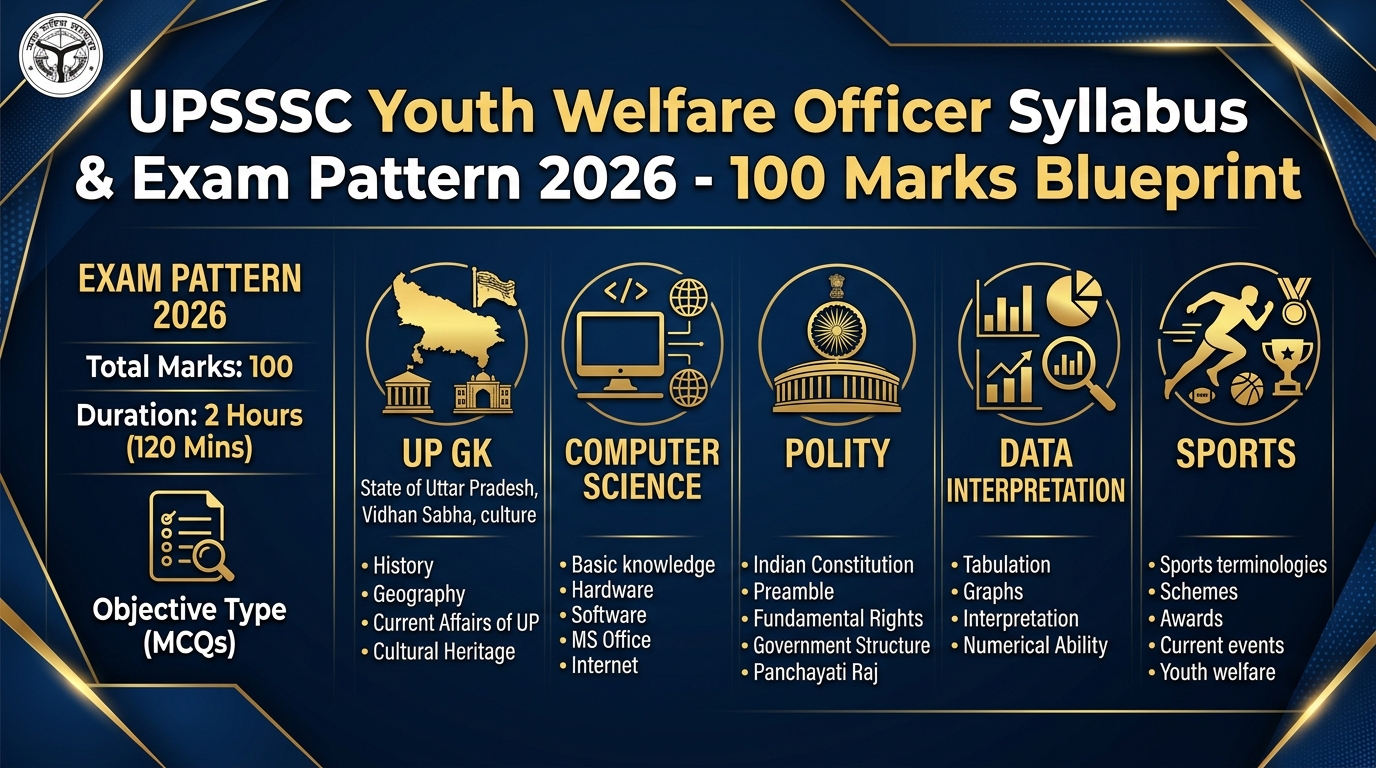
Detailed official Syllabus and examination blueprint for the UPSSSC Regional Youth Welfare & Territorial Development Squad Officer and Exercise Trainer (Vyayam Prashikshak) Main Examination 2026 under Advertisement No. 23-Exam/2026.
UPSSSC Youth Welfare Officer Exam Pattern 2026 Summary
The Main Written Examination consists of a single objective-type paper containing 100 Multiple Choice Questions (MCQs) carrying a total of 100 Marks to be solved in 2 Hours (120 Minutes). A negative marking of ¼ mark (0.25 mark) is deducted for each incorrect answer.
| Recruitment Authority | Uttar Pradesh Subordinate Services Selection Commission (UPSSSC) |
|---|---|
| Advertisement Number | 23-Exam/2026 |
| Posts Included | Regional Youth Welfare Officer (368 Posts) & Exercise Trainer (44 Posts) |
| Examination Mode | Offline (OMR-based) / Online Written Examination |
| Question Type | Objective Multiple Choice Questions (MCQs) |
| Total Questions | 100 Questions |
| Total Marks | 100 Marks |
| Duration | 2 Hours (120 Minutes) |
| Negative Marking | 0.25 Mark (¼th) deducted per wrong answer |
| Highest Weightage Subject | Uttar Pradesh General Knowledge (20 Marks / 20% Weightage) |
Subject-Wise Marks Weightage Breakdown
The 100 questions in Advertisement No. 23-Exam/2026 are distributed across 12 distinct subject areas. Crucially, 20% of the entire paper (20 marks) is dedicated to Uttar Pradesh-specific knowledge and 15% (15 marks) to Computer & IT Concepts.

| S.No. | Subject / Domain Area | Questions | Marks | Percentage Weightage |
|---|---|---|---|---|
| 1 | General Information Related to Uttar Pradesh (UP GK) | 20 | 20 | 20% |
| 2 | Computer & Information Technology and Contemporary Tech | 15 | 15 | 15% |
| 3 | Indian Polity & Constitution | 10 | 10 | 10% |
| 4 | Environmental Ecology & Disaster Management | 10 | 10 | 10% |
| 5 | Data Interpretation (DI) & Numerical Reasoning | 10 | 10 | 10% |
| 6 | History of India & Indian National Movement | 5 | 5 | 5% |
| 7 | Geography of India & World | 5 | 5 | 5% |
| 8 | Indian Economy & Social Development | 5 | 5 | 5% |
| 9 | Road Safety Rules & Regulations | 5 | 5 | 5% |
| 10 | Current Events of National & International Importance | 5 | 5 | 5% |
| 11 | Sports in India & Athletic Terminology | 5 | 5 | 5% |
| 12 | Human Anatomy & Physiology | 5 | 5 | 5% |
| Grand Total | 100 MCQs | 100 Marks | 100% | |
Highest-Weightage Priority Matrix & Strategy
To maximize score potential, candidates should not spend equal time across all 12 subjects. Categorize subjects into 3 strategic preparation tiers based on mark yield per hour studied:

🔴 Tier 1: Very High Priority (35 Marks)
- Uttar Pradesh GK: 20 Marks (20% weightage). History, geography, economy, culture, & UP state schemes.
- Computer & IT: 15 Marks (15% weightage). Fundamentals, MS Office, networking, cybersecurity, AI/IoT.
🟠 Tier 2: High Priority (30 Marks)
- Indian Polity: 10 Marks. Constitution, Articles, Amendments, Panchayati Raj.
- Environment & Disaster Mgmt: 10 Marks. Ecology, pollution, climate change, disaster protocols.
- Data Interpretation: 10 Marks. Tables, bar/pie charts, ratios, averages.
🟡 Tier 3: Medium Priority (35 Marks)
- 7 Subjects (5 Marks each): History, Geography, Economy, Road Safety, Current Affairs, Sports, Human Anatomy.
- High-return target topics: Traffic signs (Road Safety) and Muscular/Skeletal system (Human Anatomy).
Recommended 12-Subject Preparation Sequence
Instead of studying topics in arbitrary order, IndianDreamJob recommends completing preparation in the following strategic sequence to lock in 65% of the total marks within the first 6 weeks of study:
- Uttar Pradesh General Knowledge (20 Marks) — Build state-specific mastery first.
- Computer & Information Technology (15 Marks) — Learn IT concepts, shortcuts, cybersecurity & digital governance.
- Indian Polity & Constitution (10 Marks) — Master Articles, Fundamental Rights & State Executive.
- Environmental Ecology & Disaster Management (10 Marks) — Study ecosystems, climate treaties & disaster preparedness.
- Data Interpretation (10 Marks) — Daily practice of timed bar charts, tables & pie charts.
- Sports in India (5 Marks) — Essential focus for Youth Welfare Officer & Exercise Trainer posts.
- Human Anatomy & Physiology (5 Marks) — Crucial section for Exercise Trainer / Vyayam Prashikshak candidates.
- Road Safety Rules (5 Marks) — Traffic signs, signals, Motor Vehicle Act regulations & post-accident first aid.
- History of India & Freedom Movement (5 Marks) — Modern history & 1857 Revolt in UP.
- Geography of India & World (5 Marks) — Indian physical geography, rivers, climate & soils.
- Indian Economy & Social Development (5 Marks) — Budget, inflation, RBI, & government welfare schemes.
- Current Events of National & International Importance (5 Marks) — Last 6–12 months revision.
1. History of India & Indian National Movement — 5 Marks
Focus on key historical milestones, particularly freedom struggle events and UP's role in the 1857 rebellion:
- Ancient Indian History & Indus Valley Civilization
- Medieval Indian dynasties & cultural developments
- British rule expansion & Constitutional Acts
- The Great Revolt of 1857 (special reference to UP centers)
- Social and religious reform movements
- Formation of Indian National Congress (1885)
- Moderate and Extremist phases of Congress
- Swadeshi Movement & Partition of Bengal
- Non-Cooperation & Khilafat Movements
- Civil Disobedience Movement & Dandi March
- Quit India Movement (1942) & INA
- Role of Mahatma Gandhi & major freedom fighters
2. Indian Polity & Constitution — 10 Marks
High-yield 10-mark section covering constitutional frameworks and administrative structures:
- Historical background & Drafting of the Constitution
- Preamble, Salient Features & Schedules
- Fundamental Rights (Articles 12–35) & Writ Jurisdiction
- Directive Principles of State Policy (DPSP) & Fundamental Duties
- Union Executive: President, Vice-President, Prime Minister
- Union Parliament: Lok Sabha & Rajya Sabha legislative procedures
- Supreme Court & High Courts structure and powers
- State Executive: Governor, Chief Minister, Council of Ministers
- Panchayati Raj System (73rd Amendment) & Municipalities (74th Amendment)
- Constitutional & Statutory Bodies: CAG, Election Commission, UPSC, Finance Commission
- Emergency Provisions (Articles 352, 356, 360)
- Centre-State Relations & Major Constitutional Amendments
3. Geography of India & World — 5 Marks
Physical geography, natural resources, and environmental landforms:
- Physical features of India: Himalayas, Plains, Peninsular Plateau
- River systems of India: Himalayan & Peninsular rivers
- Climate of India, Monsoon mechanism, & rainfall distribution
- Soil types of India, vegetation, and forest conservation
- Agriculture, major crops, irrigation projects & mineral distribution
- Population geography, density, & transport networks
- World Geography: Continents, major oceans, mountain ranges
- Major global geographical features & climatic zones
4. Indian Economy & Social Development — 5 Marks
Economic concepts, national income, fiscal policies, and social welfare:
- Basic economic concepts: GDP, GNP, NNP, Per Capita Income
- Inflation, CPI, WPI, Unemployment types & measurement
- Monetary Policy, RBI functions, & Commercial Banking
- Fiscal Policy, Union Budget structure, & Taxation system
- Economic planning, NITI Aayog, & Sustainable Development Goals
- Agricultural policies, MSP, & Rural Development Programs
- Social sector initiatives: Education, Health, Women & Child development
- Government Flagship Welfare Schemes & Financial Inclusion (Jan Dhan)
5. Road Safety Rules & Regulations — 5 Marks
- Mandatory, Cautionary, & Informatory Traffic Signs
- Traffic Light Signals & Road Surface Markings
- Motor Vehicles (Amendment) Act rules & penalty provisions
- Driving licenses, vehicle registration, & insurance norms
- Speed limits, lane discipline, & overtaking rules
- Pedestrian safety, zebra crossings, & sidewalk regulations
- Helmet safety standards & seat-belt compliance rules
- Drunk driving regulations (BAC limits) & penalties
- Post-accident Emergency First Aid & Good Samaritan Guidelines
- National & UP State Road Safety awareness campaigns
6. Current Events of National & International Importance — 5 Marks
Focus on events from 6 to 12 months prior to the exam date:
- National Current Affairs: Government initiatives, policies, summits
- Major constitutional appointments & committee reports
- Science & Technology breakthroughs, space missions (ISRO)
- National Sports Awards, tournaments & medal tallies
- International Summits (G20, BRICS, SCO, ASEAN, UN)
- Global rankings, indices (HDI, Happiness, Innovation)
- Major international awards (Nobel Prizes, Oscars)
- International climate conferences & environmental pacts
7. Sports in India — 5 Marks
- History and evolution of sports in India
- National Games, Khelo India Youth Games & University Games
- Olympic Games, Paralympic Games, Asian Games, Commonwealth Games
- Major sports: Athletics, Hockey, Cricket, Wrestling, Boxing, Badminton, Shooting, Archery, Football, Kabaddi
- Prominent Indian sportspersons & recent record holders
- National Sports Awards: Khel Ratna, Arjuna Award, Dronacharya Award, Dhyan Chand Award
- Sports governing bodies: IOA, SAI, BCCI, Hockey India, AIFF
- Sports terminology, ground dimensions, & equipment rules
8. Human Anatomy & Physiology — 5 Marks
- Skeletal System: Major bones, joint types, & bone structure
- Muscular System: Muscle types (skeletal, smooth, cardiac) & contraction
- Digestive & Excretory Systems: Organs, enzymes, & waste elimination
- Respiratory System: Lungs, gas exchange, & VO2 max basics
- Circulatory System: Heart anatomy, blood components, & circulation
- Nervous & Endocrine Systems: Brain, spinal cord, hormones
- Sense Organs: Eye, ear structure & perception mechanisms
- Physical fitness, exercise physiology, & body mass index (BMI)
9. Environmental Ecology & Disaster Management — 10 Marks
High-weightage 10-mark domain covering ecological conservation and emergency response:
- Ecosystem components, Food Chains, Food Webs, & Pyramids
- Biodiversity hotspots, In-situ & Ex-situ conservation
- Air, Water, Soil, Noise, & Plastic Pollution sources and control
- Global warming, Climate Change, Greenhouse effect, & Ozone depletion
- National Parks, Wildlife Sanctuaries, & Biosphere Reserves in UP & India
- Natural Disasters: Earthquakes, Floods, Cyclones, Droughts, Tsunami, Landslides, Heatwaves
- Industrial & Chemical disaster protocols
- Disaster Preparedness, Mitigation, Rescue, & Rehabilitation cycles
- National Disaster Management Authority (NDMA), SDMA, & NDRF roles
- Community-based disaster management & emergency response
10. Data Interpretation & Tabulation — 10 Marks
Numerical reasoning and graphical data analysis carrying 10 full marks:
- Data Tables & Multi-column Tabulation Analysis
- Bar Graphs (Single, Double, Stacked Bar Charts)
- Line Graphs & Trend Analysis
- Pie Charts (Single & Multiple Comparative Pie Diagrams)
- Percentage calculations, growth rates, & ratio comparisons
- Averages, weighted averages, & numerical mean calculations
- Profit/Loss & Data-based mathematical reasoning
- Timed practice sets for calculation speed & accuracy
11. Computer & Information Technology — 15 Marks
- Computer Fundamentals: Architecture, CPU, Input/Output, RAM/ROM, Storage
- Operating Systems: Windows, Linux, Android basics, File management
- MS Office Suite: MS Word, MS Excel (formulas, functions), MS PowerPoint
- Internet & Networking: WWW, Browsers, Search Engines, Email, LAN/WAN/MAN
- Networking Concepts: IP Address, MAC Address, DNS, Wi-Fi, Routers
- Cyber Security: Viruses, Malware, Trojans, Ransomware, Phishing, Firewalls
- Digital Identity, Passwords, Safe Browsing & IT Act provisions
- Emerging Technologies: Artificial Intelligence (AI), Machine Learning (ML)
- Cloud Computing, Internet of Things (IoT), Big Data & Blockchain
- Digital Governance in UP: e-District, DigiLocker, UPI, & e-Portals
12. General Information Related to Uttar Pradesh (UP GK) — 20 Marks
- Ancient, Medieval & Modern History of Uttar Pradesh
- Role of UP in 1857 Revolt & Freedom Movement
- Physical Geography of UP: Rivers, Climate, Soil, Forests, Minerals
- Districts, Divisions, & Administrative Structure of UP
- State Polity: UP Vidhan Sabha, Vidhan Parishad, High Court (Prayagraj)
- Panchayati Raj & Municipal Governance in UP
- UP Economy: Agriculture, Major Crops, MSMEs, ODOP Scheme
- Industrial centers, Expressways, Tourism & Infrastructure
- UP Culture: Folk Dances (Charkula, Nautanki), Folk Songs, Festivals
- Languages, Dialects (Awadhi, Braj, Bhojpuri), Literature & Fairs
- UP Government Welfare Schemes & State Budget Highlights
- Recent UP State Current Affairs & Sports achievements
Negative Marking & Score Calculation Rules
UPSSSC applies standard 1/4th negative marking for objective examinations. Understand the marking formula:
- Correct Answer: +1.0 Mark
- Incorrect Answer: -0.25 Mark (¼th)
- Unattempted Question: 0.0 Mark (No penalty)

Frequently Asked Questions (FAQs)
Official Links & Recruitment Hub
| Official Resource / Cluster Guide | Link |
|---|---|
| UPSSSC Regional Youth Welfare Officer 412 Posts Recruitment Page | View Recruitment Details |
| Official UPSSSC Website | Visit UPSSSC Portal |
| Official Notification PDF (Advt 23-Exam/2026) | Download Official PDF |