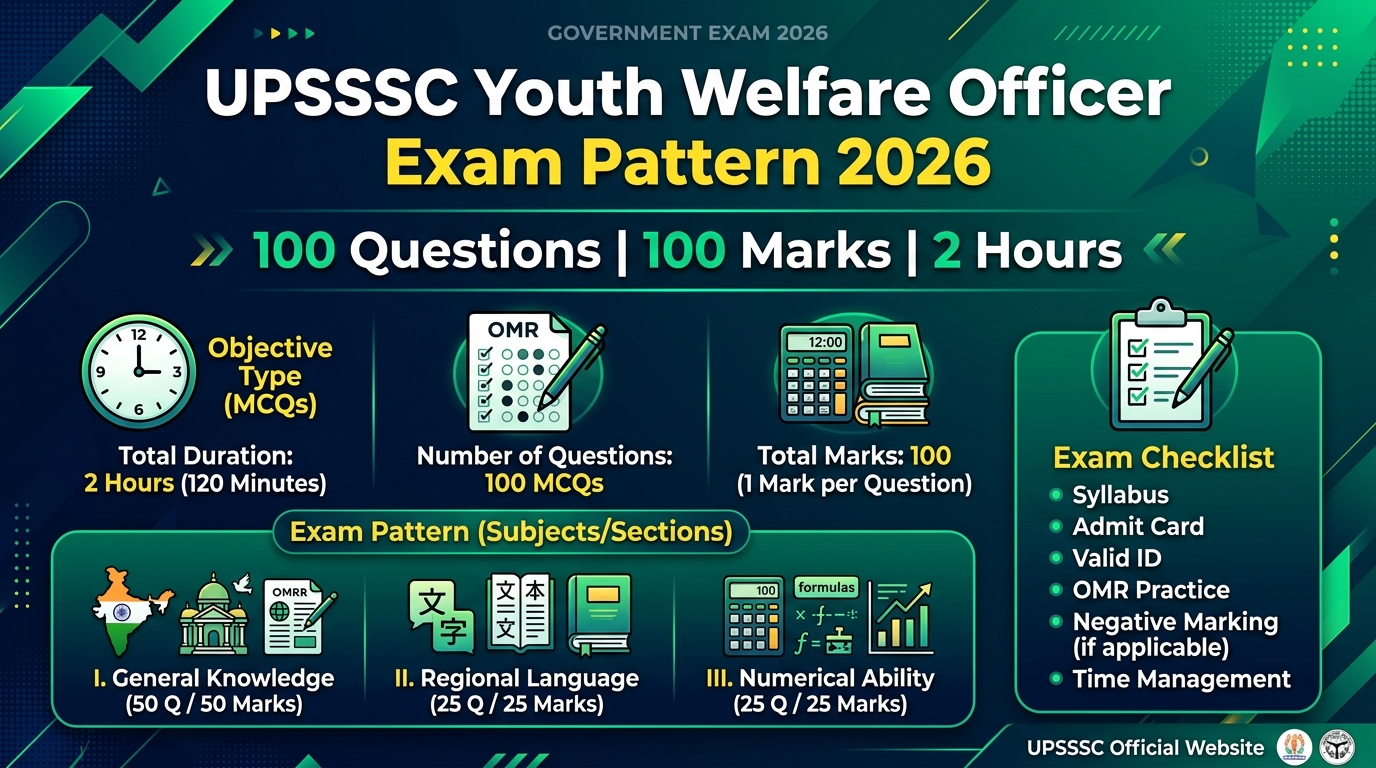
The UPSSSC Regional Youth Welfare & Territorial Development Squad Officer and Exercise Trainer Main Examination 2026 will be conducted under Advertisement No. 23-Exam/2026 as an objective-type written test comprising 100 questions for 100 total marks.
UPSSSC Youth Welfare Officer Exam Pattern 2026 Highlights
This is a PET-2025 based Main Written Examination. Final selection merit is determined strictly on the score obtained in this 100-mark written exam, subject to qualifying the prescribed physical standards and document verification.
Subject-Wise Questions & Marks Distribution Table
| S.No. | Subject / Domain Area | Questions | Marks |
|---|---|---|---|
| 1 | History of India & Indian National Movement | 5 | 5 |
| 2 | Indian Polity & Constitution | 10 | 10 |
| 3 | Geography of India & World | 5 | 5 |
| 4 | Indian Economy & Social Development | 5 | 5 |
| 5 | Road Safety Rules | 5 | 5 |
| 6 | Current Events of National & International Importance | 5 | 5 |
| 7 | Sports in India | 5 | 5 |
| 8 | Human Anatomy | 5 | 5 |
| 9 | Environmental Ecology & Disaster Management | 10 | 10 |
| 10 | Data Interpretation | 10 | 10 |
| 11 | Computer & Information Technology and Contemporary Tech | 15 | 15 |
| 12 | General Information Related to Uttar Pradesh (UP GK) | 20 | 20 |
| Total | 100 | 100 | |
Subject-Wise Priority Tiers (65/100 Core Sections)
The 5 core sections listed below account for 65 out of 100 total marks. Scoring high in these 5 sections guarantees a strong competitive position:
- Uttar Pradesh General Information: 20 Marks (20% of the entire paper)
- Computer & Information Technology: 15 Marks (15% of the paper)
- Indian Polity & Constitution: 10 Marks
- Environmental Ecology & Disaster Management: 10 Marks
- Data Interpretation: 10 Marks
Negative Marking Rules & Score Calculation Example
UPSSSC enforces a negative marking of ¼ mark (0.25 mark) for every incorrect response:

Practical Candidate Score Calculation Example
Suppose a candidate attempts the 100-question paper with the following result breakdown:
Exam Time Allocation (1.2 Minutes Per Question)
With 100 questions to solve in 120 minutes, candidates have an average of 1.2 minutes (72 seconds) per question:

3-Round Exam Attempt Strategy
To ensure optimal score performance without running out of time, follow the 3-round attempt strategy:

| Round | Time Window | Action Plan & Objective |
|---|---|---|
| Round 1 | Minutes 0 – 45 | Attempt all direct, easy, and 100% certain factual questions (UP GK, Computer, Polity, Road Safety). Do not stall on calculation questions. |
| Round 2 | Minutes 45 – 90 | Solve moderate-difficulty questions and Data Interpretation (DI) calculation sets requiring working steps. |
| Round 3 | Minutes 90 – 105 | Evaluate remaining doubtful questions. Use option elimination techniques (eliminating 2 out of 4 choices) before attempting. |
| Final Review | Minutes 105 – 120 | Verify marked OMR/online answers, ensure no bubble darkening errors, and refrain from wild last-minute guessing. |
Frequently Asked Questions (FAQs)
Official Links & Topic Cluster Navigation
| Official Resource / Cluster Guide | Link |
|---|---|
| UPSSSC Youth Welfare Officer Detailed Syllabus 2026 | View 12 Subject Syllabus |
| UPSSSC Regional Youth Welfare Officer 412 Posts Recruitment Page | View 412 Posts Details |
| Official UPSSSC Website | Visit UPSSSC Portal |