Official Source Verification: Published on 26 October 2026 on the official recruitment notice board of the Atomic Energy Education Society (AEES), Department of Atomic Energy (DAE), Government of India (aees.gov.in). This Syllabus guide outlines the Computer-Based Test (CBT) structure, subject-wise weightages, marking conventions, and direct official PDF download links for all eight recruitment categories under Notification 01/2026. Important editorial note: AEES published individual subject syllabi on 26.10.2026; Political Science PGT PDF link is currently not resolving on the official server, candidates should refer to the general PGT humanities framework until AEES issues a mirror update.
AEES Syllabus 2026 – Quick Overview & Key Facts
The Atomic Energy Education Society (AEES) conducts a single-stage Computer Based Test (CBT) followed by a qualifying Skill Test for direct recruitment to 254 teaching and school leadership posts across India. All candidates preparing for Advt No. 01/2026 must understand that the examination pattern is divided into three distinct structures depending on the administrative or teaching level.
| Recruitment Authority | Atomic Energy Education Society (AEES), DAE, Govt. of India |
|---|---|
| Advertisement Number | Recruitment Notification No. 01/2026 (Dated 29.10.2026) |
| Syllabus Release Date | 26 October 2026 (Published on Official AEES Portal) |
| Total Vacancies | 254 Tentative Posts across 8 distinct cadres |
| Mode of Examination | Computer-Based Test (CBT) (Online Multiple Choice Questions) |
| Negative Marking | NO NEGATIVE MARKING (1 mark for each correct answer) |
| Language of Question Paper | Bilingual (English & Hindi) (Discipline languages in their respective scripts) |
| Subsequent Selection Stage | Skill Test (Conducted strictly on a Go / No-Go Qualifying Basis) |
| Official Application Portal | aees.onlineregistrationforms.com |
| Official Website | aees.gov.in |
CBT Exam Pattern & Marking Scheme (3 Tier Structure)
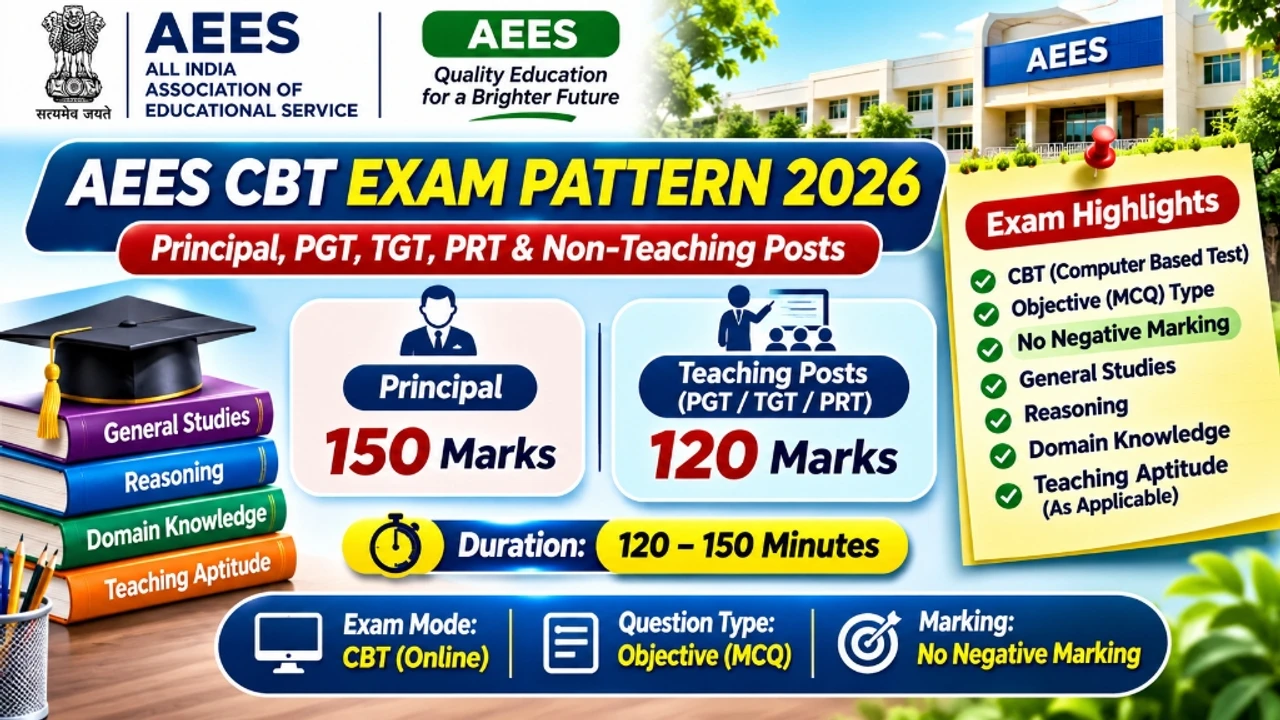
AEES Notification 01/2026 prescribes two distinct duration and marks tiers for CBT candidates: a 150-mark comprehensive examination for senior administrative cadres, and a 120-mark two-part test for teaching cadres.
Principal & Vice-Principal Pattern
- Total Questions: 150 Multiple Choice Questions (MCQs)
- Total Marks: 150 Marks (1 mark each)
- Total Time: 150 Minutes (2 Hours 30 Minutes)
- Negative Marking: Nil (No penalty for incorrect answers)
- Core Focus: School administration, finance rules (FR/SR/GFR), RTE Act, NEP 2020, POCSO Act, Official Language Rules, Leadership.
PGT, TGT, PRT, Music, Balvatika & Librarian
- Total Questions: 120 Multiple Choice Questions (MCQs)
- Total Marks: 120 Marks (1 mark each)
- Total Time: 120 Minutes (2 Hours)
- Negative Marking: Nil (No penalty for incorrect answers)
- Core Focus: Part I: General Studies, Reasoning, Teaching Methodology (50 Qs); Part II: Core Subject Discipline (70 Qs).
AEES Principal & Vice-Principal Detailed Syllabus
Candidates applying for AEES Principal Recruitment 2026 (Pay Level 12) or AEES Vice-Principal Recruitment 2026 (Pay Level 10) must prepare across 7 core examination sections:
| Part | Subject / Domain | Questions | Marks | Core Topics Covered |
|---|---|---|---|---|
| Part I | General Knowledge & Current Affairs | 15 | 15 | National & international events, Indian polity, geography, scientific advancements, DAE initiatives. |
| Part II | Reasoning Ability | 15 | 15 | Analogies, syllogisms, blood relations, seating arrangement, coding-decoding, logical puzzles, critical reasoning. |
| Part III | Numerical Ability & Data Interpretation | 15 | 15 | Percentages, ratios, profit & loss, simple & compound interest, averages, charts, tables, bar graphs. |
| Part IV | Language Proficiency (English & Hindi) | 15 (English) + 15 (Hindi) | 30 | Grammar, comprehension passages, idioms & phrases, sentence correction, synonyms & antonyms, vocabulary. |
| Part V | Educational Administration & Leadership | 30 | 30 | National Education Policy (NEP 2020), Right to Education (RTE Act 2009), POCSO Act 2012, school safety, pedagogical leadership, curriculum framework. |
| Part VI | Service Rules & Financial Management | 30 | 30 | CCS (Conduct) Rules 1964, CCS (CCA) Rules 1965, General Financial Rules (GFR 2017), FR & SR, Leave Rules, LTC, Medical Attendance Rules. |
| Part VII | Official Language Policy (Rajbhasha) | 15 | 15 | Constitutional provisions regarding Official Language, Official Language Act 1963, Official Languages Rules 1976, annual Hindi programme. |
| TOTAL | 150 Questions | 150 Marks | 150 Minutes Composite Time | |
AEES PGT Subject-Wise Syllabus (All 9 Subjects)
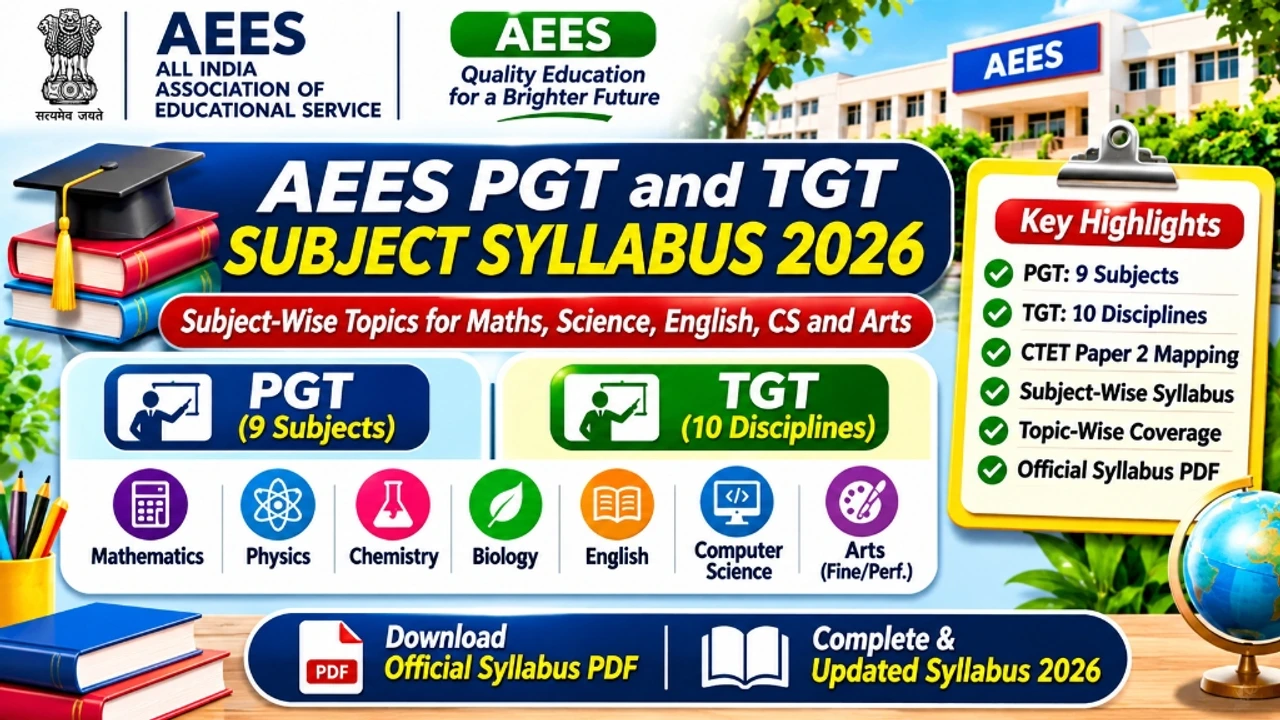
For AEES PGT Recruitment 2026 (27 Vacancies, Level 8), the CBT consists of 50 questions in Part I (General & Pedagogy) and 70 questions in Part II (Subject Discipline at Post Graduate level).
Part I: General Section (50 Marks)
- General Knowledge (10 Marks): Science, Constitution, History, Geography, Current Events.
- Reasoning Ability (10 Marks): Verbal and non-verbal logic, spatial orientation.
- Teaching Methodology & Pedagogy (10 Marks): Classroom management, child psychology, learning theories.
- General English (10 Marks): Reading comprehension, error detection, vocabulary.
- General Hindi (10 Marks): Vyakaran, sandhi, samas, muhavare, comprehension.
Part II: Discipline Subject (70 Marks)
- Questions benchmarked at the Post Graduate (Master's Degree) level with foundational concepts connecting CBSE Classes XI–XII.
- Application-oriented questions assessing deep conceptual clarity, experimental methods, and theoretical depth.
- No negative marking; all 70 questions carry 1 mark each.
Grammar: Tenses, clauses, voice, direct/indirect narration, prepositional phrases.
Literature (British, American, Indian Writing in English): Shakespearean drama, Romantic poetry (Wordsworth, Keats, Shelley), Victorian prose, Modern poetry (T.S. Eliot, Yeats), Indian English literature (R.K. Narayan, Mulk Raj Anand, Kamala Das, Nissim Ezekiel).
Calculus & Analysis: Limits, continuity, differentiability, Mean Value Theorems, partial differentiation, Riemann integration, line & surface integrals.
Vectors & 3D Geometry: Lines, planes, spheres, cones, vector differential operators, Gauss & Stokes theorems.
Differential Equations: Ordinary and partial differential equations, Fourier series.
Probability & Statistics: Discrete/continuous distributions, mathematical expectation, correlation & regression.
Electromagnetism: Maxwell's equations, electromagnetic waves in media, electrostatics, magnetostatics.
Quantum Mechanics: Wave-particle duality, Schrödinger wave equation, hydrogen atom, perturbation theory.
Thermodynamics & Statistical Mechanics: Laws of thermodynamics, Maxwell-Boltzmann, Bose-Einstein, Fermi-Dirac statistics.
Nuclear & Particle Physics: Nuclear models, radioactivity, nuclear reactors (special relevance to DAE), elementary particles.
Solid State & Electronics: Crystal structures, semiconductors, operational amplifiers, digital logic gates.
Inorganic Chemistry: Periodic properties, chemical bonding, coordination compounds (crystal field theory), organometallics, bioinorganic chemistry, f-block elements (lanthanides/actinides relevant to nuclear technology).
Organic Chemistry: Reaction mechanisms (SN1, SN2, E1, E2), aromaticity, stereochemistry, named reactions, spectroscopic methods (NMR, IR, UV-Vis, Mass spectrometry), biomolecules.
Plant Physiology & Anatomy: Photosynthesis (C3, C4, CAM), respiration, nitrogen metabolism, plant hormones.
Animal Physiology & Human Biology: Digestion, circulation, nervous system, endocrine glands, immune system.
Ecology & Evolution: Ecosystem dynamics, biodiversity conservation, theories of evolution, population genetics.
Programming in Python & C++: Data structures (arrays, stacks, queues, linked lists, trees, graphs), sorting & searching algorithms, OOP concepts.
Database Management (DBMS): SQL queries, relational algebra, normal forms (1NF to BCNF), transaction processing, ACID properties.
Computer Networks & Security: OSI & TCP/IP models, routing algorithms, IP addressing, cryptography, network security, cyber laws.
Emerging Technologies: Cloud computing, AI/ML fundamentals, Big Data.
Business Studies: Principles of management (Fayol & Taylor), business environment, marketing management, consumer protection, financial markets.
Financial Management: Capital budgeting, working capital management, cost of capital.
Macroeconomics: National income accounting, Keynesian theory of employment, money and banking, fiscal & monetary policy, balance of payments.
Indian Economy & Development: Economic reforms since 1991, poverty, human capital formation, sustainable development.
Modern Indian History: British expansion, Revolt of 1857, Indian National Movement (Gandhian era, partition, integration of states).
World History: Renaissance, Industrial Revolution, French Revolution, World Wars I & II, Cold War era.
AEES TGT Subject-Wise Syllabus (All 10 Subjects)
Candidates preparing for AEES TGT Recruitment 2026 (102 Vacancies, Level 7) will encounter 50 questions in Part I (General & Pedagogy) and 70 questions in Part II (Subject Discipline at Graduation level).
| TGT Cadre | Vacancies | Discipline Core Syllabus Topics (Part II - 70 Marks) |
|---|---|---|
| TGT English | 15 | Grammar & usage (tenses, modals, voice, reported speech, clauses), unseen comprehension, writing formats (letters, articles, notices), literary appreciation of poetry and prose up to graduation level. |
| TGT Hindi / Sanskrit | 11 | Hindi Vyakaran (varn, sandhi, samas, upsarg, pratyay, ras, chhand, alankar), Hindi literature history (Aadi kaal to Aadhunik kaal), Sanskrit grammar (shabdroop, dhaturoop, karak). |
| TGT Maths / Physics | 20 | Maths: Real numbers, polynomials, linear equations, quadratic equations, arithmetic progressions, coordinate geometry, trigonometry, circles, mensuration, statistics & probability. Physics: Motion, force, laws of motion, gravitation, work & energy, sound, light (reflection & refraction), human eye, electricity, magnetic effects of electric current, sources of energy. |
| TGT Chemistry / Biology | 10 | Chemistry: Chemical reactions & equations, acids, bases & salts, metals & non-metals, carbon compounds, periodic table classification. Biology: Life processes (nutrition, respiration, circulation, excretion), control & coordination, reproduction, heredity & evolution, our environment, natural resource management. |
| TGT Social Science | 14 | History (French & Russian Revolutions, Nazism, Nationalism in India), Geography (resources, water resources, agriculture, minerals, manufacturing industries), Political Science (democracy, federalism, gender & caste, political parties), Economics (development, sectors of economy, money & credit, globalization). |
| TGT Computer Science | 11 | Computer fundamentals, Python programming basics, lists, dictionaries, tuples, functions, SQL fundamentals, Cyber ethics and digital safety, HTML/CSS basics. |
| TGT Art | 07 | Fundamentals of visual arts (line, color, form, texture, space), Indian art history (Indus Valley, Buddhist art, Temple architecture, Mughal & Rajput miniatures, Modern Indian art), practical painting techniques & color theory. |
| TGT PET (Male & Female) | 11 (8 M + 3 F) | Concept of physical education, anatomy & physiology in sports, biomechanics, kinesiology, rules & measurements of major games (cricket, football, volleyball, athletics), sports training principles, yoga & wellness, first aid and sports injuries. |
| TGT Special Educator | 03 | Identification and assessment of children with disabilities (RPwD Act 2016 21 conditions), Individualized Education Program (IEP), assistive technologies, inclusive classroom management, curriculum adaptation, behavioral modification strategies. |
AEES PRT & Balvatika Teacher Syllabus
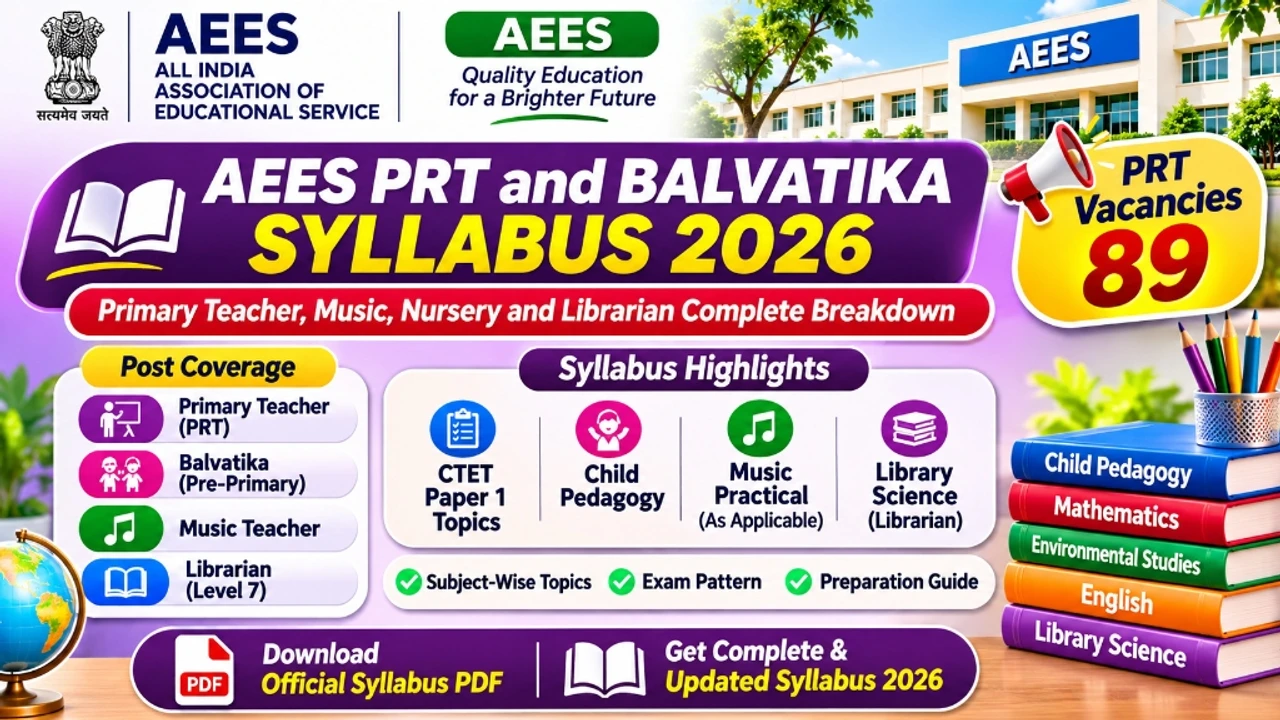
Both AEES PRT Recruitment 2026 (89 Vacancies, Level 6) and AEES Balvatika Teacher Recruitment 2026 (08 Vacancies, Level 6) focus heavily on foundational stage literacy, numeracy, and developmental pedagogy.
AEES PRT Syllabus (89 Posts)
- Part I: General Aptitude (50 Marks): General Awareness, Reasoning, Teaching Aptitude, General English & General Hindi.
- Part II: Subject Specialization (70 Marks):
- Core Mathematics: Number system, LCM/HCF, fractions, unitary method, basic geometry, measurements, time & calendar.
- Environmental Studies (EVS): Family & friends, food, shelter, water, travel, things we make & do, environmental conservation.
- General Science & Social Studies: Foundational concepts up to Class X standard.
- Pedagogical Content Knowledge: Teaching methods for foundational literacy and numeracy (FLN - NIPUN Bharat).
AEES Balvatika Teacher Syllabus (08 Posts)
- Part I: General Aptitude (50 Marks): GA, Reasoning, English, Hindi, and Basics of Early Childhood Care and Education (ECCE).
- Part II: ECCE & Pre-Primary Pedagogy (70 Marks):
- National Curriculum Framework for Foundational Stage (NCF-FS 2022): Panchakosha concept of child development.
- Child Development (Ages 3–6): Physical, cognitive, language, social-emotional, and sensory development milestones.
- Play-Based Learning: Storytelling, rhymes, puppetry, sensory exploration, art and craft in pre-primary education.
- Health, Nutrition & Safety: Balanced nutrition for toddlers, hygiene practices, early screening for developmental delays.
AEES PRT Music Syllabus (10 Posts)
Candidates applying for AEES PRT Music Recruitment 2026 (Pay Level 6) must prepare for:
- Part I (50 Marks): General Awareness, Reasoning, Teaching Aptitude, General English, and General Hindi.
- Part II (70 Marks) — Core Music Discipline:
- Indian Classical Music (Vocal & Instrumental): Swar, Saptak, Thaat, Raga, Naad, Shruti, Alankar, Laya, Taal (Teentaal, Dadra, Keharwa, Roopak, Ektaal, Jhaptaal).
- Raga Knowledge: Detailed study of prescribed ragas (Bhairav, Yaman, Kafi, Bilawal, Khamaj, Asavari, Bhupali, Des).
- Musical Forms: Dhrupad, Dhamar, Khayal (Bada & Chhota Khayal), Tarana, Thumri, Lokgeet (Folk songs of different Indian states).
- History of Indian Music: Ancient treatises (Natya Shastra, Sangeet Ratnakar), contributions of legendary musicians (Tansen, Pt. Vishnu Narayan Bhatkhande, Pt. Vishnu Digambar Paluskar).
- Musical Instruments: Classification of instruments (Tat, Sushir, Avanaddha, Ghana), tuning and maintenance of Tanpura, Harmonium, Tabla.
AEES Librarian Syllabus (13 Posts)
Candidates applying for AEES Librarian Recruitment 2026 (Pay Level 7) will be evaluated on:
- Part I (50 Marks): General Awareness, Reasoning, English, Hindi, and Educational Pedagogy.
- Part II (70 Marks) — Library & Information Science:
- Foundation of Library Science: Five Laws of Library Science by Dr. S.R. Ranganathan, library legislation in India, role of national and international associations (ILA, IASLIC, IFLA, UNESCO).
- Knowledge Organization & Cataloguing: Dewey Decimal Classification (DDC), Colon Classification (CC), AACR-2, MARC 21, metadata standards.
- Information Sources & Services: Reference services, CAS, SDI, electronic resource management, abstracting & indexing.
- Library Automation & Digital Libraries: Integrated Library Management Systems (Koha, SOUL), RFID technology, barcode integration, institutional repositories (DSpace).
- Library Management: Collection development, stock verification, catalog maintenance, preservation & conservation of library materials.
Explore All 8 AEES Recruitment Cadres (Direct Links)
Access our comprehensive recruitment guides for individual posts under AEES Notification 01/2026. Each guide provides post-specific eligibility, category-wise vacancy breakdowns, salary calculations, and direct application steps:
Official Syllabus PDF Downloads & Portal Links
The following links point directly to the official syllabus documents and recruitment archives on the AEES portal. Candidates should download and archive their subject PDF for offline revision:
| Cadre / Subject Document | Date of Release | Official PDF Link |
|---|---|---|
| AEES Principal Syllabus PDF | 26.10.2026 | Download Principal PDF |
| AEES Vice-Principal Syllabus PDF | 26.10.2026 | Download Vice-Principal PDF |
| AEES PGT Syllabus (All Subjects Portal) | 26.10.2026 | AEES PGT Subject PDFs |
| AEES TGT Syllabus (All Cadres Portal) | 26.10.2026 | AEES TGT Subject PDFs |
| AEES PRT & Balvatika Syllabus PDF | 26.10.2026 | Download PRT & Balvatika PDF |
| AEES Librarian Syllabus PDF | 26.10.2026 | Download Librarian PDF |
| Official Recruitment Notice No. 01/2026 (Full PDF) | 29.10.2026 | Download Advt No. 01/2026 PDF |
| Official Online Apply Portal | Active till 22.11.2026 | Go to Online Apply Portal |
High-Scoring AEES 2026 CBT Preparation Strategy
1. Leverage Zero Negative Marking
Because there is no negative marking in the AEES Computer Based Test, candidates must attempt all 150 questions (Principal/VP) or 120 questions (Teaching cadres). Master the process of elimination for difficult MCQs to optimize your hit rate without risk of penalty.
2. NCERT & Standard University Textbooks
For TGT and PGT posts, question framing heavily mirrors the NCERT Class VI–XII syllabi and undergraduate core curricula. Solve exemplar problems and conceptual chapter-end exercises before moving to specialized competitive books.
3. Deep Dive into NEP 2020 & Pedagogy
Teaching Methodology in Part I carries 10–30 marks across posts. Focus on experiential learning, toy-based pedagogy, inclusive education, competency-based assessments, and the pedagogical structure (5+3+3+4) outlined under NEP 2020.
4. Mock Test Time Management (1 Min / Question)
The time allowance is exactly 1 minute per question (120 minutes for 120 questions; 150 minutes for 150 questions). Allocate no more than 35 minutes to General Studies and Languages, reserving the remaining 85 minutes for analytical discipline questions.