UKSSSC Inter Level Recruitment 2026 Topic Cluster:
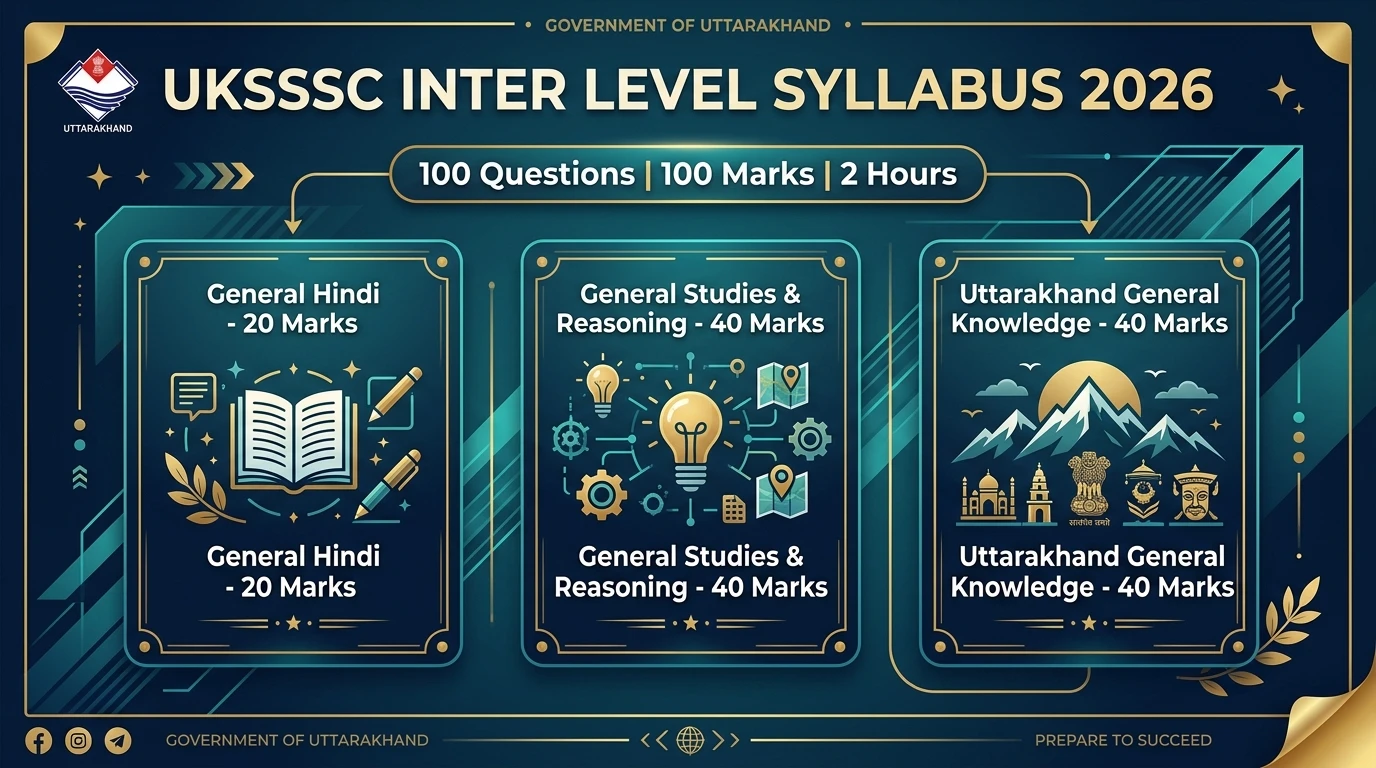
Infographic: UKSSSC Inter Level Syllabus 2026 Overview (100 Questions, 100 Marks, 2 Hours)
Official Publication Context: The official syllabus document was published on 31 August 2026 under the Intermediate/Junior Assistant level framework. The paper comprises 100 objective questions for 100 marks with a duration of 2 hours, covering General Hindi (20 Marks), General Knowledge & General Studies (40 Marks), and General Knowledge of Uttarakhand (40 Marks).
Table of Contents
1. UKSSSC Inter Level Syllabus 2026 – Overview & Written Exam Scheme
Before diving into individual topics, review the key structural parameters of the UKSSSC Inter Level written competitive examination:
| Particular | Details |
|---|---|
| Recruiting Organization | Uttarakhand Subordinate Service Selection Commission (UKSSSC) |
| Exam Name | UKSSSC Inter Level / Group C Recruitment Exam 2026 |
| Advertisement No. | 80/उ0अ0से0च0आ0/2026 |
| Total Vacancies | 553 Posts |
| Syllabus Framework | Intermediate / 12th Standard Level |
| Exam Format | Objective Type Multiple Choice Questions (MCQs) |
| Total Questions | 100 Questions |
| Total Marks | 100 Marks |
| Exam Duration | 2 Hours (120 Minutes) |
| General Hindi Weightage | 20 Questions = 20 Marks |
| General Knowledge & GS | 40 Questions = 40 Marks |
| Uttarakhand General Knowledge | 40 Questions = 40 Marks |
| Marking Scheme | +1 mark for correct; −0.25 mark for incorrect answer |
| Typing Test | Qualifying in nature (where applicable for clerical posts) |
2. Subject-Wise UKSSSC Inter Level Syllabus 2026 Marks Breakdown
The written examination is divided into three distinct subject sections under UKSSSC Inter Level Syllabus 2026 guidelines:

Infographic: UKSSSC Inter Level Syllabus 2026 Subject-Wise Weightage & Topics
| Subject Section | Questions | Marks | Percentage Weightage |
|---|---|---|---|
| General Hindi (सामान्य हिंदी) | 20 | 20 | 20% |
| General Knowledge & General Studies (सामान्य ज्ञान व अध्ययन) | 40 | 40 | 40% |
| General Knowledge of Uttarakhand (उत्तराखंड सामान्य ज्ञान) | 40 | 40 | 40% |
| Total | 100 | 100 | 100% |
3. UKSSSC Inter Level Syllabus 2026 – Section 1: General Hindi (20 Marks)
The General Hindi section carries 20 Marks and covers core grammar rules, vocabulary, sentence structure, official letter writing, and Hindi computing concepts as prescribed in the official syllabus document:
भाषा एवं लिपि
- भाषा एवं भाषा के प्रकार: मौखिक, लिखित एवं सांकेतिक भाषा
- हिंदी भाषा का विकास: संस्कृत से हिंदी तक का विकास क्रम
- हिंदी भाषा के विविध रूप: बोली, मानक भाषा, राजभाषा, राष्ट्रभाषा
- कार्यालयी हिंदी: प्रशासकीय एवं आधिकारिक प्रयुक्तियाँ
- उत्तराखंड की प्रमुख बोलियाँ: कुमाऊँनी, गढ़वाली एवं जौनसारी
- देवनागरी लिपि: लिपि का विकास, गुण एवं दोष, वैज्ञानिकता
वर्णमाला एवं वर्तनी
- वर्णमाला: स्वर (ह्रस्व, दीर्घ, प्लुत) एवं व्यंजन (स्पर्श, अंतःस्थ, ऊष्म, संयुक्त)
- हिंदी वर्तनी: शुद्ध-अशुद्ध शब्द विश्लेषण एवं नियम
- विराम चिह्न: पूर्ण विराम, अल्प विराम, अर्ध विराम, प्रश्नवाचक आदि
- हिंदी अंक: देवनागरी एवं अंतरराष्ट्रीय अंकों का स्वरूप
शब्द संरचना एवं व्याकरण
- शब्द प्रकार: वर्ण, अक्षर, उपसर्ग, प्रत्यय
- व्याकरणिक कोटियाँ: संज्ञा, सर्वनाम, क्रिया, विशेषण, क्रिया-विशेषण
- अव्यय एवं विकार: कारक, लिंग, वचन, पुरुष
- संधि: स्वर संधि, व्यंजन संधि, विसर्ग संधि एवं संधि-विच्छेद
शब्द भंडार, पत्र एवं कंप्यूटर
- शब्द भंडार: तत्सम, तद्भव, देशज, आगत/विदेशी शब्द
- शब्द भेद: एकार्थी, अनेकार्थी, विलोम, पर्यायवाची, श्रुतिसमभिन्नार्थक
- मुहावरे एवं लोकोक्तियाँ: परिभाषा, अर्थ एवं वाक्य प्रयोग
- पत्र लेखन: शासकीय, अर्द्धशासकीय, टिप्पणी, प्रारूपण, विज्ञप्ति
- जनसंचार एवं कंप्यूटर: जनसंचार माध्यम एवं हिंदी कंप्यूटर अनुप्रयोग
4. UKSSSC Inter Level Syllabus 2026 – Section 2: General Knowledge & General Studies (40 Marks)
The General Knowledge and General Studies section accounts for 40 Marks and is sub-divided into Reasoning, History, Geography, Polity, Economics, Current Affairs, and Computer Knowledge:
Verbal Reasoning Topics:
- Alphabetical Test & Sequence
- Coding-Decoding (Letter & Number)
- Analogy (Word, Number & Figure)
- Classification & Odd One Out
- Order & Ranking Arrangement
- Blood Relations
- Direction & Distance Sense
- Venn Diagrams & Syllogism
- Calendar & Clock Problems
Non-Verbal Reasoning Topics:
- Figure Classification & Series
- Figure Counting (Triangles, Squares)
- Figure Completion & Pattern Matching
- Grouping of Identical Figures
- Mirror & Water Images
- Paper Folding & Paper Cutting
- Cube & Dice Reasoning
- Ancient Indian History (हड़प्पा सभ्यता से 1206 ई.): Indus Valley Civilization, Vedic Culture, Jainism & Buddhism, Mauryan Empire, Gupta Period, South Indian Kingdoms.
- Medieval India (1206 ई. से 1707 ई.): Delhi Sultanate, Mughal Empire, Vijayanagara Empire, Bhakti & Sufi Movements.
- Modern India & National Movement: British Rule in India, Revolt of 1857, Indian National Congress, Freedom Struggle under Mahatma Gandhi, Revolutionary Movements, Partition & Independence (1947).
- World History Events: Renaissance in Europe, American War of Independence, French Revolution, Russian Revolution, First World War (1914–1918), Second World War (1939–1945).
- Geography of India: Physical Relief Features, Climate & Monsoons, Drainage System (Major Rivers), Natural Vegetation & Forests, Soil Types, Water Resources, Mineral & Energy Resources, Agriculture, Population Demographics, Air & Water Pollution.
- World Geography: Origin of Solar System, Latitudes & Longitudes, Earth Relief Features, Rock Types, Ocean Currents, Tides, Global Climate Zones, Major World Industries & Population Distribution.
- National Renaissance & Freedom Movement
- Constitution of India: Preamble & Features
- Fundamental Rights & Fundamental Duties
- Directive Principles of State Policy (DPSP)
- Indian Parliament, President & Prime Minister
- Political Parties & Electoral Process
- Panchayati Raj & Local Self-Government
- United Nations Organization (UNO)
- Features of Indian Economy & Population
- Indian Agriculture: Problems & Food Security
- Industrial Development & Small Scale Sector
- Money, Banking & RBI Monetary Policy
- New Economic Policy (1991 Reforms)
- Poverty, Unemployment & Human Capital
- Indian Taxation System & GST Basics
- Foreign Trade, Balance of Payments & Globalization
4.6 National & International Current Affairs
National events, major appointments, government schemes, awards & honors, sports events, scientific discoveries, international organizations, defense exercises, and significant events from the preceding 6–12 months.
5. UKSSSC Inter Level Syllabus 2026 – Section 3: General Knowledge of Uttarakhand (40 Marks)
Uttarakhand General Knowledge carries 40 Marks (40% of written paper) and requires in-depth state-specific preparation across geography, history, culture, administration, economy, and state current affairs:
| Syllabus Module | Detailed Prescribed Topics |
|---|---|
| Geography of Uttarakhand | Geographical location and boundaries, Himalayan ranges, mountain peaks, glaciers, major river systems (Ganga, Yamuna, Kali, Alaknanda, Bhagirathi), lakes, forest types, National Parks (Jim Corbett, Valley of Flowers, Rajaji), Wildlife Sanctuaries, soil & climate zones. |
| History of Uttarakhand | Ancient dynasties (Kuninda, Katyuri, Chand, Parmar/Garhwal dynasty), Gorkha rule in Garhwal & Kumaon, British colonial period, role of Uttarakhand in Indian Freedom Struggle, social reform movements, and the Uttarakhand Statehood Movement (उत्तराखंड राज्य आंदोलन). |
| Economy of Uttarakhand | Agriculture & horticulture, tourism & pilgrimage economy (Char Dham), forest resources, mineral resources, hydropower projects, major industries, employment statistics, and state government developmental schemes. |
| Art, Culture & Traditions | Folk dances (Chholiya, Jhora, Thali), folk songs, traditional festivals (Nanda Devi Raj Jat, Phool Dei, Harela), fairs, local handicrafts, traditional attire, and regional dialects (Kumaoni, Garhwali, Jaunsari). |
| Environment & Biodiversity | Himalayan ecosystem, biodiversity conservation, water resources, environmental pollution, natural disasters & disaster management strategies (आपदा प्रबंधन) in hill areas. |
| Administration & Institutions | District-wise administrative structure (13 districts, 2 divisions), State Legislative Assembly, local self-government, major state institutions, and governance initiatives. |
| Uttarakhand Current Affairs | Recent state government decisions, new infrastructure projects, state awards, sports achievements, and current state affairs. |
6. UKSSSC Inter Level Syllabus 2026 – Computer & Emerging Technologies
The computer section under UKSSSC Inter Level Syllabus 2026 includes advanced topics beyond basic office tools, covering cyber security and emerging technologies:
Computer Fundamentals & OS
- History & Classification of Computers
- Hardware: CPU, Memory (RAM, ROM), I/O Devices
- Software, Algorithms & Flowcharts
- Operating System Functions, Processes & GUI OS
- Database Management Systems (DBMS Concepts & Keys)
- Office Automation: Word, Excel, PowerPoint
Cyber Security & Emerging Tech
- Networking: LAN, WAN, Protocols & Internet
- Web Browsers, URLs, HTML Tags & Search Engines
- Cyber Threats, Cyber Security & Indian IT Act
- Artificial Intelligence (AI) & Machine Learning (ML)
- Internet of Things (IoT) Fundamentals
- Cloud Computing Concepts & Services
7. Official UKSSSC Inter Level Syllabus PDF 2026 Direct Download Links
Candidates can view and download the official UKSSSC Intermediate level syllabus PDF documents dated 31 August 2026 directly from the official servers:
Syllabus PDF 1
Junior Assistant / Inter Level Official Syllabus Document (2026083162713751.pdf)
Download PDF 18. UKSSSC Inter Level Syllabus 2026 – Recommended Daily Study Plan & 30-Day Revision Roadmap
To systematically cover all topics before the tentative exam date of 15 November 2026, candidates are advised to follow a structured 30-day revision plan:

Infographic: UKSSSC Inter Level Syllabus 2026 30-Day Revision Plan
| Days | Focus Subject & Activities | Daily Allotment |
|---|---|---|
| Days 1–5 | General Hindi: Grammar rules, Sandhi, Vocabulary, Letter Writing | 1.0 to 1.5 Hours |
| Days 6–9 | Reasoning: Verbal & Non-Verbal practice, Coding, Analogy, Figures | 1.5 to 2.0 Hours |
| Days 10–13 | Indian History (Ancient, Medieval, Modern & World History events) | 2.0 Hours |
| Days 14–16 | Geography (India Physical, World Geography & Climate) | 2.0 Hours |
| Days 17–18 | Political Science & Indian Constitution (Rights, DPSP, Parliament) | 1.5 Hours |
| Days 19–20 | Indian Economy & Agriculture, Banking, Tax System | 1.5 Hours |
| Days 21–22 | Computer Fundamentals, DBMS, Networking, Cyber Security & AI/ML | 1.5 Hours |
| Days 23–27 | Uttarakhand GK (History, Geography, Culture, Economy, Schemes) | 2.5 to 3.0 Hours |
| Day 28 | National, International & Uttarakhand Current Affairs Revision | 2.0 Hours |
| Days 29–30 | Full-Length 100-Question Mock Test & Weak Topic Revision | 3.0 Hours |