RSSB JE Civil Mock Test 2 2026: Rajasthan Staff Selection Board (RSSB) द्वारा आयोजित की जाने वाली Junior Engineer (Civil) भर्ती परीक्षा 2026 के लिए IndianDreamJob द्वारा यह विशेष Full-Length Practice Mock Test 2 तैयार किया गया है। इस टेस्ट में 120 प्रश्न (40 Rajasthan GK + 80 Civil Engineering), 120 अंक और 2 घंटे (120 मिनट) की समय सीमा निर्धारित की गई है।
Get real-time updates on latest government job mock tests, previous year papers, and recruitment notifications directly in Google Search.
⭐ Add IndianDreamJob as Preferred SourceRSSB JE Recruitment 2026 (874 Posts) & Test Series
Check 874 post breakup, 120-mark pattern, branch Syllabus, and full-length practice sets.
RSSB JE Civil Mock Test 2 – Instructions
| Particular | Details |
|---|---|
| Total Questions | 120 Questions |
| Total Marks | 120 Marks (1 Mark per Question) |
| Practice Duration | 2 Hours (120 Minutes) |
| Part A | Rajasthan GK – 40 Questions (Q1 to Q40) |
| Part B | Civil Engineering – 80 Questions (Q41 to Q120) |
| Question Type | Multiple Choice Questions (MCQ) |
| Difficulty Level | Easy + Moderate + Difficult |
| Negative Marking | 1/3rd Mark (-0.33) deduction per incorrect attempt |
Practice Rule:
पहले Answer Key देखे बिना पूरा paper 2 घंटे के अंदर attempt करें। उसके बाद अंत में दिए गए Answer Key और Score Calculator से अपने अंक जोड़ें।
PART A – RAJASTHAN GENERAL KNOWLEDGE
Questions 1–40 (40 Marks)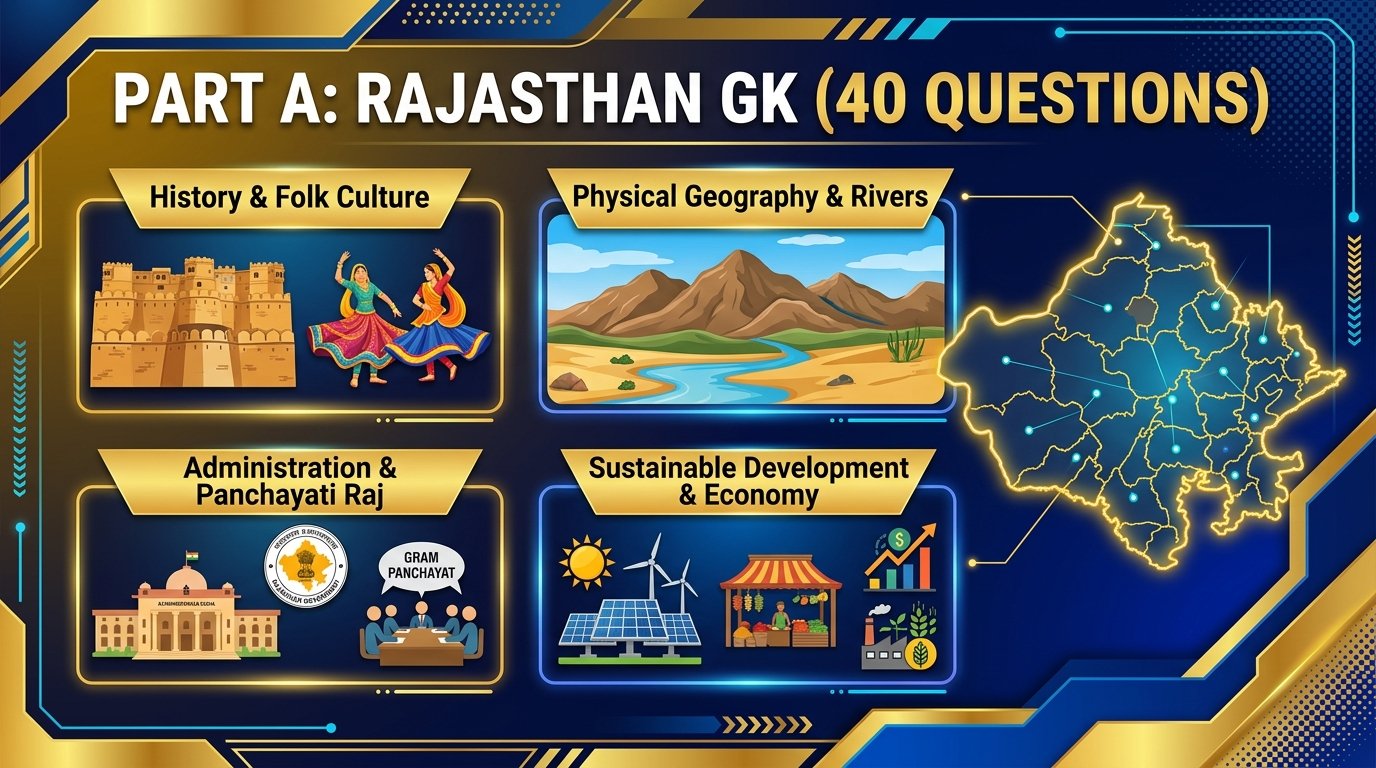
Rajasthan History & Culture (Q1 – Q10)
Q1. राजस्थान की लोक संस्कृति का महत्वपूर्ण हिस्सा कौन-सा है?
Q2. घूमर किससे संबंधित है?
Q3. राजस्थान के ऐतिहासिक किलों का महत्व मुख्यतः किस क्षेत्र में है?
Q4. राजस्थान की पारंपरिक जल-संरचना कौन-सी है?
Q5. राजस्थान की राजधानी कौन-सी है?
Q6. जयपुर को सामान्यतः किस नाम से जाना जाता है?
Q7. राजस्थान की हस्तशिल्प परंपरा किसका उदाहरण है?
Q8. राजस्थान के मेलों और त्योहारों का महत्व किससे जुड़ा है?
Q9. राजस्थान की सांस्कृतिक विविधता में क्या शामिल है?
Q10. राजस्थान की पारंपरिक वास्तुकला में किसका विशेष महत्व है?
Rajasthan Geography (Q11 – Q20)
Q11. राजस्थान का प्रमुख मरुस्थलीय क्षेत्र कौन-सा है?
Q12. अरावली पर्वतमाला किस राज्य के भूगोल का महत्वपूर्ण हिस्सा है?
Q13. राजस्थान के कई भागों में किस प्रकार की जलवायु पाई जाती है?
Q14. राजस्थान में जल संरक्षण का महत्व मुख्यतः किस कारण है?
Q15. निम्न में से कौन राजस्थान का प्राकृतिक संसाधन है?
Q16. राजस्थान में सौर ऊर्जा की अच्छी संभावना किस प्राकृतिक कारण से है?
Q17. राजस्थान में कृषि के लिए सिंचाई का मुख्य उद्देश्य क्या है?
Q18. राजस्थान की भौगोलिक विविधता में क्या शामिल हो सकता है?
Q19. मरुस्थलीय क्षेत्र की वनस्पति सामान्यतः किसके अनुकूल होती है?
Q20. राजस्थान में पारंपरिक जल संरक्षण संरचनाओं का मुख्य उद्देश्य क्या था?
Rajasthan Polity & Administration (Q21 – Q25)
Q21. राजस्थान की राज्य विधायिका कौन-सी है?
Q22. पंचायती राज व्यवस्था का उद्देश्य क्या है?
Q23. ग्राम पंचायत किस स्तर की संस्था है?
Q24. जिला प्रशासन में जिला कलेक्टर की भूमिका मुख्यतः किससे संबंधित है?
Q25. स्थानीय स्वशासन का प्रमुख लाभ क्या है?
Rajasthan Economy & Environment (Q26 – Q40)
Q26. राजस्थान की अर्थव्यवस्था में पर्यटन का योगदान किससे जुड़ा है?
Q27. राजस्थान में खनिज संसाधन किस क्षेत्र के लिए महत्वपूर्ण हैं?
Q28. ग्रामीण क्षेत्र में सड़क connectivity से क्या लाभ होता है?
Q29. Renewable energy का उदाहरण कौन-सा है?
Q30. राजस्थान में पशुपालन का महत्व किससे संबंधित है?
Q31. जैव विविधता संरक्षण का मुख्य उद्देश्य क्या है?
Q32. जल प्रदूषण कम करने का उचित तरीका कौन-सा है?
Q33. Sustainable development का अर्थ क्या है?
Q34. वन संरक्षण का प्रमुख लाभ क्या है?
Q35. जल संरक्षण का एक प्रभावी उपाय क्या है?
Q36. राजस्थान की ग्रामीण अर्थव्यवस्था में कौन-से क्षेत्र महत्वपूर्ण हैं?
Q37. राजस्थान में पर्यटन का एक महत्वपूर्ण आधार क्या है?
Q38. मरुस्थलीय क्षेत्रों में जल प्रबंधन क्यों महत्वपूर्ण है?
Q39. राजस्थान के प्राकृतिक संसाधनों का sustainable use क्यों आवश्यक है?
Q40. Rajasthan GK में अच्छी तैयारी के लिए क्या पढ़ना चाहिए?
PART B – CIVIL ENGINEERING CORE SUBJECTS
Questions 41–120 (80 Marks)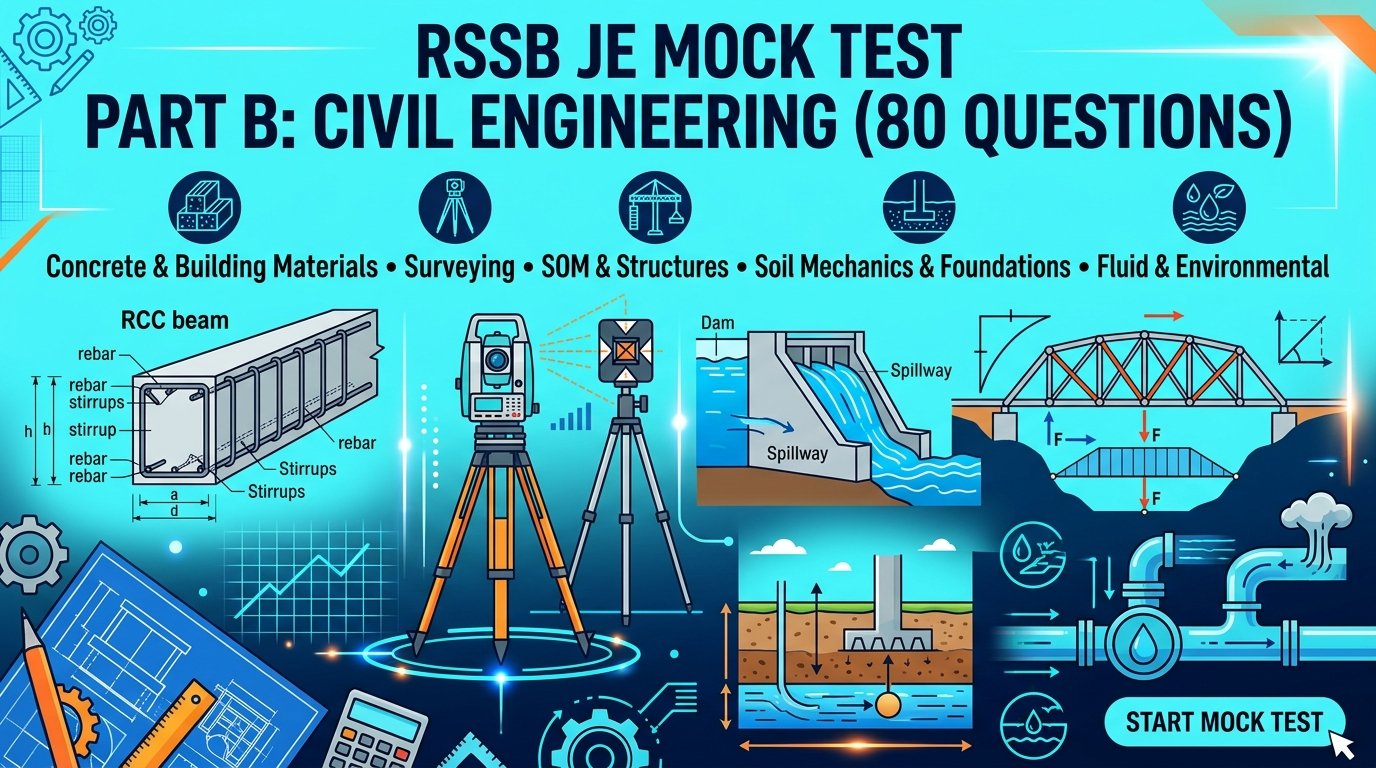
Surveying (Q41 – Q48)
Q41. Surveying में horizontal angle मापने के लिए कौन-सा instrument उपयोगी है?
Q42. Levelling का मुख्य उद्देश्य क्या है?
Q43. Contour line किसे जोड़ती है?
Q44. Benchmark में क्या ज्ञात होता है?
Q45. Chain surveying में मुख्य measurement क्या है?
Q46. Plane table surveying का प्रमुख लाभ क्या है?
Q47. Temporary benchmark का उपयोग किसके लिए किया जाता है?
Q48. Traversing में survey lines के लिए क्या निर्धारित किया जाता है?
Building Materials & Construction (Q49 – Q56)
Q49. Cement का मुख्य कार्य concrete में क्या है?
Q50. Fine aggregate का सामान्य उदाहरण क्या है?
Q51. Slump test किसके लिए किया जाता है?
Q52. Concrete curing के लिए क्या आवश्यक है?
Q53. Water-cement ratio का concrete strength पर क्या प्रभाव होता है?
Q54. Concrete में coarse aggregate का मुख्य कार्य क्या है?
Q55. Cement hydration किसके साथ reaction है?
Q56. Concrete का मुख्य advantage क्या है?
Strength of Materials (Q57 – Q64)
Q57. Stress का formula क्या है?
Q58. Strain क्या है?
Q59. Young's modulus का relation क्या है?
Q60. Bending moment की SI unit क्या है?
Q61. Shear force की unit क्या है?
Q62. Tensile load member में सामान्यतः क्या उत्पन्न करता है?
Q63. Torsion किससे संबंधित है?
Q64. Beam में bending के कारण मुख्यतः कौन-सा stress आता है?
Structural Engineering (Q65 – Q72)
Q65. RCC का पूरा नाम क्या है?
Q66. RCC में steel reinforcement मुख्यतः किसके लिए महत्वपूर्ण है?
Q67. Column में मुख्य load सामान्यतः कैसा होता है?
Q68. Footing का उद्देश्य क्या है?
Q69. Beam मुख्यतः किस action के लिए design की जाती है?
Q70. Slab load को सामान्यतः किस ओर transfer करती है?
Q71. Truss के ideal members में internal force सामान्यतः—
Q72. Structural analysis का उद्देश्य क्या है?
Soil Mechanics (Q73 – Q82)
Q73. Soil mechanics का संबंध किससे है?
Q74. Soil permeability क्या दर्शाती है?
Q75. Compaction का मुख्य उद्देश्य क्या है?
Q76. Consolidation में क्या होता है?
Q77. Bearing capacity किससे संबंधित है?
Q78. Atterberg limits मुख्यतः किस soil के लिए उपयोगी हैं?
Q79. Proctor test किसका निर्धारण करता है?
Q80. Soil compaction से सामान्यतः क्या बढ़ता है?
Q81. Foundation का selection मुख्यतः किस पर निर्भर करता है?
Q82. Retaining wall किस pressure को resist करती है?
Fluid Mechanics (Q83 – Q90)
Q83. Pressure की SI unit क्या है?
Q84. Continuity equation किस conservation principle पर आधारित है?
Q85. Bernoulli equation किससे संबंधित है?
Q86. Viscosity किसे दर्शाती है?
Q87. Reynolds number किसका संकेत देता है?
Q88. Venturimeter का उपयोग किसके लिए होता है?
Q89. Discharge की SI unit है—
Q90. Laminar flow में fluid particles का motion सामान्यतः—
Hydrology & Irrigation (Q91 – Q96)
Q91. Rainfall measurement के लिए कौन-सा instrument उपयोग होता है?
Q92. Evaporation का अर्थ क्या है?
Q93. Infiltration का अर्थ है—
Q94. Runoff किससे संबंधित है?
Q95. Irrigation का उद्देश्य क्या है?
Q96. Canal irrigation में canal का मुख्य काम क्या है?
Environmental Engineering (Q97 – Q103)
Q97. Water treatment का पहला महत्वपूर्ण उद्देश्य क्या है?
Q98. Sedimentation किस process से संबंधित है?
Q99. Filtration का मुख्य उद्देश्य क्या है?
Q100. Chlorination का मुख्य उद्देश्य क्या है?
Q101. BOD का संबंध किससे है?
Q102. Sewage treatment का उद्देश्य क्या है?
Q103. Solid waste management में segregation का अर्थ है—
Transportation Engineering (Q104 – Q109)
Q104. Flexible pavement में प्रमुख binding material क्या हो सकता है?
Q105. Camber क्यों दिया जाता है?
Q106. Highway geometric design में sight distance क्यों महत्वपूर्ण है?
Q107. Traffic volume का अर्थ क्या है?
Q108. Road pavement का subgrade क्या है?
Q109. Culvert किस purpose के लिए दिया जाता है?
Estimation & Construction Management (Q110 – Q120)
Q110. Estimation में quantity का अर्थ क्या है?
Q111. BOQ का full form है—
Q112. Rate analysis में क्या निकाला जाता है?
Q113. Construction scheduling का उद्देश्य क्या है?
Q114. CPM का full form क्या है?
Q115. Critical path का महत्व किससे जुड़ा है?
Q116. Construction safety में PPE का उद्देश्य क्या है?
Q117. Darcy's law किससे संबंधित है?
Q118. Concrete cube compression test किसके लिए उपयोगी है?
Q119. A benchmark in surveying provides—
Q120. Foundation का मुख्य कार्य है—
RSSB JE Civil Mock Test 2 – Answer Key
पूरा टेस्ट देने के बाद अपने उत्तरों की जांच नीचे दी गई तालिका से करें:
| Q.No | Ans | Q.No | Ans | Q.No | Ans | Q.No | Ans |
|---|---|---|---|---|---|---|---|
| 1 | A | 31 | A | 61 | A | 91 | A |
| 2 | B | 32 | A | 62 | A | 92 | A |
| 3 | C | 33 | A | 63 | A | 93 | A |
| 4 | A | 34 | A | 64 | A | 94 | A |
| 5 | A | 35 | A | 65 | A | 95 | A |
| 6 | B | 36 | C | 66 | A | 96 | A |
| 7 | A | 37 | A | 67 | A | 97 | A |
| 8 | A | 38 | A | 68 | A | 98 | A |
| 9 | D | 39 | A | 69 | A | 99 | A |
| 10 | A | 40 | D | 70 | A | 100 | A |
| 11 | A | 41 | A | 71 | A | 101 | A |
| 12 | A | 42 | A | 72 | A | 102 | A |
| 13 | A | 43 | A | 73 | A | 103 | A |
| 14 | A | 44 | A | 74 | A | 104 | A |
| 15 | D | 45 | A | 75 | A | 105 | A |
| 16 | A | 46 | A | 76 | A | 106 | A |
| 17 | A | 47 | A | 77 | A | 107 | A |
| 18 | D | 48 | A | 78 | A | 108 | A |
| 19 | A | 49 | A | 79 | A | 109 | A |
| 20 | A | 50 | A | 80 | A | 110 | A |
| 21 | A | 51 | A | 81 | A | 111 | A |
| 22 | A | 52 | A | 82 | A | 112 | A |
| 23 | A | 53 | A | 83 | A | 113 | A |
| 24 | A | 54 | A | 84 | A | 114 | A |
| 25 | A | 55 | A | 85 | A | 115 | A |
| 26 | A | 56 | A | 86 | A | 116 | A |
| 27 | A | 57 | A | 87 | A | 117 | A |
| 28 | A | 58 | A | 88 | A | 118 | A |
| 29 | A | 59 | A | 89 | A | 119 | A |
| 30 | A | 60 | A | 90 | A | 120 | A |
RSSB JE Civil Mock Test 2 – Score Calculation

Practice Score Formula:
उदाहरण: यदि आप 90 सही और 20 गलत करते हैं, तो आपका स्कोर 90 − 6.67 = 83.33 अंक होगा।
Performance Analysis & Topic Tracking
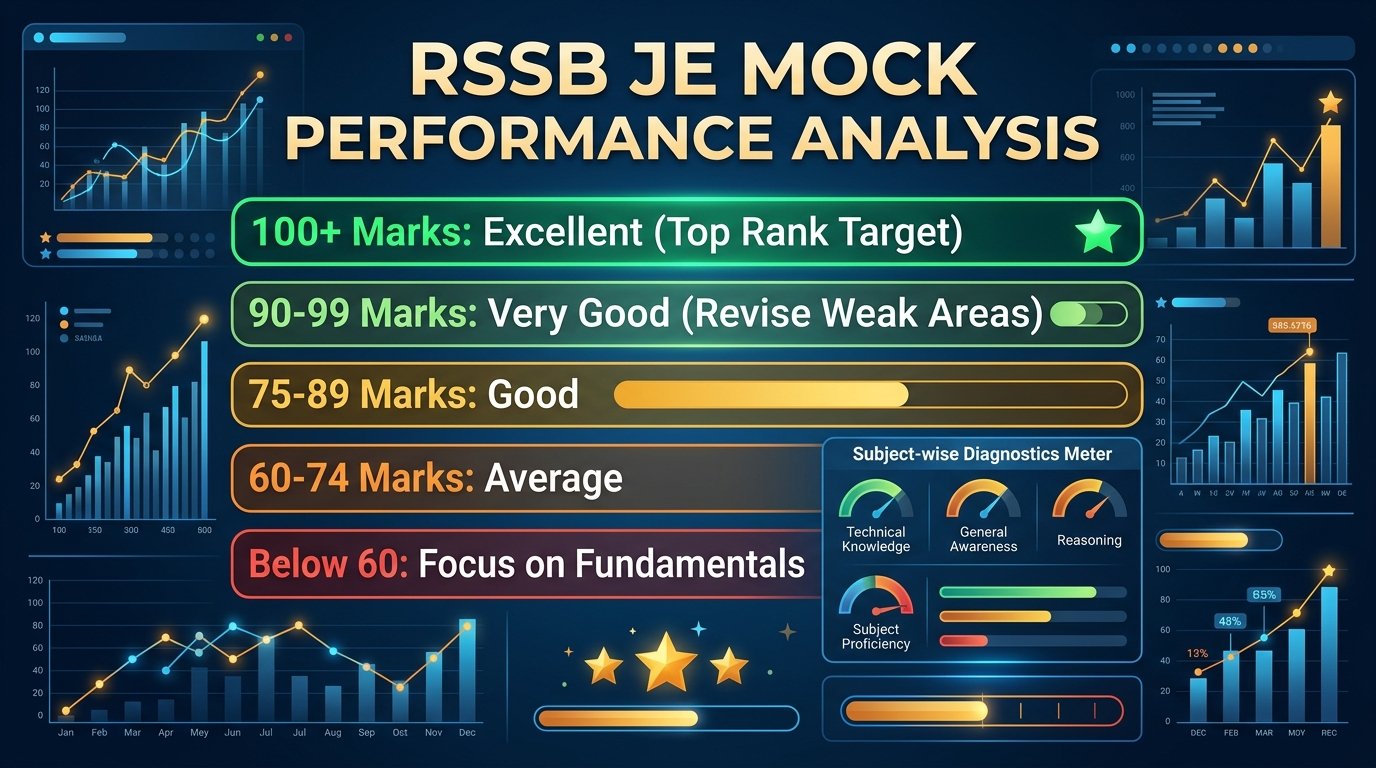
| Score Band | Performance | Next Action Plan |
|---|---|---|
| 100–120 Marks | Excellent | Top Rank Candidate. Maintain your consistency and focus on time-saving shortcuts. |
| 90–99 Marks | Very Good | Strong selection chance. Revise remaining minor technical topics to reach 100+. |
| 75–89 Marks | Good | Solid foundation. Eliminate negative-marking traps in Rajasthan GK and Surveying. |
| 60–74 Marks | Needs Improvement | Revise core formulas, standard IS codes, and dedicated daily Rajasthan GK facts. |
| Below 60 Marks | More Revision Required | Re-study fundamental engineering concepts from standard textbooks. |
Topic-Wise Question Categorization
Part A (Rajasthan GK):
- History & Culture: Q1 – Q10
- Geography: Q11 – Q20
- Polity & Administration: Q21 – Q25
- Economy & Awareness: Q26 – Q40
Part B (Civil Engineering):
- Surveying: Q41 – Q48
- Building Materials & Concrete: Q49 – Q56
- Strength of Materials: Q57 – Q64
- Structural Engineering: Q65 – Q72
- Soil Mechanics: Q73 – Q82
- Fluid Mechanics: Q83 – Q90
- Hydrology & Irrigation: Q91 – Q96
- Environmental Engineering: Q97 – Q103
- Transportation: Q104 – Q109
- Estimation & Management: Q110 – Q116
- Mixed Civil Engineering: Q117 – Q120
📚 RSSB JE Civil Preparation Resources
| Preparation Resource | Description | Action |
|---|---|---|
| RSSB JE Recruitment 2026 | 874 Vacancies in PWD, WRD, PHED, Eligibility, Salary & Online SSO Form | View Job Post |
| RSSB JE Civil Mock Test 1 | Full-Length Practice Test 1 (120 Questions) with Answer Key & Score Calculator | Mock Test 1 |
| RSSB JE Exam Pattern 2026 | 120-Mark Scheme, 1/3rd Negative Marking & 3-Round Paper Attempt Strategy | Exam Pattern |
| RSSB JE Syllabus 2026 | Subject-Wise Topic Breakdown for Rajasthan GK & Engineering Disciplines | View Syllabus |
| RSSB Previous Year Papers | Solved Previous Year Question Papers & Detailed Explanations | View PYQs |
Frequently Asked Questions (FAQs)
1. What is RSSB JE Civil Mock Test 2 2026?
यह IndianDreamJob का दूसरा Civil Engineering practice test है, जिसे RSSB JE Civil preparation के लिए बनाया गया है।
2. How many questions are in RSSB JE Civil Mock Test 2?
इस practice paper में कुल 120 MCQs हैं (40 Rajasthan GK + 80 Civil Engineering)।
3. What is the duration of RSSB JE Civil Mock Test 2?
इस full-length practice test को 2 hours (120 minutes) में attempt करने की सलाह दी जाती है।
4. Does RSSB JE Civil Mock Test 2 include Rajasthan GK?
हाँ। इसमें Rajasthan GK के 40 questions शामिल हैं।
5. How many Civil Engineering questions are included?
इस test में 80 Civil Engineering practice questions हैं।
6. Is RSSB JE Civil Mock Test 2 an official RSSB paper?
नहीं। यह IndianDreamJob द्वारा तैयार किया गया original practice material है।
7. Which Civil Engineering topics are covered?
Surveying, Building Materials, Concrete, Strength of Materials, Structural Engineering, Soil Mechanics, Fluid Mechanics, Hydrology, Environmental Engineering, Transportation और Construction Management जैसे topics शामिल हैं।
8. How should I attempt RSSB JE Civil Online Test?
Timer लगाकर 2 hours में पूरा paper attempt करें और answer key अंत में check करें।
9. How can I improve my RSSB JE Civil Mock Test score?
हर mock के बाद गलत questions को topic-wise classify करें और उसी topic की revision तथा numerical practice करें।
10. Where can I find the next RSSB JE Civil Mock Test?
Mock Test 3 को इसी RSSB JE Civil Test Series में अलग practice paper के रूप में publish किया जाएगा।
Source & Verification Disclaimer
Practice Notice: This full-length practice test 2 is independently created by the IndianDreamJob academic team for candidate practice and self-evaluation based on published RSSB JE examination standards.
Authority: Rajasthan Staff Selection Board (RSSB), Jaipur (rssb.rajasthan.gov.in).
Conclusion
RSSB JE Civil Mock Test 2 2026 को वास्तविक examination जैसी practice के लिए use करें। पहले पूरे 120 questions को निर्धारित समय में solve करें, फिर answer key से score निकालें और अपनी कमजोर topics की पहचान करें। लगातार RSSB JE Syllabus → Concept Revision → Topic-wise Questions → Full-Length Mock Test → Error Analysis → Revision का चक्र दोहराते रहें।