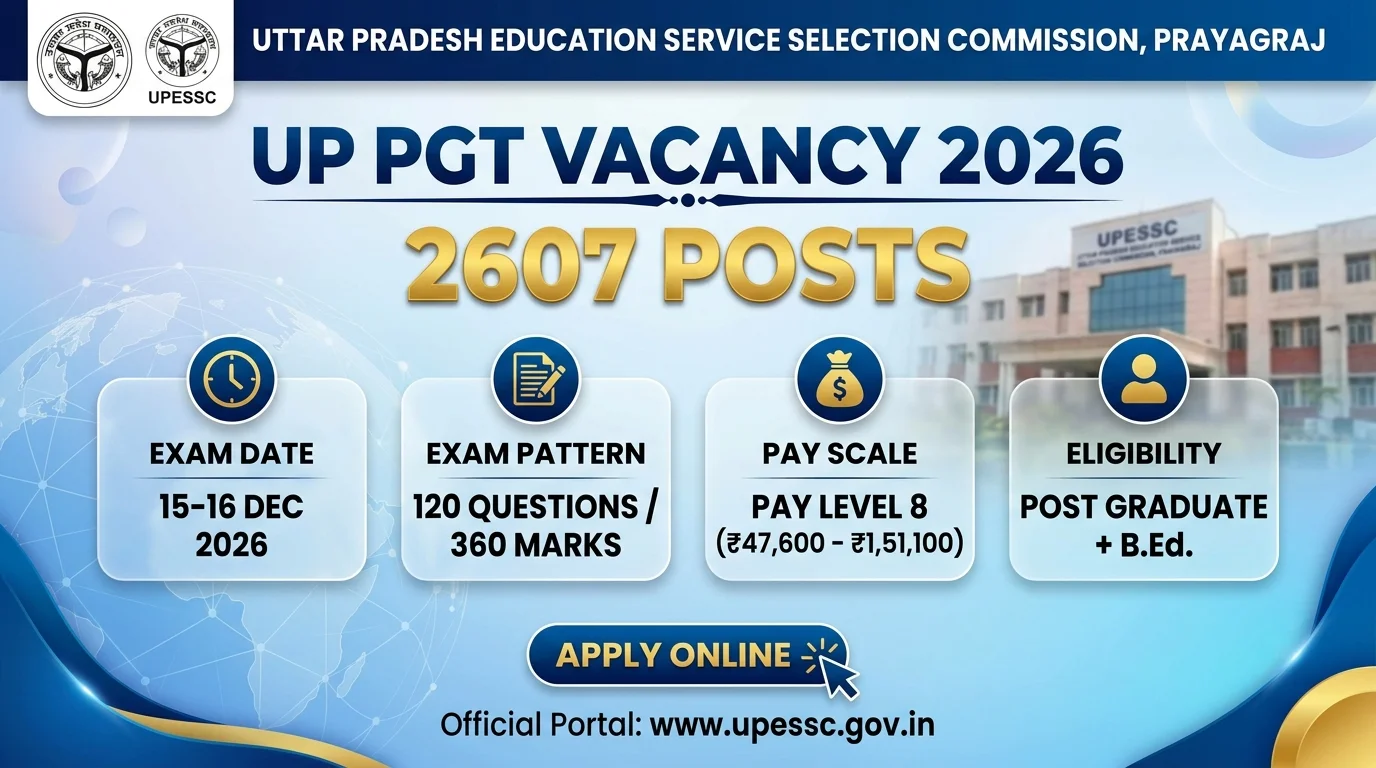
UP PGT Vacancy 2026 has been officially announced for 2,607 Post Graduate Teacher (PGT) posts in aided secondary schools of Uttar Pradesh. The Uttar Pradesh Education Service Selection Commission (UPESSC), Prayagraj has issued Advertisement No. 06/2026 for the PGT Selection Examination 2026.
According to the official notification, there are 2,329 vacancies in boys' schools and 278 vacancies in girls' schools, making a grand total of 2,607 PGT vacancies across 26 subjects. Online registration/application begins on 18 September 2026, the last date for fee payment is 17 October 2026, and form corrections can be made up to 21 October 2026. The written examination is scheduled for 15 and 16 December 2026.
UP PGT Notification PDF 2026
Download official UPESSC recruitment notification PDF containing subject-wise vacancies, rules & eligibility.
UP PGT Civics 2021 Previous Year Paper
Complete 125 question paper with political thought & political science solutions for exam preparation.
The notification confirms that applications are to be submitted online through the official UPESSC portal (www.upessc.up.gov.in) and One Time Registration (OTR) is mandatory before applying.
UP PGT Vacancy 2026 – Overview
| Recruitment Name | UP PGT Recruitment 2026 |
|---|---|
| Post Name | Post Graduate Teacher (PGT) / प्रवक्ता |
| Conducting Authority | Uttar Pradesh Education Service Selection Commission (UPESSC), Prayagraj |
| Advertisement No. | Advt. No. 06/2026 |
| Total Vacancies | 2,607 Posts |
| Boys' Schools Vacancies | 2,329 Posts |
| Girls' Schools Vacancies | 278 Posts |
| Job Location | Uttar Pradesh |
| Minimum Age Limit | 21 years (as on 01 July 2026) |
| Pay Scale | Level 8: ₹47,600 – ₹1,51,100 |
| Application Mode | Online (OTR Mandatory) |
| Online Registration Starts | 18 September 2026 |
| Fee Payment Last Date | 17 October 2026 |
| Application Correction Deadline | 21 October 2026 |
| Written Exam Date | 15 & 16 December 2026 |
| Selection Process | Written Exam (360 Marks) + Interview (40 Marks) = Total 400 Marks |
| Official Portal | www.upessc.up.gov.in |
UP PGT 2026 Important Dates
Candidates planning to appear for UP PGT 2026 recruitment should keep track of the following timeline as released in Advertisement No. 06/2026:
| Event / Activity | Official Date |
|---|---|
| Official Notification Publication Date | 15 September 2026 |
| Online Application Registration & OTR Begins | 18 September 2026 |
| Last Date to Pay Application Fee | 17 October 2026 |
| Last Date for Application Form Correction | 21 October 2026 |
| UP PGT Written Exam Date 2026 | 15 & 16 December 2026 |
UP PGT Vacancy 2026 – 2,607 Posts
The biggest highlight of this new recruitment cycle is the notification of 2,607 Post Graduate Teacher vacancies across government-aided secondary institutions in Uttar Pradesh. The Commission has divided the total vacancies into two cadres:
- Boys' Secondary Schools (बालक वर्ग): 2,329 Posts
- Girls' Secondary Schools (बालिका वर्ग): 278 Posts
- Total Combined PGT Vacancies: 2,607 Posts
Note: As per UPESSC rules, the total number of vacancies may increase or decrease based on revised institutional requirements before final selection.
UP PGT Subject-Wise Vacancy 2026 (26 Subjects)
The official recruitment table covers 26 different academic and vocational subjects. Below is the comprehensive subject-wise breakdown of vacancies:

| S.No. | Subject Name (विषय) | Total Vacancies |
|---|---|---|
| 1 | Hindi (हिंदी) | 374 |
| 2 | English (अंग्रेजी) | 285 |
| 3 | Sanskrit (संस्कृत) | 264 |
| 4 | Geography (भूगोल) | 248 |
| 5 | Economics (अर्थशास्त्र) | 202 |
| 6 | Chemistry (रसायन विज्ञान) | 185 |
| 7 | Physics (भौतिक विज्ञान) | 132 |
| 8 | Civics (नागरिक शास्त्र) | 132 |
| 9 | Biology (जीव विज्ञान) | 130 |
| 10 | Mathematics (गणित) | 112 |
| 11 | History (इतिहास) | 112 |
| 12 | Sociology (समाजशास्त्र) | 84 |
| 13 | Drawing / Painting (चित्रकला) | 69 |
| 14 | Commerce (वाणिज्य) | 63 |
| 15 | Psychology (मनोविज्ञान) | 50 |
| 16 | Education (शिक्षा शास्त्र) | 40 |
| 17 | Agriculture (कृषि) | 32 |
| 18 | Physical Education (शारीरिक शिक्षा) | 21 |
| 19 | Urdu (उर्दू) | 13 |
| 20 | Home Science (गृह विज्ञान) | 12 |
| 21 | Military Science (सैन्य विज्ञान) | 12 |
| 22 | Logic (तर्कशास्त्र) | 12 |
| 23 | Instrumental Music (संगीत वादन) | 11 |
| 24 | Vocal Music (संगीत गायन) | 6 |
| 25 | Agronomy (सस्य विज्ञान) | 4 |
| 26 | Art (कला) | 2 |
| Grand Total Vacancies Across 26 Subjects | 2,607 Posts | |
The highest vacancy allocations include Hindi (374), English (285), Sanskrit (264), Geography (248), Economics (202), and Chemistry (185). Candidates should refer to the official notification PDF for category-wise reservation breakdowns (General / SC / ST / OBC / EWS) and school type (Boys/Girls) distribution.
UP PGT Eligibility Criteria 2026
Educational qualifications for UP PGT vary according to the specific subject applied for. Candidates must ensure they meet the specific academic and training requirements set forth in Advertisement No. 06/2026.
General Academic & Professional Standard:
For mainstream academic subjects (e.g. Hindi, English, Economics, Sociology, Physics, Chemistry, Mathematics, History, Sanskrit, Geography), candidates must hold a Master's Degree (Post-Graduation) in the relevant discipline from a recognized University, along with a B.Ed. degree from an NCTE-recognized institution.
UP PGT Age Limit 2026
As prescribed in official Advertisement No. 06/2026:
- Minimum Age: 21 Years as on 01 July 2026.
- Maximum Age / Superannuation: 62 Years.
Relaxation in upper age limit for reserved categories (SC/ST/OBC/Ex-Servicemen/PwD) applies in accordance with current Uttar Pradesh State Government rules.
UP PGT Salary 2026
Appointed Post Graduate Teachers in UP Aided Secondary Schools will receive pay under Pay Level 8 of the 7th Central Pay Commission (CPC):
₹47,600 – ₹1,51,100 (Grade Pay ₹4,800)
UP PGT Application Fee 2026
The application and examination fee prescribed in official Advertisement No. 06/2026 is categorized as follows:
| Category | Application & Exam Fee |
|---|---|
| General / Unreserved (UR) | ₹1,500/- |
| Other Backward Classes (OBC) | ₹1,500/- |
| Economically Weaker Sections (EWS) | ₹1,500/- |
| Scheduled Castes (SC) | ₹750/- |
| Scheduled Tribes (ST) | ₹750/- |
| Persons with Disabilities (PwD) | ₹500/- |
Payment must be completed online via net banking, debit card, credit card, or UPI through the UPESSC payment gateway.
UP PGT Exam Pattern & Selection Blueprint 2026
Candidates should take careful note of the updated examination blueprint under Advertisement 06/2026, as older formats published online may no longer apply.

| Stage / Component | Questions | Total Marks | Weightage |
|---|---|---|---|
| Written Exam (Concerned Subject) | 90 Questions | 270 Marks | 75% of Written |
| Written Exam (General Knowledge) | 30 Questions | 90 Marks | 25% of Written |
| Total Written Examination | 120 MCQs | 360 Marks | 90% of Final Selection |
| Interview Stage | Personal Interview | 40 Marks | 10% of Final Selection |
| Grand Total Selection Score | 120 Questions + Interview | 400 Marks | 100% Total |
Marking Scheme & Negative Marking Rules:
- Total Duration: 2 Hours (120 Minutes).
- Marks per Correct Answer: +3 Marks.
- Negative Marking: -1 Mark deducted for each incorrect answer or multiple choices filled.
UP PGT Selection Process 2026
The selection process comprises three sequential stages:
- Written Examination (360 Marks): 120 objective questions testing Subject Knowledge (90 Qs) and General Knowledge (30 Qs).
- Interview Stage (40 Marks): Shortlisted candidates based on written marks appear for personal interview and domain assessment.
- Final Merit List & Document Verification: Prepared on the aggregate score out of 400 marks. Official tie-breaking rules apply if candidates score equal marks.
UP PGT Written Exam Syllabus 2026
The written paper consists of two distinct modules:
Module 1: Concerned Subject (90 Questions / 270 Marks)
Covers deep post-graduate level core concepts in the chosen discipline (e.g., Civics: Political Theory, Indian Government & Politics, Comparative Politics, International Relations; Physics: Mechanics, Electromagnetism, Quantum Mechanics; Hindi: Sahitya Ka Itihas, Bhasha Vigyan, Kavyashastra). Devote 75% of total study time here.
Module 2: General Knowledge (30 Questions / 90 Marks)
Includes Indian History, Polity, Geography, Indian Economy, General Science, Uttar Pradesh State GK & Current Affairs.
UP PGT Previous Year Question Papers (Civics 2021 PDF)
Practicing previous-year question papers is vital for understanding question patterns, difficulty depth, and time management. We have made available the official UP PGT Civics 2021 Previous Year Paper containing 125 questions in English and Hindi.

| Previous Question Paper Name | Year | Language | Download Action |
|---|---|---|---|
| UP PGT Civics Official Question Paper | 2021 | Hindi & English | Download PDF |
| UP PGT Notification PDF (Advt 06/2026) | 2026 | Hindi & English | Download PDF |
UP PGT Civics 2021 Official Question Paper Answer Key (125 MCQs)
Below is the complete 125-question Answer Key with verified correct options and detailed explanations for the UP PGT Civics 2021 Selection Examination (PG-01/A):
| Q.No. | Question Text / Concept | Official Correct Option | Explanation / Reference |
|---|---|---|---|
| #1 | Not written by a contractualist thinker? | (C) On liberty | J.S. Mill wrote 'On Liberty' (Utilitarianism). Hobbes, Locke, and Rousseau wrote contractualist works. |
| #2 | 'A decision in its simplest form is a selection of alternatives' statement by? | (D) Ray A. Killians | Ray A. Killians defined decision making as selection among alternatives. |
| #3 | Adhikarans in Kautilya's 'Arthashastra' are? | (B) Fifteen | Kautilya's Arthashastra is divided into 15 Adhikaranas (Books) and 150 Adhyayas (Chapters). |
| #4 | Objective not embodied in the Preamble of India? | (B) Economic liberty | Preamble guarantees Economic Justice, NOT Economic Liberty. |
| #5 | Marxists hold that the State is: | (A) The State is a class-structure | Marxism defines State as an instrument of class domination and class oppression. |
| #6 | Who was NOT an extremist leader? | (D) Gopal Krishna Gokhale | Gopal Krishna Gokhale was a Moderate. Tilak, Rai, and Pal (Lal-Bal-Pal) were Extremists. |
| #7 | Triumph of liberal democracy described as 'end of history' by? | (C) Francis Fukuyama | Francis Fukuyama wrote 'The End of History and the Last Man' (1992). |
| #8 | Bitterest critic of Austin's theory of sovereignty? | (A) Sir Henry Maine | Sir Henry Maine criticized Austin from the Historical Jurisprudence perspective. |
| #9 | Match List-I with List-II (Morgenthau, Cohen, Kaplan, Berd)? | (D) ii, iii, i, iv | Morton Kaplan = Systems Theory; Morgenthau = Realism; Bernard Cohen = Decision Making. |
| #10 | First Lokpal bill introduced in Indian Parliament in? | (A) 1968 | First Lokpal Bill was introduced in 4th Lok Sabha in May 1968 by Shanti Bhushan. |
| #11 | Incorrectly matched pair of theory of origin of State? | (C) Patriarchal – McLennan | Sir Henry Maine advocated Patriarchal Theory; McLennan advocated Matriarchal Theory. |
| #12 | Decade declared by UN as 'Decade for Women'? | (A) 1976 - 1985 | United Nations declared 1976-1985 as the UN Decade for Women. |
| #13 | 'Be educated, be agitated, be organised' slogan by? | (D) B. R. Ambedkar | Historic call to action given by Dr. B.R. Ambedkar for social emancipation. |
| #14 | Incorrectly matched Author - Book pair? | (D) Lipset – Wealth of Nations | 'Wealth of Nations' (1776) was written by Adam Smith, NOT Seymour Martin Lipset. |
| #15 | Public corporation is accountable to? | (D) Parliament | Public corporations are autonomous statutory bodies accountable to Parliament. |
| #16 | Match Leaders & Books (Gandhi, Ambedkar, Golwalkar, Savarkar)? | (B) 2, 3, 1, 4 | Gandhi = Hind Swaraj; Ambedkar = Annihilation of Caste; Golwalkar = Bunch of Thoughts; Savarkar = Hindutva. |
| #17 | Order of UN Secretary Generals (U Thant, Waldheim, Lie, Hammarskjold)? | (C) iii, iv, i, ii | Trygve Lie (1st) -> Dag Hammarskjold (2nd) -> U Thant (3rd) -> Kurt Waldheim (4th). |
| #18 | 'Consent Model' of authority conceived by? | (D) Bernard | Chester Barnard formulated the Acceptance/Consent Theory of Authority. |
| #19 | 'War is to man what maternity is to woman' said by? | (A) Mussolini | Benito Mussolini stated this in his essay 'The Doctrine of Fascism'. |
| #20 | 73rd Amendment passed during Primeministership of? | (C) P. V. Narasimha Rao | 73rd Constitutional Amendment Act 1992 was passed under P.V. Narasimha Rao. |
| #21 | 'State is an ethical institution for moral development' held by? | (B) Idealists | Idealist thinkers (Hegel, Kant, T.H. Green) view State as a moral institution. |
| #22 | NOT a device for maintaining balance of power? | (D) Non-intervention | Balance of power devices include Alliances, Armaments, Buffer States, Compensation. |
| #23 | 'Over himself, over his mind and body, individual is supreme' in? | (A) On Liberty | John Stuart Mill wrote this in Chapter 1 of 'On Liberty' (1859). |
| #24 | 'Politics Among Nations' written by? | (A) H. J. Morgenthau | Hans J. Morgenthau published 'Politics Among Nations: The Struggle for Power and Peace' (1948). |
| #25 | NOT included in Kautilya's four fundamental Vidyas? | (C) Nirukta | Kautilya's 4 Vidyas: Anvikshiki, Trayi, Varta, Dandaniti. |
| #26 | Principle of proportionate equality first enunciated by? | (A) Aristotle | Aristotle formulated proportionate equality in 'Politics'. |
| #27 | Schedule amended to create a new State in Indian Union? | (A) First schedule | First Schedule lists names and territorial jurisdictions of States and UTs. |
| #28 | General control over district police for law & order exercised by? | (A) The District Collector/Magistrate | Under Section 4 of Police Act 1861, District Magistrate exercises general control over police. |
| #29 | Presidential system of Government is based on? | (C) Separation of powers between three organs | Presidential system follows strict separation of powers (Executive, Legislature, Judiciary). |
| #30 | 'This constitution may be called the Constitution of India' in Article? | (C) Article 393 | Article 393 provides the Short Title of the Indian Constitution. |
| #31 | Liberty and equality are complementary held by? | (C) R. H. Tawney | R.H. Tawney argued in 'Equality' (1931) that liberty and equality are complementary. |
| #32 | District and sessions judge works directly under control of? | (B) High Court of the State | Article 235 vests control over subordinate courts in the High Court. |
| #33 | Exponent of modern individualism? | (D) Graham Wallas | Graham Wallas emphasized psychological/social factors in modern individualism. |
| #34 | 'Greece had democracy without unity, Rome unity without democracy'? | (D) Gettell | R.G. Gettell stated this in 'History of Political Thought'. |
| #35 | Modern civilization called a 'Nine days wonder' by? | (C) Gandhi | Mahatma Gandhi criticized modern industrial civilization in 'Hind Swaraj' (1909). |
| #36 | United Nations Charter is mainly devoted to? | (C) Wide range of subjects including peace, justice & social rights | UN Charter covers international peace, security, social and economic development. |
| #37 | Jai Prakash Narayan preached the concept of? | (B) Total Revolution | JP Narayan launched Total Revolution (Sampoorna Kranti) in 1974. |
| #38 | NOT a characteristic of parliamentary government? | (D) Complete separation of executive from legislature | Parliamentary system features fusion of powers, not separation. |
| #39 | Example of auxiliary agency in Govt of India? | (C) Central Public Works Department (CPWD) | CPWD is an auxiliary agency performing housekeeping/house-servicing functions. |
| #40 | 'History of all hitherto existing societies is history of class struggle' in? | (B) Communist Manifesto | Opening line of Section 1 of 'The Communist Manifesto' (1848). |
| #41 | Doctrine of Judicial Review originated in? | (A) United States of America | Established by US Supreme Court in Marbury v. Madison (1803). |
| #42 | A rigid constitution is that which: | (C) Is amended by a method different from ordinary law-making | Rigid constitution requires special procedure for amendment. |
| #43 | Law defined as 'Reason free from all passion' by? | (A) Aristotle | Aristotle defined law as 'reason unaffected by desire' in Politics. |
| #44 | Match Socialism types (Utopian, Fabian, Scientific, Guild)? | (A) a-iv, b-iii, c-i, d-ii | Utopian = Saint Simon; Fabian = Sydney Webb; Scientific = Karl Marx; Guild = G.D.H. Cole. |
| #45 | Office of 'Governor General of India' first provided by? | (B) Charter Act, 1833 | Charter Act 1833 redesignated Governor General of Bengal as Governor General of India. |
| #46 | Match International Treaties (FMCT, Montreal, TRIPS, WSF)? | (A) iii, i, ii, iv | FMCT = Non-proliferation; Montreal = Climate/Ozone; TRIPS = World Trade; WSF = Global social movements. |
| #47 | Incorrectly matched pair? | (B) M. A. Jinnah – Khilafat Movement | M.A. Jinnah opposed mixing religion with politics in Khilafat Movement. |
| #48 | 'Public Corporation' type of administration seeks to achieve? | (D) Mixing of public accountability with business efficiency | Herbert Morrison defined public corporation as combining public accountability with business efficiency. |
| #49 | Austin explained theory of sovereignty in book? | (D) Lectures on Jurisprudence | John Austin published 'Lectures on Jurisprudence' in 1832. |
| #50 | 'Uniting for Peace Resolution' enhanced power of? | (A) General Assembly | UN General Assembly Resolution 377A (1950) empowered GA when Security Council deadlocked. |
| #51 | Method NOT adopted by pressure groups? | (D) Contesting elections | Pressure groups do not contest elections directly; political parties do. |
| #52 | Advanced 'Dependency Theory' of underdevelopment? | (B) Gundar Frank | Andre Gunder Frank developed Dependency Theory (Metropolis-Periphery model). |
| #53 | 'State of nature is a state of peace, goodwill and mutual assistance'? | (C) Locke | John Locke described state of nature as peaceful in 'Second Treatise'. |
| #54 | NOT correct about a Cantonment Board? | (A) It is created by an executive resolution | Cantonment Boards are statutory bodies created under Cantonments Act 2006. |
| #55 | NOT a supporter of pluralist theory of sovereignty? | (C) Bodin | Jean Bodin supported absolute monistic sovereignty. |
| #56 | Bill requiring special majority in each House separately? | (A) Constitution Amendment Bill | Under Article 368, Constitution Amendment Bills require special majority in each house. |
| #57 | NOT a member country of BIMSTEC? | (D) Spain | BIMSTEC members: Bangladesh, Bhutan, India, Myanmar, Nepal, Sri Lanka, Thailand. Spain is European. |
| #58 | UPSC Chairman and members hold office for term of? | (D) Six years | Article 316 specifies 6 years or until age 65. |
| #59 | Propagated idea of cultural revolution under socialism? | (B) Mao-Tse-Tung | Mao Zedong launched Cultural Revolution in China (1966-1976). |
| #60 | President of US during Cuban Missile crisis 1962? | (B) J. F. Kennedy | John F. Kennedy was US President during October 1962 missile crisis. |
| #61 | According to Hobbes state of nature is? | (C) Both pre political and pre social | Hobbesian state of nature lacks both society and political government. |
| #62 | 'Hare System' refers to? | (A) Single transferable vote system | Thomas Hare devised Proportional Representation by Single Transferable Vote. |
| #63 | Theory of 'Power Elite' formulated by? | (B) C. Wright Mills | C. Wright Mills published 'The Power Elite' (1956). |
| #64 | 'Public corporation not essentially different from department' view of? | (A) Ralf Assheton | Ralf Assheton expressed this view before UK Parliamentary Select Committee. |
| #65 | Joint sitting of Indian Parliament presided over by? | (D) The Speaker of the Lok Sabha | Article 118(4) empowers Speaker of Lok Sabha to preside over joint sittings. |
| #66 | Pluralists give primary importance to? | (B) Groups and associations | Pluralism views society as a web of autonomous groups and associations. |
| #67 | Term 'City-State' generally associated with? | (C) Ancient Greece | Ancient Greek Polis (Athens, Sparta) are classic City-States. |
| #68 | Only feature for which Marx praised bureaucracy? | (A) Rationality | Marx recognized bureaucracy's formal technical rationality while critiquing its class role. |
| #69 | NOT a tool of legislative control over administration? | (A) Delegated legislation | Delegated legislation transfers rulemaking power to executive, reducing legislative control. |
| #70 | 'Unitary state with subsidiary federal features' by? | (A) K. C. Wheare | K.C. Wheare described Indian Constitution as 'Quasi-Federal'. |
| #71 | Do NOT consider Political Science as a science? | (D) F. W. Maitland | F.W. Maitland famously questioned whether politics can be termed a science. |
| #72 | NOT an idealist thinker? | (D) Bentham | Jeremy Bentham was a Utilitarian philosopher, not an Idealist. |
| #73 | NOT related to Cold War? | (D) None of the above | Fulton Speech, Truman Doctrine, and Marshall Plan are all seminal Cold War events. |
| #74 | 'Detente' between USA and USSR implies? | (B) De-escalation of tension between the two | Detente refers to relaxation of strained geopolitical relations in the 1970s. |
| #75 | Ram Manohar Lohia was a supporter of? | (A) Decentralised socialism | Lohia advocated Four-Pillar State (Chaukhamba Raj) and decentralized socialism. |
| #76 | Agency having monopoly of execution in public administration? | (A) Line Agency | Line agencies directly execute core organizational goals and policy decisions. |
| #77 | Power of Judicial Review is vested in? | (D) Both Supreme Court and High Courts | Supreme Court under Art 32 and High Courts under Art 226 exercise judicial review. |
| #78 | 'Laws are body of rules for regulation of social conduct' by? | (C) Duigvit | Leon Duguit defined law based on social solidarity. |
| #79 | 'Political Science is historical investigation, analytical study & ethical discussion'? | (A) Gettell | Raymond G. Gettell defined political science scope in three dimensions. |
| #80 | NOT a Fundamental Duty under Constitution of India? | (A) To vote in public elections | Voting in elections is a legal right, not a Fundamental Duty under Art 51A. |
| #81 | Liberty and equality are antithetical to each other held by? | (A) Lord Acton | Lord Acton stated: 'The passion for equality made vain the hope of freedom'. |
| #82 | Book NOT written by Henri Fayol? | (C) The theory of social and economic organization | Written by Max Weber (translated by Talcott Parsons). |
| #83 | Incorrectly matched Author - Book pair? | (C) Josef Stalin: Wage, Labour and Capital | 'Wage Labour and Capital' (1849) was written by Karl Marx. |
| #84 | Considers National Interest as decisive element of world politics? | (A) Morgenthau | Hans Morgenthau defined international politics in terms of national interest defined as power. |
| #85 | Highest law officer of Govt of India? | (C) The Attorney General of India | Article 76 designates Attorney General of India as highest law officer. |
| #86 | Associated with Gandhi's philosophy (Trusteeship, Nai Talim, Hijrat, Sarvodaya)? | (D) 1, 2, 3 and 4 | All 4 concepts (Trusteeship, Basic Education, Nonviolent Resistance/Emigration, Welfare of All) are Gandhian. |
| #87 | Provision for Election Commission of India under Article? | (A) 324 | Article 324 provides for superintendence, direction, and control of elections. |
| #88 | Writ literally meaning 'We Command'? | (B) Mandamus | Mandamus is a Latin word meaning 'We Command'. |
| #89 | Doctrine of 'Laissez Faire' influenced by? | (B) Negative concept of liberty | Laissez-faire (non-interference) aligns with negative liberty (absence of restraint). |
| #90 | Year India invited Frank Krause for performance budgeting? | (D) 1968 | Frank Krause examined performance budgeting implementation in 1968. |
| #91 | Did NOT regard fixed territory as essential aspect of state? | (C) John Seeley | Sir John Seeley argued that fixed territory is not indispensable for a State. |
| #92 | Year India & Pakistan became full members of SCO? | (D) 2017 | Admitted as full members at Astana Summit on June 9, 2017. |
| #93 | Wrongly matched institution location? | (C) Railway Staff College – Ahmedabad | National Academy of Indian Railways (Railway Staff College) is in Vadodara, Gujarat. |
| #94 | Empowered to suspend operation of Fundamental Rights? | (C) President | President under Article 359 can suspend enforcement of Fundamental Rights during Emergency. |
| #95 | Advocated two factor theory of motivation? | (C) Herzberg | Frederick Herzberg proposed Motivator-Hygiene Theory (1959). |
| #96 | Match Scholars with Tradition (Burke, Nozick, Bentham, MacIntyre)? | (D) iii, ii, iv, i | Burke = Conservatism; Nozick = Libertarianism; Bentham = Utilitarianism; MacIntyre = Communitarianism. |
| #97 | According to Kaplan, balance of power system transforms into? | (C) Bipolar system | Morton Kaplan's 6 models predict balance of power degrades into Loose Bipolar System. |
| #98 | 'Republic is finest treatise on education ever written' by? | (D) Rousseau | Rousseau wrote in 'Emile' that Plato's Republic is the finest treatise on education. |
| #99 | When annual Union Budget is not passed by Lok Sabha? | (D) PM submits resignation of Council of Ministers | Budget failure signifies loss of majority confidence, forcing government resignation. |
| #100 | Constitutes essence of Good Governance? | (D) Transparent and accountable administration | World Bank defines Good Governance by transparency, accountability, and efficiency. |
| #101 | Regard language as most important factor in nationalism? | (D) All of these | Mazzini, Fichte, and Ramsay Muir all stressed linguistic unity for national consciousness. |
| #102 | Incorrectly matched pair? | (B) New Humanism – Aurobindo Ghosh | New Humanism / Radical Humanism was propounded by M. N. Roy. |
| #103 | Parliament of which country called 'Mother of Parliaments'? | (A) Britain | John Bright coined 'Mother of Parliaments' for British Westminster Parliament. |
| #104 | Propounded trait approach of leadership? | (A) R. M. Stogdill | Ralph M. Stogdill conducted major leadership trait studies (1948, 1974). |
| #105 | 'Politics so far from being a science is most backward of arts' by? | (B) Buckle | Henry Thomas Buckle stated this in 'History of Civilization in England'. |
| #106 | Right to Equality granted by Articles? | (B) Article 14 to 18 | Articles 14 to 18 of Part III of Indian Constitution. |
| #107 | Match Organization Scope (Global/Regional, General/Limited)? | (A) ii, i, iv, iii | Global General = UN; Regional General = EU; Regional Limited = NATO; Global Limited = ILO. |
| #108 | UN Secretary General who submitted 'An Agenda for Peace' (1992)? | (B) Boutros Boutros-Ghali | Boutros Boutros-Ghali presented report in June 1992. |
| #109 | Regarded as Father of International Law? | (B) Hugo Grotius | Hugo Grotius published 'De Jure Belli ac Pacis' (1625). |
| #110 | 'Politics is that part of social science treating State & Government' by? | (C) Paul Janet | Paul Janet defined political science in 'Histoire de la Science Politique'. |
| #111 | 'State comes into existence for bare needs, continues for good life' by? | (D) Aristotle | Famous quote from Book I of Aristotle's 'Politics'. |
| #112 | Governor can issue an ordinance when? | (C) State Legislature not in session & immediate action needed | Under Article 213 of the Indian Constitution. |
| #113 | Hoover Commission recommended organization based on? | (B) Process | First Hoover Commission (1949) emphasized process and major purpose. |
| #114 | Country NOT a member of CENTO? | (A) USA | CENTO members: Iran, Iraq, Pakistan, Turkey, UK. USA was an observer. |
| #115 | President of India addresses resignation letter to? | (B) The Vice President | Article 56(1)(a) requires President to address resignation to Vice President. |
| #116 | Collective security system does NOT permit? | (C) Both (A) and (B) | Collective security forbids unilateral armaments race and permanent neutrality. |
| #117 | 'The God who gave us life gave us liberty at same time' by? | (C) Jefferson | Thomas Jefferson wrote this in 'Summary View of Rights of British America' (1774). |
| #118 | Finance bill introduced in Legislative Assembly on recommendation of? | (B) Governor | Article 207 requires Governor's recommendation for Money/Finance Bills in State Assembly. |
| #119 | UN organ responsible for international peace & security? | (B) Security Council | Article 24 of UN Charter confers primary responsibility on Security Council. |
| #120 | Supreme Court of India consists of CJI and how many judges? | (B) 33 | Supreme Court (Number of Judges) Amendment Act 2019 increased strength to 33 + CJI = 34. |
| #121 | Article empowering Supreme Court to review its own judgement? | (C) Article 137 | Article 137 provides Supreme Court power to review its judgments. |
| #122 | Under list system, each voter: | (D) Can indicate preference for candidates in the list for which he votes | List system allows voting for party list with candidate preference options. |
| #123 | Secularism described as 'equal protection to all religions' by? | (A) Mahatma Gandhi | Gandhian concept of 'Sarva Dharma Sambhava'. |
| #124 | Plato gave concept of mixed constitution in book? | (B) The Laws | Plato formulated mixed constitution in 'The Laws' (Book VI). |
| #125 | DPSPs called 'a cheque on a bank payable at convenience of bank' by? | (D) K. T. Shah | Prof. K.T. Shah made this statement during Constituent Assembly debates. |
How to Apply Online for UP PGT Recruitment 2026
- Visit the official UPESSC portal at www.upessc.up.gov.in.
- Complete One Time Registration (OTR) if not already registered on the UPESSC platform.
- Locate Advertisement No. 06/2026 (PGT Selection Exam 2026) under the active recruitment section.
- Select your subject (e.g. Civics, Hindi, Physics, Geography) and choose the appropriate cadre (Boys' / Girls' School).
- Fill out the online application form carefully and upload mandatory documents (Photo in JPG/JPEG, Signature in JPG/JPEG, Certificates in PDF).
- Pay the prescribed application fee (₹1,500 for UR/OBC/EWS; ₹750 for SC/ST; ₹500 for PwD) online.
- Submit the application form before 17 October 2026 and save a printed copy of the final form for future reference.
Documents Required for UP PGT 2026
- High School Certificate & Marksheet (for Date of Birth proof)
- Intermediate (10+2) Certificate & Marksheet
- Graduation Degree & Year-wise Marksheets
- Post-Graduation (Master's) Degree & Marksheet in the applied subject
- B.Ed. Degree / Teacher Training Certificate (where applicable)
- Caste / Category Certificate (SC/ST/OBC/EWS) issued by competent UP authority
- Persons with Disabilities (PwD) / Ex-Servicemen certificates (if applicable)
- Recent Passport-size Photograph & Signature image
UP PGT 2026 Preparation Strategy
With 90 of the 120 questions originating from the concerned subject, post-graduate depth is essential. At the same time, the 30 General Knowledge questions carry 90 marks and must not be neglected. Due to the +3 / -1 negative marking structure, accuracy is just as critical as speed. Practice Mock Test and analyze past papers to maximize score output.
Important Links – UP PGT Recruitment 2026
| Official Resource | Direct Link / Action |
|---|---|
| UP PGT Official Notification PDF (Advt 06/2026) | Download Notification PDF |
| UP PGT Apply Online / OTR Portal | UPESSC Apply Online / OTR |
| UPESSC Official Website | Visit Official Website |
| UP PGT Official Syllabus | Check Official Syllabus |
| UP PGT Civics 2021 Previous Year Paper PDF | Download Civics PYQ PDF |
UP PGT Vacancy 2026 FAQs
1. How many vacancies are announced for UP PGT 2026?
UPESSC has notified 2,607 PGT vacancies, comprising 2,329 posts in boys' schools and 278 posts in girls' schools.
2. When does UP PGT 2026 application start?
Online registration/application starts on 18 September 2026 via UPESSC portal.
3. What is the last date for UP PGT 2026 application?
The last date for online fee submission is 17 October 2026, while application correction closes on 21 October 2026.
4. When will the UP PGT exam be held?
The written examination is scheduled for 15 and 16 December 2026.
5. What is the UP PGT salary?
The post carries Pay Level 8 with a pay scale of ₹47,600–₹1,51,100.
6. How many questions are there in the UP PGT 2026 written exam?
There are 120 objective questions: 90 from the concerned subject and 30 from General Knowledge.
7. Is there negative marking in UP PGT 2026?
Yes. Advertisement 06/2026 specifies +3 marks for correct answers and a deduction of 1 mark for incorrect/multiple answers.
8. Is an interview included in UP PGT selection?
Yes. The written examination carries 360 marks and the interview carries 40 marks, making the total selection score 400 marks.