SBI SCO Trade Finance Officer Interview Preparation 2026
Official Notification-Based Topics (Advt No. CRPD/SCO/2026-27/15) • JMGS-I (Maker) & MMGS-II (Checker)
SBI SCO Trade Finance Officer Interview Preparation 2026: The State Bank of India (SBI) has invited applications for appointment as Trade Finance Officer – IBG (TFO-IBG) under Advertisement No. CRPD/SCO/2026-27/15. For this specialist recruitment drive, SBI has prescribed a selection process consisting of Shortlisting + Personal Interview. The interview carries a full weightage of 100 Marks, and the final selection is determined strictly on the basis of interview performance.
While SBI does not issue a conventional chapter-wise written Syllabus, the official notification explicitly details the essential Key Responsibility Areas (KRAs), required competencies, mandatory IIBF certification, and specialized operational duties for both JMGS-I (Maker) and MMGS-II (Checker) grades. This guide provides a comprehensive preparation blueprint directly mapped to these official requirements.
SBI SCO Interview – Official Pattern & Selection Structure
| Particular | Official Details |
|---|---|
| Recruiting Cadre | Specialist Cadre Officer (Regular Service) |
| Post Name | Trade Finance Officer – IBG (TFO-IBG) |
| Advertisement Number | CRPD/SCO/2026-27/15 |
| Selection Methodology | Shortlisting + Personal Interview |
| Interview Total Marks | 100 Marks (Final Merit prepared on Interview score) |
| Written Examination (CBT) | Not prescribed for this recruitment cycle |
| Targeted Grades | JMGS-I (Maker) & MMGS-II (Checker) |
| Core Operating Department | International Banking Group (IBG) / Trade Finance |
| Mandatory Qualification | Graduation + IIBF Certificate in Forex Operations (dated on/before 31.07.2026) |
Official Editorial Clarification
SBI has not released a separate chapter-wise interview Syllabus for CRPD/SCO/2026-27/15. This preparation guide is based on the Trade Finance Officer responsibilities, Key Responsibility Areas, mandatory qualifications, and skills specified in the official SBI recruitment notification. The additional interview questions and model answers provided below represent expert banking editorial guidance to help candidates prepare effectively and are not an official SBI question bank.
Official SBI SCO Biodata Form – What Candidates Must Prepare
State Bank of India has published an official 8-page Candidate’s Bio-Data-cum-Attestation Form under Advt No. CRPD/SCO/2026-27/15. Shortlisted candidates are required to complete this document and present it alongside original certificates at the interview venue. The interview panel frequently uses this form as a direct reference for conversational and technical inquiries.
Key Information Fields to Prepare
- Medium of Interview Choice: Hindi or English preference declaration.
- Complete Educational Record: Marks, distinctions, and institutions from Matriculation to Graduation.
- Banking Specializations: Details of IIBF certifications, CAIIB, CDCS, or in-service bank trainings.
- Employment History: Accurate breakdown of scheduled commercial bank roles (Maker/Checker).
- Extra-Curriculars & Hobbies: Sports, reading, cultural interests, or community initiatives.
Mandatory Enclosures Checklist
- Filled Bio-Data-cum-Attestation Form & Detailed Resume
- SBI Interview Call Letter & Valid Photo ID Proof
- Date of Birth Proof (10th Passing Certificate)
- Graduation Degree Certificate & All Semester Marksheets
- IIBF Forex Operations Certificate (Mandatory)
- Bank Experience Letters & Relieving Certificates
- Current Employer Form-16, Latest Salary Slips & NOC
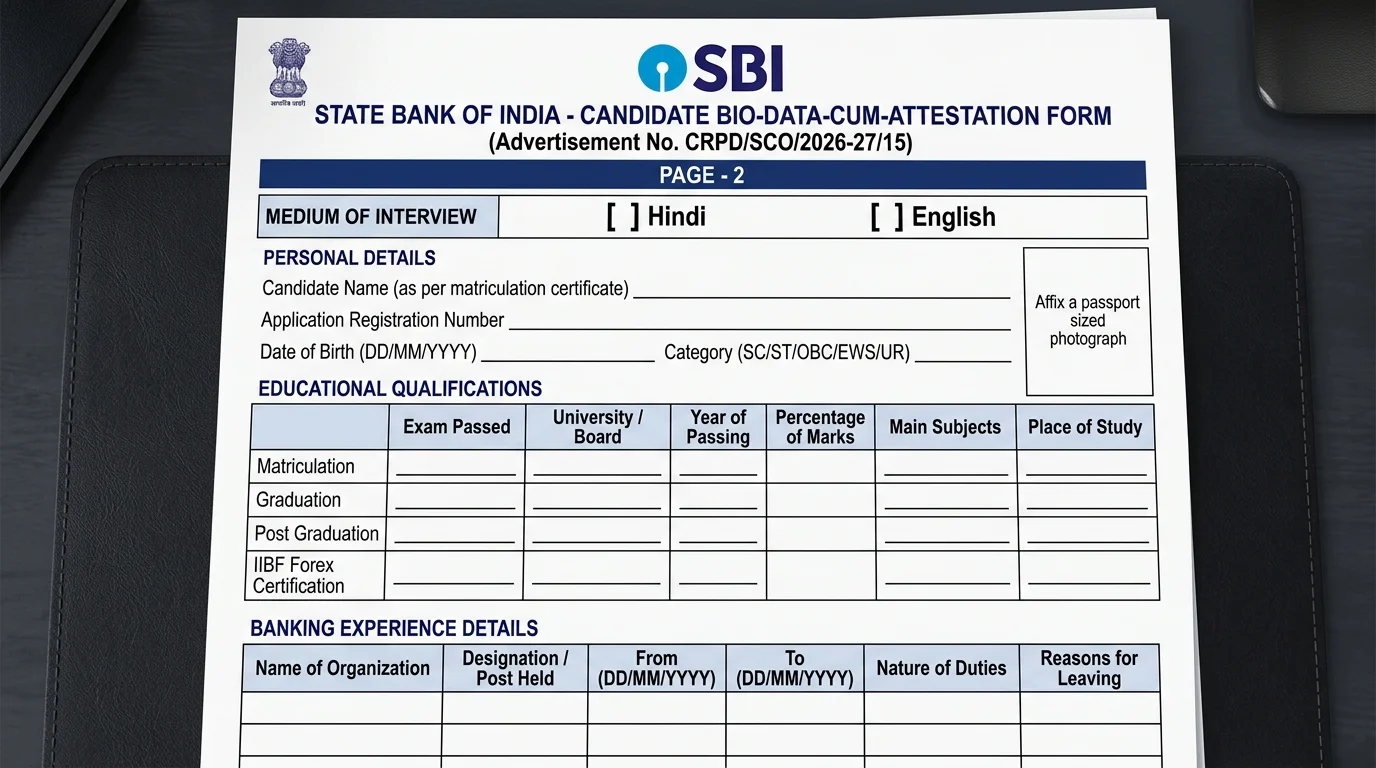
Candidate's Bio-Data-cum-Attestation Form
Official SBI notification form showing the interview language choice (Hindi / English) and personal / educational qualification details.
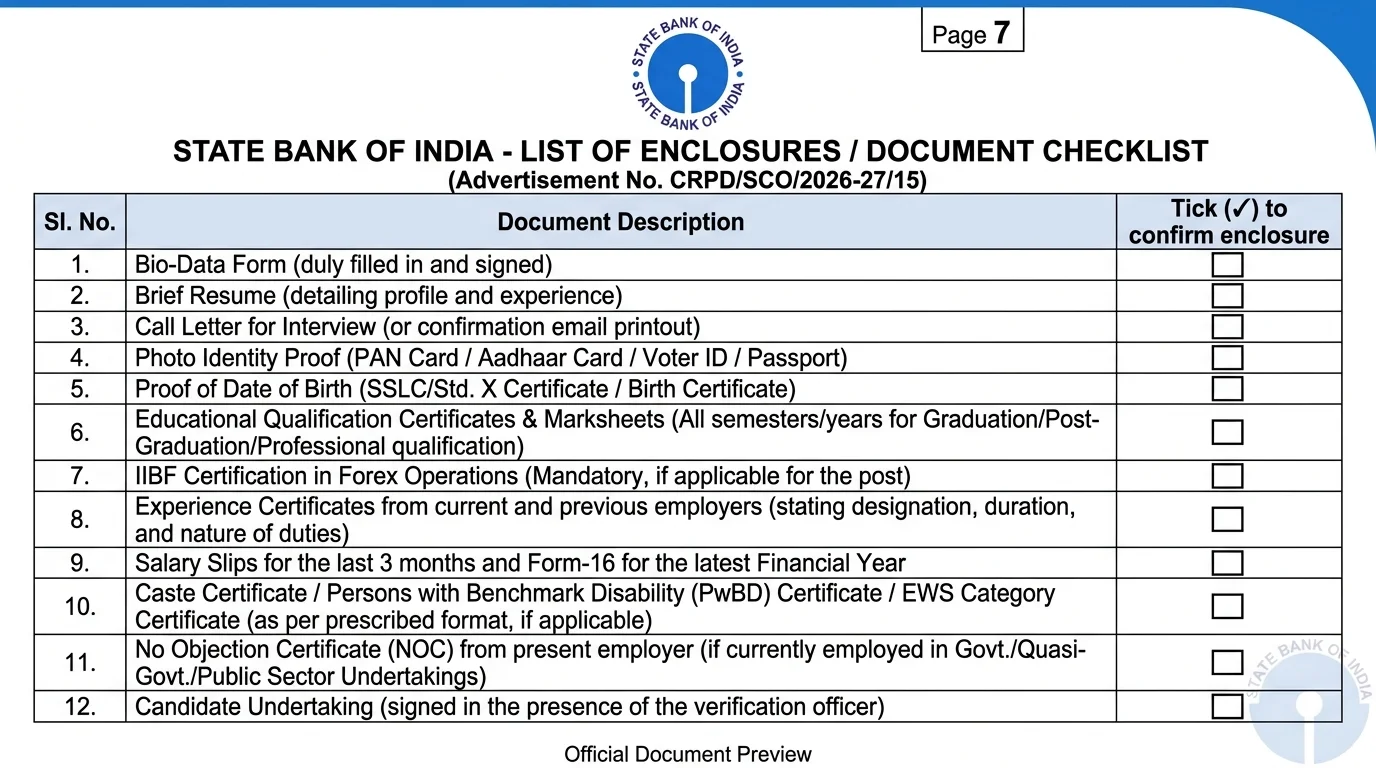
List of Enclosures (Document Checklist)
Official SBI enclosure checklist detailing all original certificates, Form-16, salary slips, and IIBF proof required at interview.
Caption: Official SBI Biodata-cum-Attestation Form for Specialist Cadre Officer Recruitment 2026-27, Advertisement No. CRPD/SCO/2026-27/15.
18 Official-Notification-Based Interview Preparation Areas
These topics correspond directly to the technical terminology, responsibilities, and performance parameters described in SBI's recruitment notification:
1. Trade Finance Processing
Fundamental knowledge of the global trade finance ecosystem and operational lifecycles.
- Trade finance lifecycle for imports and exports
- Fund-based vs non-fund-based trade credit facilities
- Documentary collections (DP & DA mechanisms)
- Turnaround Time (TAT) and exception management
2. Document Scrutiny & Verification
Core responsibility for scrutinizing trade documentation against international banking standards.
- Scrutiny of Commercial Invoices, Packing Lists, Bills of Lading, Airway Bills
- Verification of Bill of Entry (BOE) on IDPMS and Shipping Bill on EDPMS
- Discrepancy identification and notice of refusal
3. Trade Finance Data Entry (JMGS-I Maker)
Precision transaction entry in core banking and trade applications.
- Entering LC issuance, amendments, and bill settlements accurately
- Document scanning, metadata tagging, and repository uploads
- Error prevention strategies under high-volume daily workloads
4. Sanctions & AML Scrutiny (MMGS-II Checker)
Screening parties and trade corridors against global anti-money laundering frameworks.
- Customer Due Diligence (CDD) and Enhanced Due Diligence (EDD)
- Name screening, vessel tracking, dual-use goods verification
- Handling potential matches, false positives, and escalation matrices
5. OFAC Regulations & Release Authority
Critical role of MMGS-II Checkers acting as official OFAC releasers.
- Understanding US Treasury OFAC sanctions lists (SDN & Sectoral)
- Investigating sanctions alerts on SWIFT messages (MT103, MT202, MT700)
- Strict adherence to release controls without compromising compliance
6. Regulatory Compliance (RBI & FEMA)
Master Directions and statutory reporting requirements.
- RBI Master Directions on Import and Export of Goods & Services
- Foreign Exchange Management Act (FEMA 1999) compliance
- Trade-Based Money Laundering (TBML) indicators and reporting
7. Turnaround Time (TAT) & Productivity
Operational performance benchmarks specified in SBI KRAs.
- Maintaining average TAT benchmarks without cutting compliance corners
- Managing peak-hour transaction queues and end-of-day cutoffs
- Balancing processing speed with zero-defect quality control
8. Maker & Checker Dynamics
Four-eye principle safeguarding banking operations.
- Distinct segregation of duties between JMGS-I and MMGS-II
- Error resolution loops between Maker and Checker
- Reducing operational risk through independent verification
9. Risk & Control Self-Assessment (RCSA)
Operational risk framework for MMGS-II Officers.
- Identifying inherent operational risks in trade processing
- Assessing key control effectiveness and residual risk ratings
- Formulating Corrective and Preventive Action (CAPA) plans
10. Process Review & Root-Cause Analysis
Continual improvement in trade workflows.
- Identifying systemic bottlenecks and recurring audit findings
- Root-cause analysis (5-Whys methodology) for trade processing errors
- Implementing digitized checklists and staff training sessions
11. Forex Operations & IIBF Concepts
Mandatory knowledge tested via IIBF certification.
- Spot, Forward, and Swap currency transactions
- Forex risk management, hedging tools, and EEFC/NOSTRO accounts
- Role of Authorized Dealer Category-I (AD-I) banks
12. Letter of Credit (UCPDC 600 Rules)
International trade payment cornerstone.
- Parties in LC: Applicant, Beneficiary, Issuing, Advising, Confirming Bank
- Types of LC: Sight, Usance, Irrevocable, Confirmed, Transferable, Back-to-Back
- ISBP 745 and UCPDC 600 key articles on document examination
Summary Table: Essential Trade Documents & Audit Points
| Document Name | Purpose in Trade Finance | Critical Audit Checkpoints during Scrutiny |
|---|---|---|
| Commercial Invoice | Billing & description of merchandise | Invoice value matches LC amount; beneficiary and applicant details match exactly; proper currency denomination. |
| Bill of Lading (B/L) | Document of title & transport contract | Clean on-board endorsement, port of loading/discharge, consignee matches LC stipulations, full set (3/3) presented. |
| Airway Bill (AWB) | Air carriage receipt (Non-negotiable) | Carrier signature, flight number, airport codes, and consigned to the issuing bank if required. |
| Certificate of Origin | Proof of manufacturing country | Issued by authorized Chamber of Commerce; confirms origin compliance for preferential trade tariffs. |
| Insurance Certificate | Cargo risk protection | Covers minimum 110% of CIF/CIP value; currency matches LC; dated on or before date of shipment. |
| Bill of Entry (BOE) | Customs clearance for imports | Verified on RBI IDPMS portal; duty payment status and custom tariff codes checked. |
| Shipping Bill | Export clearance document | Tracked on EDPMS; matched against foreign inward remittance realization. |
Top 25 Most Important SBI SCO Interview Questions & Model Answers
These 25 questions reflect actual technical scenarios, compliance checks, and HR expectations for the Trade Finance Officer role:
- Q11. What is the difference between a Bank Guarantee (BG) and a Letter of Credit (LC)?
- Q12. What are IncoTerms 2020 and how do FOB, CIF, and CFR dictate insurance and freight obligations?
- Q13. What is a Clean Bill of Lading vs a Claused / Foul Bill of Lading?
- Q14. Explain the role of SWIFT messages MT700, MT707, MT710, MT734, MT752, and MT760 in trade.
- Q15. What are the FEMA guidelines for Advance Remittance against imports?
- Q16. What is Pre-shipment Export Finance (Packing Credit) in Foreign Currency (PCFC)?
- Q17. How do you handle a situation where an importer requests document delivery against acceptance (DA) when the LC terms mandate payment at sight?
- Q18. What is an EEFC account and who is eligible to maintain foreign currency balances in India?
- Q19. How would you manage a situation where a high-value corporate client pressurizes you to waive a documentary discrepancy?
- Q20. Explain the significance of SBI's International Banking Group (IBG) and its global correspondent footprint.
- Q21. How do you adapt to 24/7 rotational shifts (including night shifts) in IBG operations?
- Q22. Describe a real processing crisis or discrepancy resolution from your previous banking experience.
- Q23. What are the major challenges currently facing international trade finance (e.g., geopolitical sanctions, supply chain shocks)?
- Q24. Why do you wish to join SBI in the Specialist Cadre rather than General Banking?
- Q25. Where do you see yourself in 5 years within SBI's International Banking Group?
Grade-Specific Preparation Focus (JMGS-I vs MMGS-II)
JMGS-I (Maker Role Focus)
Candidates applying for Scale-I must demonstrate high processing speed, flawless data entry, and adherence to operational rules:
MMGS-II (Checker Role Focus)
Candidates applying for Scale-II must demonstrate risk leadership, regulatory depth, and OFAC release authority:
7-Day Structured Interview Preparation Study Plan
| Day | Core Subject Domain | Daily Study & Practical Practice Checklist |
|---|---|---|
| Day 1 | Trade Finance Fundamentals & Experience Review | Review trade lifecycles, banking terms, your resume achievements, and filled Biodata Form particulars. |
| Day 2 | Letters of Credit & UCPDC 600 Rules | Revise LC types, UCP 600 articles, ISBP 745 standards, and standard shipping document examination rules. |
| Day 3 | Import, Export & Forex Operations | Revise FEMA provisions, IIBF Forex course notes, Spot/Forward rates, IDPMS, and EDPMS guidelines. |
| Day 4 | Sanctions, AML, KYC & OFAC Releaser Controls | Deep dive into OFAC screening, TBML red flags, False-positive resolution steps, and escalation frameworks. |
| Day 5 | Maker-Checker, TAT, Productivity & RCSA | Study operational risk controls, RCSA methodologies, queue prioritization, and workload management scenarios. |
| Day 6 | SBI International Banking Group & HR Fitment | Research SBI's global footprint, IBG operations, and prepare articulate answers for 'Why SBI?' and career goals. |
| Day 7 | Full Mock Interview & Document Preparation | Conduct full-length mock interview rehearsals, verify original document folder, and finalize dress code. |
Most Important Rule: Defend Everything on Your Resume
Since this recruitment is exclusively for experienced banking professionals, the interview panel will scrutinize your submitted resume and Biodata Form with precision. If your resume states: "Handled export LC transactions and discrepancy management," expect granular follow-up questions such as:
Official Direct Links & Document Downloads
| Resource / Document | Official Direct Link |
|---|---|
| SBI SCO Biodata-cum-Attestation Form (Official 8-Page PDF) | Download Biodata Form |
| SBI SCO Apply Online Portal (Advt CRPD/SCO/2026-27/15) | Open Application Portal |
| Official SBI Notification PDF (CRPD/SCO/2026-27/15) | Download Notification |
| SBI SCO Trade Finance Officer Recruitment 2026 (Full Post) | View Recruitment Page |
| SBI Careers Current Openings Hub | SBI Careers Portal |