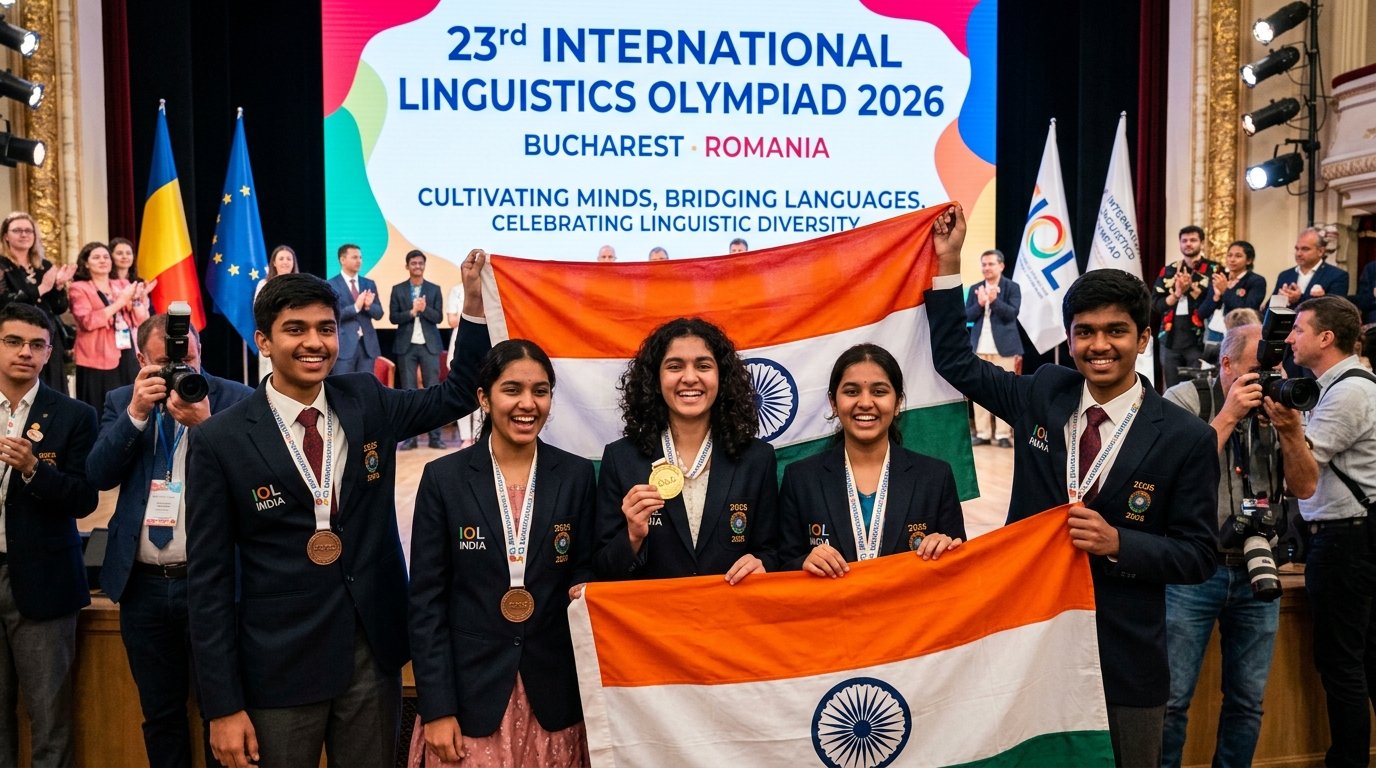
“1 Gold, 3 Bronze Medals & 1 Honourable Mention—Team India's brilliant performance at the 23rd International Linguistics Olympiad in Bucharest, Romania.”
A remarkable success story of Indian students who turned logic, curiosity and problem-solving into international achievement in Romania. India has once again demonstrated the power of young minds on the international stage.
At the International Linguistics Olympiad (IOL) 2026, held in Bucharest, Romania, Indian students produced an impressive performance, winning 1 Gold Medal, 3 Bronze Medals and an Honourable Mention.
The achievement came against participants from 46 countries and territories, with the 2026 Olympiad bringing together 255 contestants across 65 teams.
Team India IOL 2026 Medal Roll of Honour:
-
🥇
Shrilakshmi Venkatraman — Gold Medal
-
🥉
Aarav Anil Rao — Bronze Medal
-
🥉
Nishanth Shankar Lakshmanan — Bronze Medal
-
🥉
Advay Misra — Bronze Medal
-
🏅
Soham Amit Pednekar — Honourable Mention
The result represents another milestone in India's journey at the International Linguistics Olympiad. According to the official IOL results, India has now won 37 individual medals: 6 Gold, 9 Silver and 22 Bronze, along with multiple other honours.
🌟 The Gold Medal Moment
Among India's achievements, Shrilakshmi Venkatraman's Gold Medal stands out as the individual highlight of the 2026 competition.
But the competition is very different from a conventional examination. Students are not simply asked to remember facts or reproduce information they have studied.
Instead, they are presented with unfamiliar languages and language patterns and must use logic, observation and analytical reasoning to discover how those systems work. That means a contestant may encounter a language they have never studied and still have to work out its grammatical or structural rules from the information provided.
This makes the Olympiad a fascinating test of reasoning rather than memorisation.
🧠 What Makes the International Linguistics Olympiad Different?
The International Linguistics Olympiad challenges students to solve language-based puzzles using skills such as:
Students do not need extensive prior knowledge of linguistics to solve the problems. They receive evidence and examples and must discover the underlying rules themselves.
That is what makes the achievement of the Indian students particularly interesting: their success demonstrates how far strong reasoning and systematic problem-solving can take a student.
🇮🇳 The Journey Started Before Romania
The medals won in Romania were not the result of a few weeks of preparation. India's 2026 team emerged through a structured national selection and training process conducted through the Panini Linguistics Olympiad (PLO).
- The selection process began with registrations in November 2025.
- According to reports, 525 entries were received in the initial stage.
- Of these, 338 students appeared for the qualifying examination in February 2026.
- The strongest performers progressed through additional rounds and an invitational camp.
The process ultimately identified the students who would represent India internationally.
🏫 10 Days of Intensive Training at IIIT Hyderabad
One of the important stages of the journey was a 10-day residential camp at IIIT Hyderabad, held from May 31 to June 10, 2026.
The camp was not simply a classroom programme. Students participated in:
The final team was selected based on performance during the selection process, followed by further preparation before the international competition.
This shows an important lesson for students: international achievement is usually built through a long process of selection, practice, feedback and improvement.
👩🏫 The Role of Panini Linguistics Olympiad
India's participation in the International Linguistics Olympiad is supported through the Panini Linguistics Olympiad.
IIIT Hyderabad has been mentoring the PLO since 2015, through its Language Technologies Research Centre (LTRC). The programme works with academic collaborators and regional centres to identify and train students interested in challenging language and logic problems.
The Indian team was led by Prof. Parameswari Krishnamurthy of IIIT Hyderabad, who is involved in coordinating the Panini Linguistics Olympiad.
🌍 A World Stage for Young Indian Minds
The 2026 International Linguistics Olympiad was hosted in Bucharest, Romania.
The official IOL website records that the competition concluded on August 2, 2026, with 255 contestants representing 65 teams from 46 countries and territories.
For the Indian students, the event represented more than an examination. It was an opportunity to test their analytical abilities alongside some of the strongest young problem-solvers from around the world. And they returned with a Gold Medal, three Bronze Medals and an Honourable Mention.
📈 India's Growing Record at IOL
India's 2026 performance adds to a long-running record at the International Linguistics Olympiad. India first participated in the IOL in 2009.
The official IOL record now lists:
| Achievement | India's Total |
|---|---|
| 🥇 Gold Medals | 6 |
| 🥈 Silver Medals | 9 |
| 🥉 Bronze Medals | 22 |
| 🏆 Total Medals | 37 |
| ⭐ Best-Solution Prizes | 9 |
| 🏅 Honourable Mentions | 19 |
| 🌟 Repeat Medalists in Hall of Fame | 9 |
The 2026 result therefore becomes another chapter in India's continuing presence at the competition.
🤖 From Linguistics to Artificial Intelligence
There is another interesting dimension to this achievement. The skills tested by linguistics problems have applications beyond academic competitions.
IIIT Hyderabad has highlighted the connection between the skills developed through the PLO and future study and careers in AI, NLP and language technology.
For today's students, therefore, solving a language puzzle can potentially develop skills relevant to some of tomorrow's most technology-intensive fields.
💡 What Students Can Learn From Team India's Success
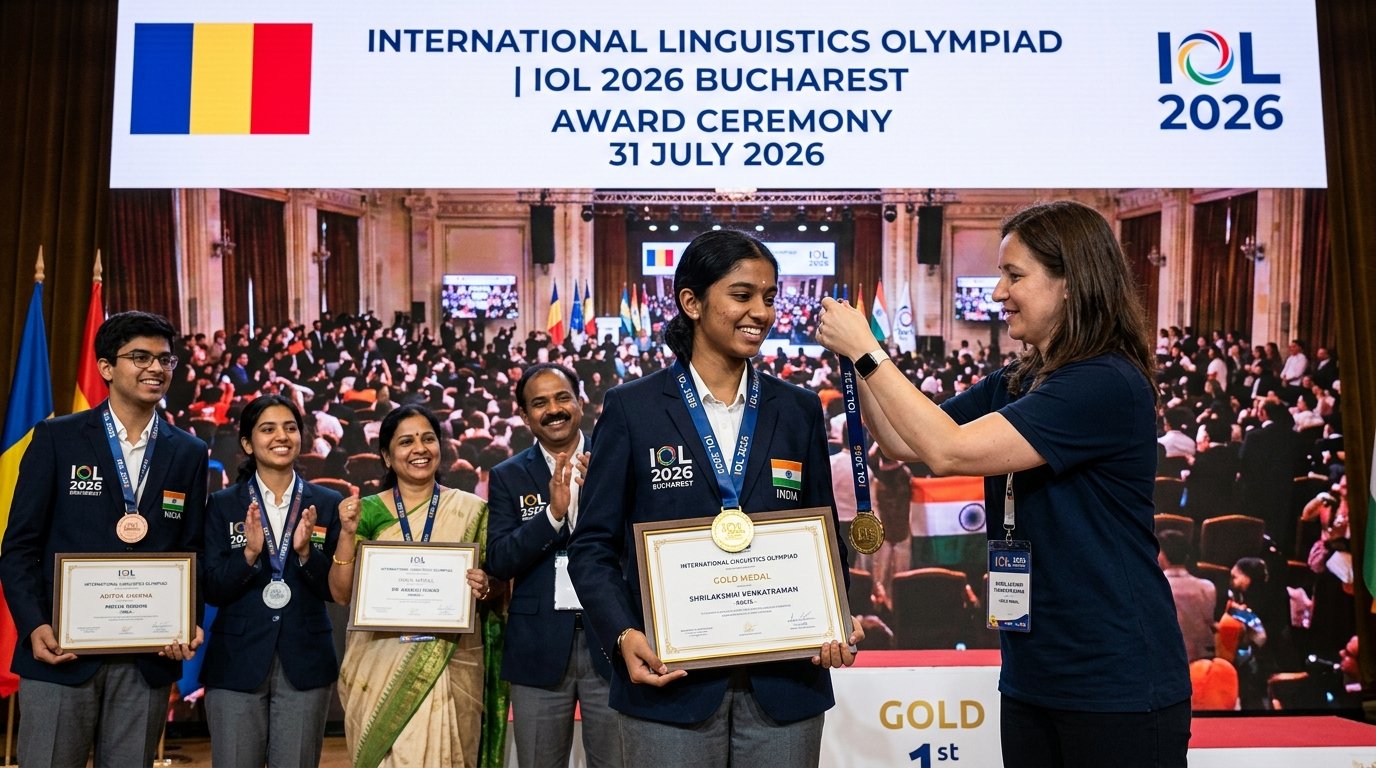
Real Photo: Shrilakshmi Venkatraman receiving Gold Medal at the 23rd International Linguistics Olympiad award ceremony in Bucharest, Romania alongside team mentors and officials.
1You don't always need to memorise more—you need to think better.
The IOL demonstrates that difficult problems can sometimes be solved by carefully analysing information and identifying patterns.
2Start before the final competition.
The Indian team's journey began months before the international event, with registration, qualification, camps and training.
3Practice unfamiliar problems.
Students can strengthen their reasoning abilities by regularly attempting problems where the answer cannot simply be memorised.
4Learn from mistakes.
Mock competitions and evaluations provide opportunities to understand weaknesses before the real competition.
5Explore subjects outside the usual syllabus.
Linguistics can connect language, mathematics, logic, computer science and AI.
6Curiosity can become a career skill.
The ability to ask "What is the hidden rule?" is useful far beyond an Olympiad.
🌟 The Bigger Success Story
The most inspiring part of Team India's IOL 2026 achievement is not simply the medal count. It is the journey behind those medals.
Hundreds of students entered the national selection process. A smaller group progressed through increasingly challenging stages. Selected students spent days learning, solving problems, attending lectures, receiving mentoring and participating in mock Olympiads.
Eventually, a small Indian contingent travelled to Romania. And on the international stage, their preparation translated into:
The achievement of Shrilakshmi Venkatraman, Aarav Anil Rao, Nishanth Shankar Lakshmanan, Advay Misra and Soham Amit Pednekar is a reminder that India's young talent can compete globally when curiosity is combined with disciplined preparation.
Their story is not just about linguistics. It is about thinking differently, solving unfamiliar problems and having the confidence to take on challenges beyond the classroom.
🇮🇳 A Message for India's Students
You don't have to be the student who memorises everything. You can be the student who asks questions.
You can be the student who searches for patterns.
You can be the student who keeps trying when the problem looks unfamiliar.
And you can turn that curiosity into something extraordinary. Team India's success at the International Linguistics Olympiad 2026 shows that a young mind equipped with curiosity, logic and perseverance can travel from a classroom in India to an international stage in Romania.
📌 Success Story at a Glance
🔎 Frequently Asked Questions
🏆 IndiaDreamJob Success Story Conclusion
From solving unfamiliar language puzzles to winning medals in Romania—Team India's IOL 2026 achievement is a powerful example of what curiosity, reasoning and disciplined preparation can achieve.
The lesson is simple: Don't just learn the answer. Learn how to find the answer. 🇮🇳