CSIR UGC NET December 2026 Syllabus: Subject-Wise Syllabus, Exam Pattern & Official PDF
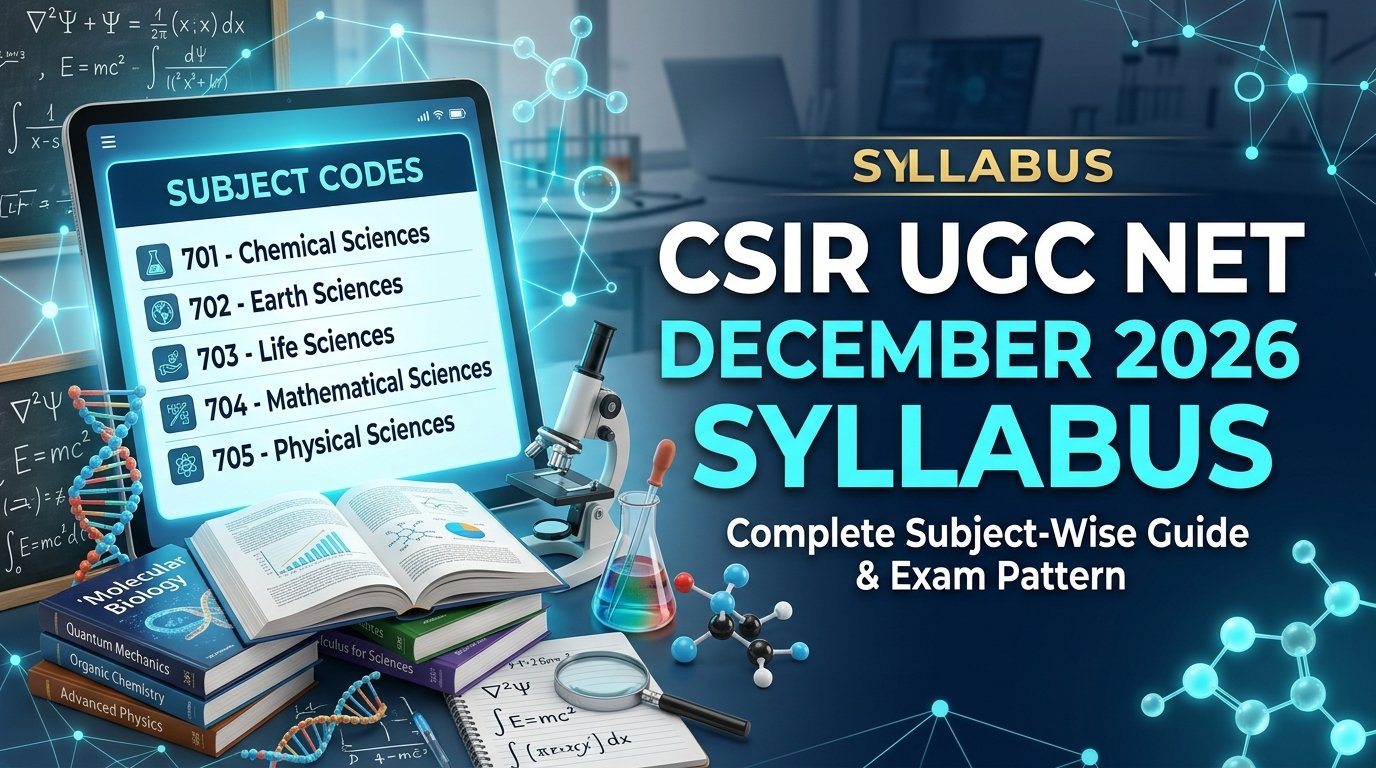
The Joint CSIR-UGC NET December 2026 syllabus covers five science subjects: Chemical Sciences, Earth, Atmospheric, Ocean and Planetary Sciences, Life Sciences and Bio-Technology, Mathematical Sciences, and Physical Sciences. The official December 2026 Information Bulletin directs candidates to the CSIR-HRDG website for the detailed syllabus and scheme of examination.
Important 2026 Revised Syllabus Alert
CSIR-HRDG Official Notice: CSIR-HRDG issued a notice stating that proposed revised syllabi had been prepared for Chemical Sciences, Earth, Atmospheric, Ocean & Planetary Sciences, Mathematical Sciences, and Physical Sciences, and invited stakeholder feedback. Candidates should verify the final syllabus applicable to their exam cycle on the official CSIR-HRDG portal rather than relying on unverified third-party PDFs.
For Life Sciences and Bio-Technology, CSIR-HRDG has published a separate revised UGC-CSIR-DBT NET syllabus containing 14 units.
CSIR NET December 2026 Syllabus – Quick Overview
| Subject Name | Subject Code | Maximum Marks | Exam Duration |
|---|---|---|---|
| Chemical Sciences | 701 | 200 Marks | 3 Hours (180 Mins) |
| Earth, Atmospheric, Ocean & Planetary Sciences | 702 | 200 Marks | 3 Hours (180 Mins) |
| Life Sciences & Bio-Technology | 703 | 200 Marks | 3 Hours (180 Mins) |
| Mathematical Sciences | 704 | 200 Marks | 3 Hours (180 Mins) |
| Physical Sciences | 705 | 200 Marks | 3 Hours (180 Mins) |
CSIR NET December 2026 Exam Pattern (Part A, B & C)
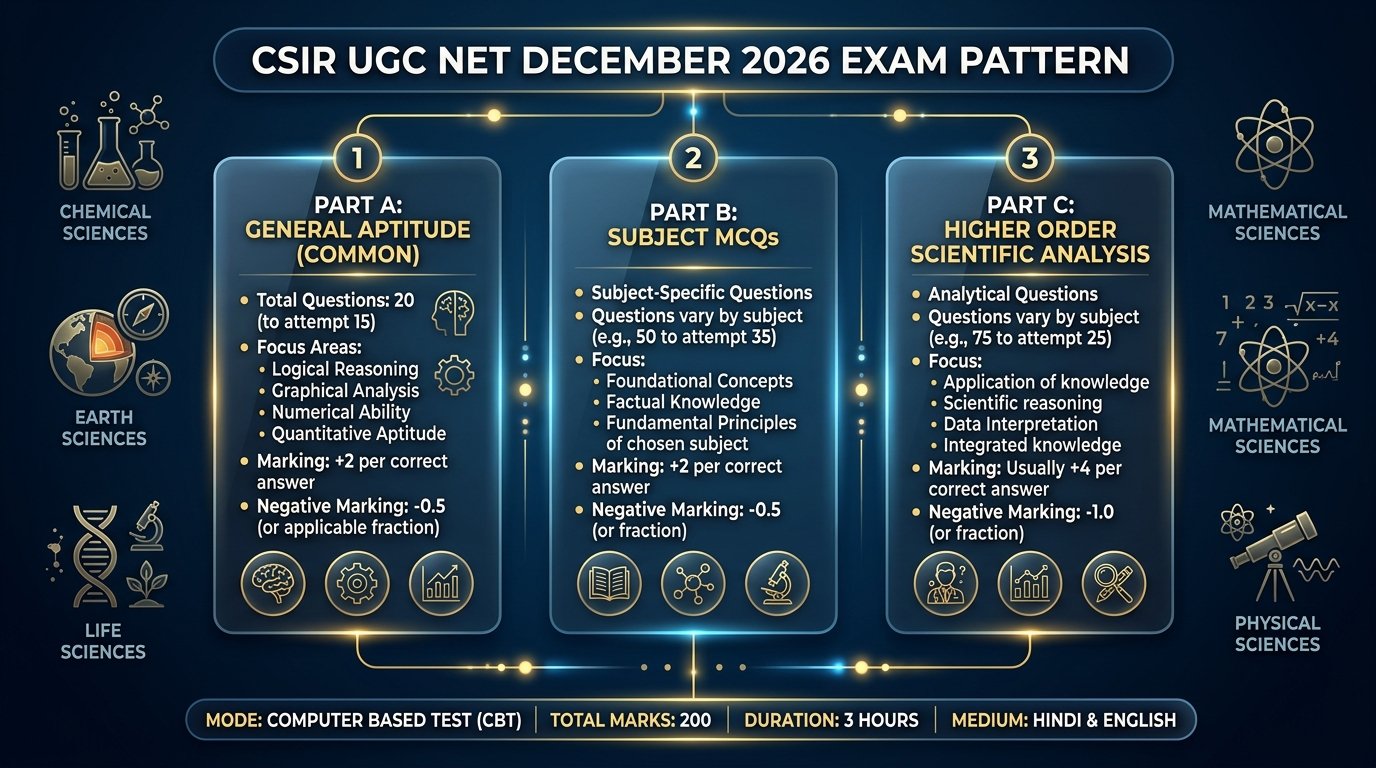
For December 2026, the question paper consists of three parts — Part A, Part B and Part C. The total marks for the paper is 200 and the duration is 3 hours.
Part A is common to all five subjects. The December 2026 bulletin specifically describes Part A as emphasizing:
• Logical Reasoning • Graphical Analysis • Analytical Ability • Numerical Ability • Quantitative Comparison • Series Formation • Puzzles • General Aptitude.
Part B contains conventional subject-related multiple-choice questions (MCQs) generally based on the prescribed subject syllabus.
Part C contains higher-order and analytical questions designed to test the candidate's ability to apply scientific concepts to solve complex problems.
Subject-Wise CSIR NET December 2026 Syllabus
1. Chemical Sciences Syllabus – Code 701
Divided into Inorganic, Physical, Organic Chemistry and Interdisciplinary Topics.
Inorganic Chemistry
Chemical periodicity; Structure and bonding; VSEPR theory; Acids and bases; Main-group elements; Transition elements; Coordination compounds; Organometallic compounds; Bioinorganic chemistry; Spectroscopic characterization (IR, Raman, NMR, EPR, Mössbauer, UV-Vis, NQR, MS, photoelectron spectroscopy); Nuclear chemistry.
Physical Chemistry
Quantum mechanics (particle-in-a-box, harmonic oscillator, hydrogen atom); Molecular orbital & valence-bond theories; Hückel theory; Group theory; Molecular spectroscopy; Chemical thermodynamics; Statistical thermodynamics; Electrochemistry; Chemical kinetics; Colloids & surfaces; Solid-state chemistry; Polymer chemistry; Data analysis.
Organic Chemistry
IUPAC nomenclature; Stereochemistry; Aromaticity; Reactive intermediates; Reaction mechanisms; Named reactions; Retrosynthesis; Asymmetric synthesis; Pericyclic reactions; Heterocyclic chemistry; Natural products; Structure determination via IR, UV-Vis, NMR and Mass spectroscopy.
Interdisciplinary Topics
Nanoscience & nanotechnology, Catalysis & green chemistry, Medicinal chemistry, Supramolecular chemistry, Environmental chemistry.
Official Chemical Sciences Syllabus PDF2. Earth, Atmospheric, Ocean & Planetary Sciences – Code 702
Covers Earth science, geology, geography, geophysics, meteorology and ocean sciences.
Part B Topics
- 1. Earth & Solar System: Origin of Earth, Kepler's laws, Geological Time Scale, Radioactive isotopes, Meteorites, Stratigraphy, Gravity and magnetic fields.
- 2. Earth Materials & Surface Processes: Minerals, Rocks, Erosion, Deposition, Soil formation, River basins of India.
- 3. Interior of Earth & Tectonics: Seismology, Internal structure, Stress & strain, Folds, Faults, Plate tectonics.
- 4. Oceans & Atmosphere: Seawater properties, Ocean currents, Thermohaline circulation, Atmospheric structure, Greenhouse gases, Monsoon, Cyclones, El Niño.
- 5. Environmental Earth Sciences: Hydrological cycle, Biodiversity, Natural hazards, Remote sensing.
Part C Specialized Disciplines
Geology (Petrology, Structural Geology, Paleontology, Sedimentology, Geochemistry), Physical Geography (Geomorphology, Climatology, Biogeography, Geography of India), Geophysics (Seismology, Field Theory, Gravity & Magnetic methods, Well logging), Meteorology & Ocean Sciences.
Official Earth Sciences Syllabus PDF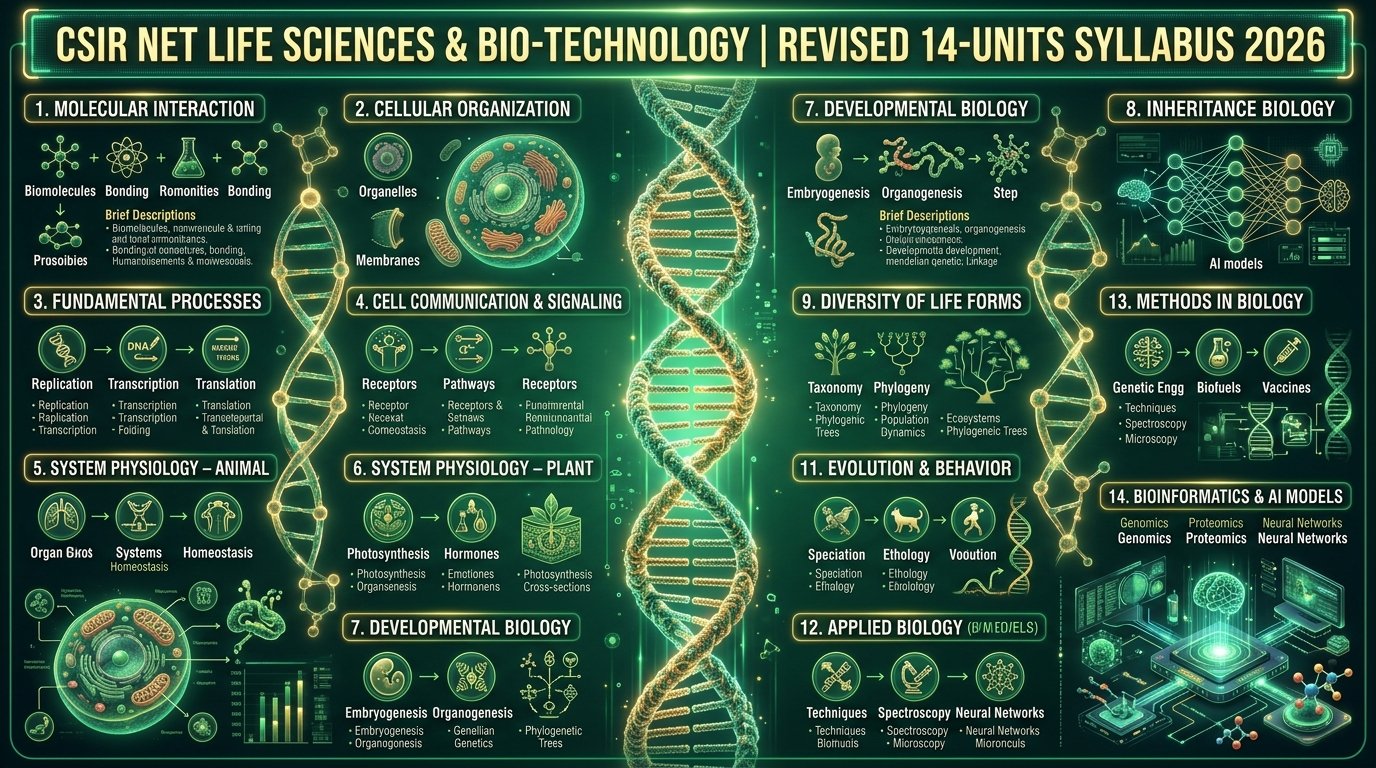
3. Life Sciences & Bio-Technology Syllabus – Code 703 (Revised 14 Units)
Published under the revised UGC-CSIR-DBT NET framework containing 14 units:
4. Mathematical Sciences Syllabus – Code 704
Organized into four major units:
- Unit 1 – Analysis & Linear Algebra: Real analysis, Lebesgue measure, Metric spaces, Vector spaces, Matrices, Eigenvalues, Jordan canonical forms.
- Unit 2 – Complex Analysis, Algebra & Topology: Analytic functions, Cauchy integral formula, Residues, Group theory, Sylow theorems, Rings, Fields, Galois theory, Topology.
- Unit 3 – Differential Equations & Numerical Analysis: ODEs, PDEs, Numerical methods (Newton-Raphson, Runge-Kutta), Calculus of variations, Classical mechanics.
- Unit 4 – Statistics & Probability: Markov chains, Estimation, Hypothesis testing, Bayesian inference, Multivariate normal distribution, ANOVA, Cluster analysis.
5. Physical Sciences Syllabus – Code 705
Covers core and advanced physics domains:
• Mathematical Methods of Physics • Classical Mechanics (Lagrangian & Hamiltonian) • Electromagnetic Theory (Maxwell's equations, Radiation) • Quantum Mechanics (Schrödinger equation, Perturbation theory) • Thermodynamics & Statistical Physics • Electronics & Experimental Methods • Atomic & Molecular Physics • Condensed Matter Physics (Superconductivity, Band theory) • Nuclear & Particle Physics.
Official Physical Sciences Syllabus PDF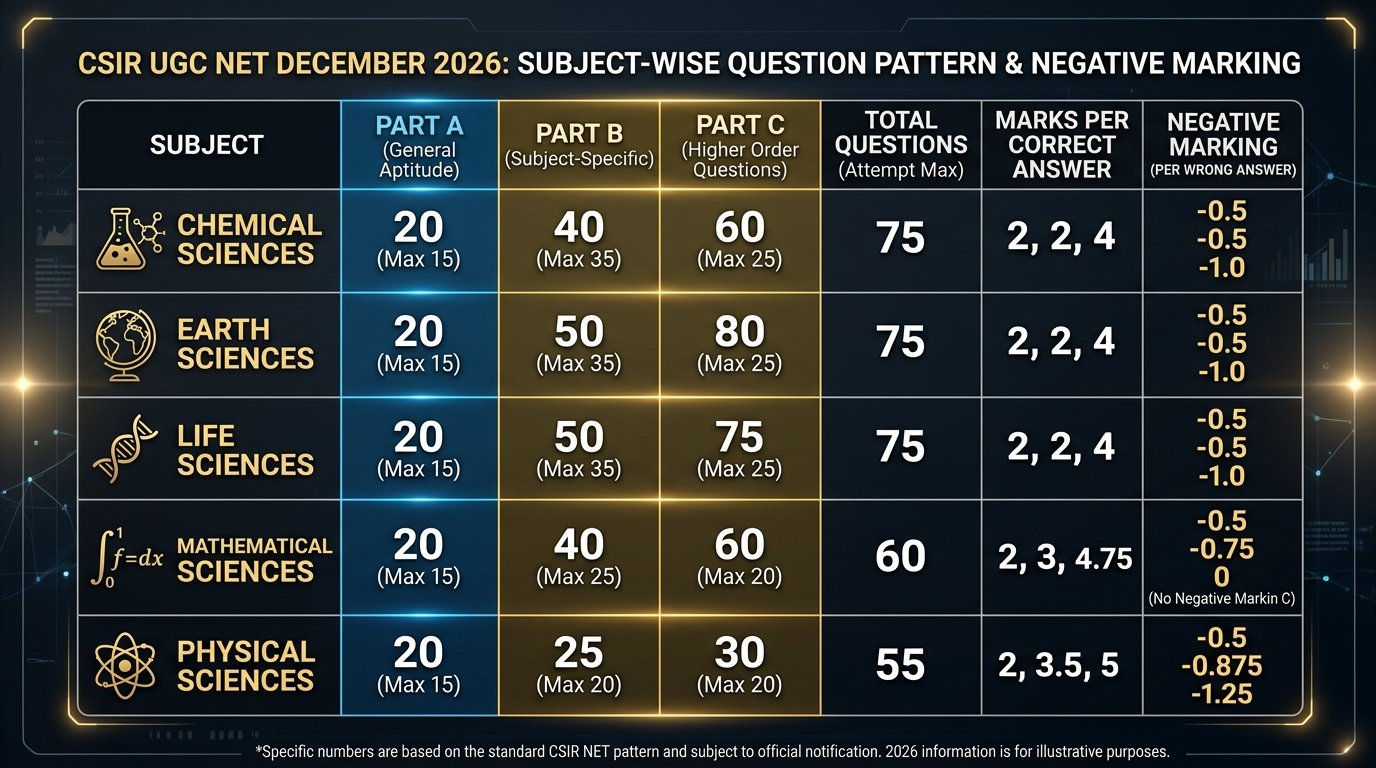
CSIR NET December 2026 Subject-Wise Question Pattern & Negative Marking
Figures taken directly from the December 2026 NTA Information Bulletin:
| Subject Name | Part A (Attempt) | Part B (Attempt) | Part C (Attempt) | Total Questions to Attempt | Total Marks |
|---|---|---|---|---|---|
| Chemical Sciences | 20 (15) | 40 (35) | 60 (25) | 75 Questions | 200 |
| Earth Sciences | 20 (15) | 50 (35) | 80 (25) | 75 Questions | 200 |
| Life Sciences & Bio-Tech | 20 (15) | 50 (35) | 75 (25) | 75 Questions | 200 |
| Mathematical Sciences | 20 (15) | 40 (25) | 60 (20) | 60 Questions | 200 |
| Physical Sciences | 20 (15) | 25 (20) | 30 (20) | 55 Questions | 200 |
Negative Marking Rules
| Subject Name | Negative Marking Penalty |
|---|---|
| Chemical Sciences | 25% penalty in Parts A, B and C |
| Earth Sciences | 25% in Parts A & B; 33% in Part C |
| Life Sciences & Bio-Technology | 25% penalty in Parts A, B and C |
| Mathematical Sciences | 25% in A & B; NO Negative Marking in Part C |
| Physical Sciences | 25% penalty in Parts A, B and C |
How to Prepare Using the CSIR NET Syllabus
- Step 1 – Download Official Syllabus: Obtain the official CSIR-HRDG syllabus PDF for your subject code.
- Step 2 – Divide into Units: Break the syllabus down into manageable units and create a completion checklist.
- Step 3 – Master Part B Concepts: Focus on core fundamental concepts to clear Part B conventional MCQs.
- Step 4 – Heavy Focus on Part C: Part C carries maximum weightage; practice solving analytical and multi-concept scientific problems.
- Step 5 – Solve PYQs: Practice topic-wise Previous Year Questions under timed exam conditions.
- Step 6 – Take Mock Tests: Take CBT mode full-length mock tests strictly adhering to the 180-minute limit.
- Step 7 – Maintain Revision List: Keep a dedicated notebook for formulas, mechanisms, and tricky questions.