CSIR UGC NET December 2026 Exam Pattern: Subject-Wise Questions, Marks, Negative Marking & Part A/B/C
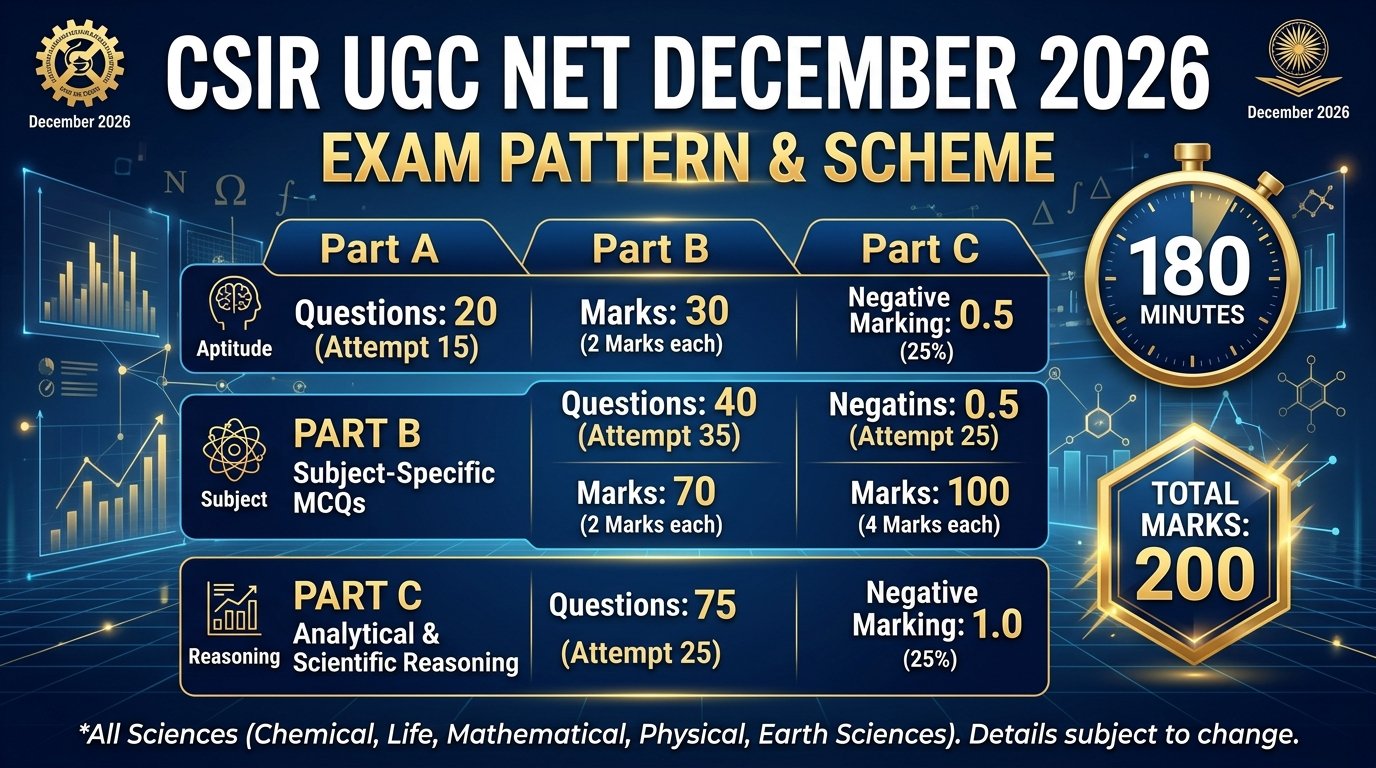
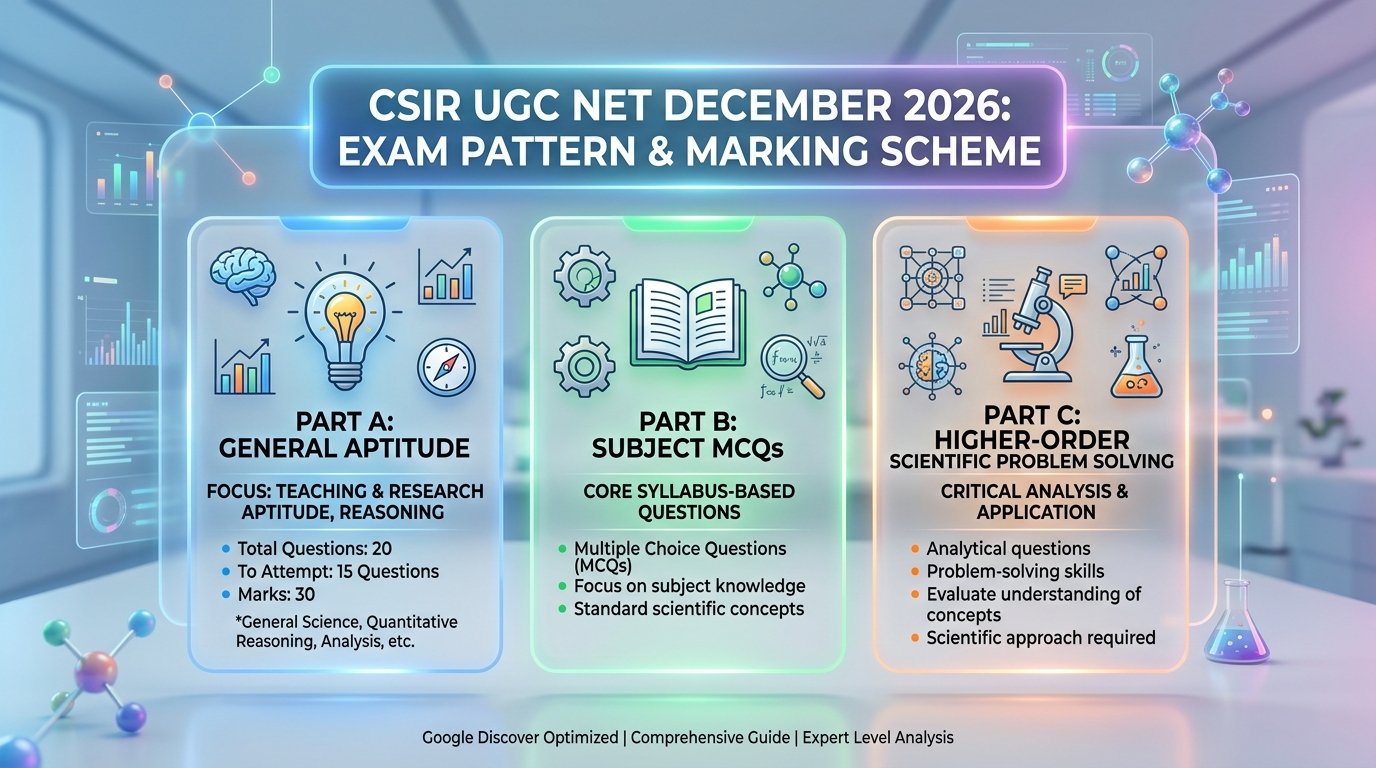
The Joint CSIR-UGC NET December 2026 examination will be conducted in Computer Based Test (CBT) mode. The question paper consists of three parts — Part A, Part B and Part C. All three parts contain objective-type multiple-choice questions, and there is no break between parts. The examination carries a maximum of 200 marks and has a duration of 180 minutes (3 hours).
Important Subject-Specific Warning
Do not assume all CSIR NET subjects follow an identical question pattern! The official December 2026 NTA Information Bulletin gives a different question distribution, attempt limit, mark weightage, and negative marking penalty for each of the five subjects: Chemical Sciences (701), Earth Sciences (702), Life Sciences & Bio-Tech (703), Mathematical Sciences (704), and Physical Sciences (705).
CSIR NET December 2026 Exam Pattern – Quick Overview
| Exam Particular | Official NTA Specification |
|---|---|
| Examination Name | Joint CSIR-UGC NET December 2026 |
| Mode of Examination | Computer Based Test (CBT) |
| Question Type | Objective-type Multiple Choice Questions (MCQs) |
| Total Parts | Part A, Part B & Part C (Single Paper) |
| Maximum Marks | 200 Marks |
| Total Duration | 180 Minutes / 3 Hours (No break between parts) |
| Medium of Paper | Bilingual (Hindi & English) |
| Total Science Subjects | 5 Subjects (Chemical, Earth, Life & Bio-Tech, Math, Physical) |
| Negative Marking | Yes, varies by subject and part |
Subject-Wise CSIR NET December 2026 Scheme of Examination
Official scheme taken from Chapter 3 of NTA's December 2026 Information Bulletin:
| Subject Name & Code | Part A Questions | Part B Questions | Part C Questions | Total Questions Provided | Questions to Attempt | Maximum Marks |
|---|---|---|---|---|---|---|
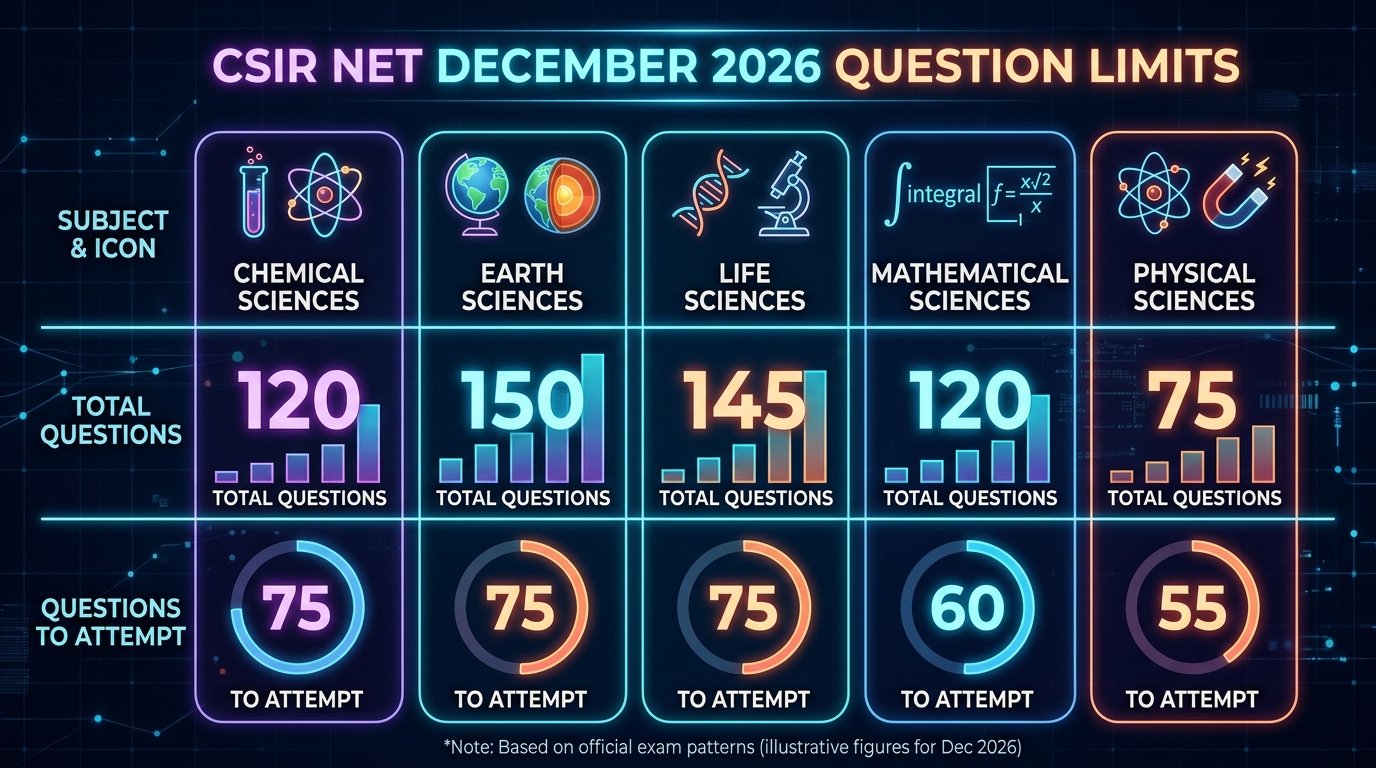
| Chemical Sciences (701) | 20 | 40 | 60 | 120 | 75 Questions | 200 |
| Earth, Atmospheric, Ocean & Planetary Sciences (702) | 20 | 50 | 80 | 150 | 75 Questions | 200 |
| Life Sciences & Bio-Technology (703) | 20 | 50 | 75 | 145 | 75 Questions | 200 |
| Mathematical Sciences (704) | 20 | 40 | 60 | 120 | 60 Questions | 200 |
| Physical Sciences (705) | 20 | 25 | 30 | 75 | 55 Questions | 200 |
Subject-Wise Detailed Pattern & Score Calculation
1. Chemical Sciences Exam Pattern – Code 701
Total Questions: 120 | Allowed Attempts: 75 | Max Marks: 200
| Section | Total Questions | To Attempt | Marks per Q | Max Marks | Negative Marking |
|---|---|---|---|---|---|
| Part A | 20 | 15 | 2 Marks | 30 Marks | -0.50 (25%) |
| Part B | 40 | 35 | 2 Marks | 70 Marks | -0.50 (25%) |
| Part C | 60 | 25 | 4 Marks | 100 Marks | -1.00 (25%) |
| Total | 120 | 75 | — | 200 Marks | — |
Score Calculation: Part A (15 × 2 = 30) + Part B (35 × 2 = 70) + Part C (25 × 4 = 100) = 200 Marks.
2. Earth, Atmospheric, Ocean & Planetary Sciences – Code 702
Total Questions: 150 | Allowed Attempts: 75 | Max Marks: 200
| Section | Total Questions | To Attempt | Marks per Q | Max Marks | Negative Marking |
|---|---|---|---|---|---|
| Part A | 20 | 15 | 2 Marks | 30 Marks | -0.50 (25%) |
| Part B | 50 | 35 | 2 Marks | 70 Marks | -0.50 (25%) |
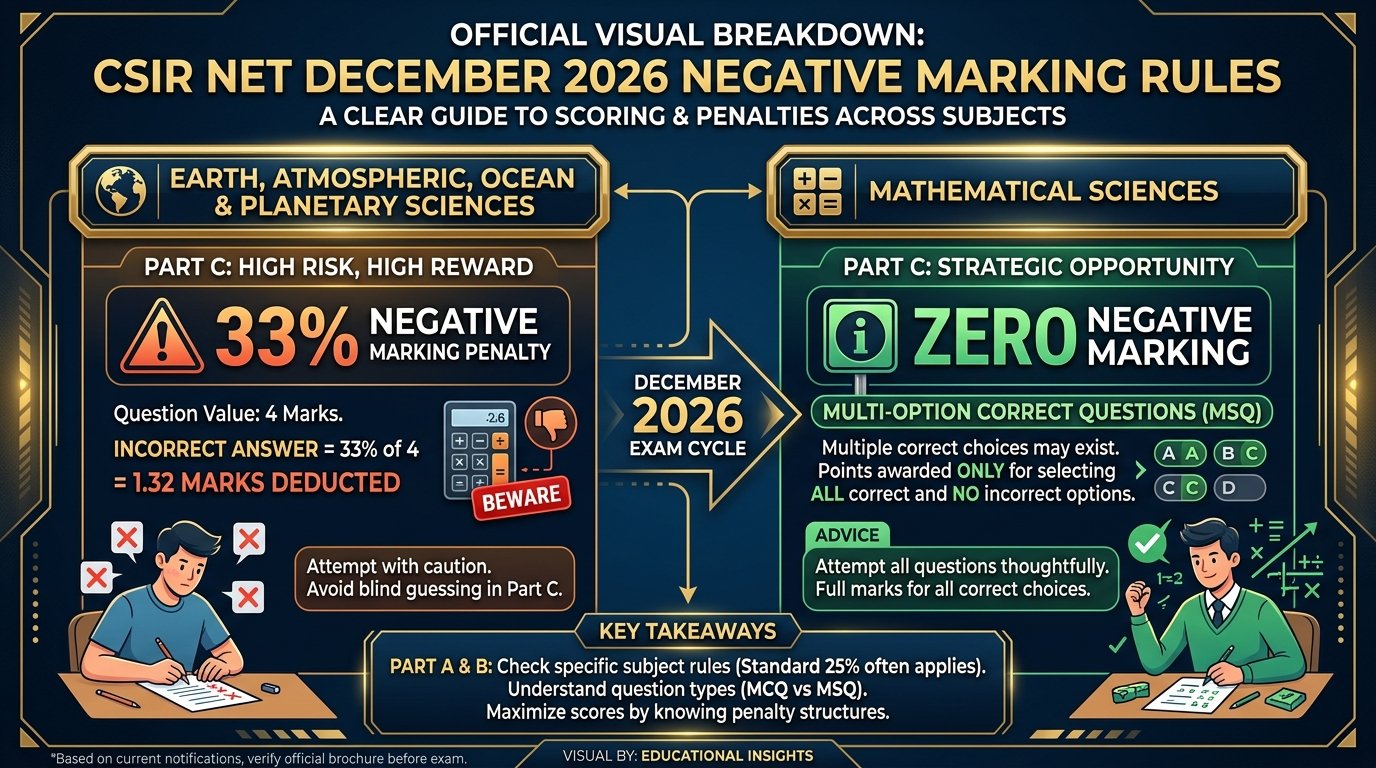
| Part C | 80 | 25 | 4 Marks | 100 Marks | -1.32 (33% Penalty) |
| Total | 150 | 75 | — | 200 Marks | — |
Important Note: Part C in Earth Sciences carries 33% negative marking (-1.32 marks per wrong answer), whereas Parts A and B carry 25% penalty.
3. Life Sciences & Bio-Technology – Code 703
Total Questions: 145 | Allowed Attempts: 75 | Max Marks: 200
| Section | Total Questions | To Attempt | Marks per Q | Max Marks | Negative Marking |
|---|---|---|---|---|---|
| Part A | 20 | 15 | 2 Marks | 30 Marks | -0.50 (25%) |
| Part B | 50 | 35 | 2 Marks | 70 Marks | -0.50 (25%) |
| Part C | 75 | 25 | 4 Marks | 100 Marks | -1.00 (25%) |
| Total | 145 | 75 | — | 200 Marks | — |
Score Calculation: Part A (15 × 2 = 30) + Part B (35 × 2 = 70) + Part C (25 × 4 = 100) = 200 Marks.
4. Mathematical Sciences Exam Pattern – Code 704
Total Questions: 120 | Allowed Attempts: 60 | Max Marks: 200
| Section | Total Questions | To Attempt | Marks per Q | Max Marks | Negative Marking |
|---|---|---|---|---|---|
| Part A | 20 | 15 | 2 Marks | 30 Marks | -0.50 (25%) |
| Part B | 40 | 25 | 3 Marks | 75 Marks | -0.75 (25%) |
| Part C | 60 | 20 | 4.75 Marks | 95 Marks | NO Negative Marking |
| Total | 120 | 60 | — | 200 Marks | — |
1. Part C questions carry 4.75 marks each with ZERO negative marking.
2. Part C questions may have one or more correct options. Full credit is given ONLY when all correct options are selected and no wrong option is marked.
5. Physical Sciences Exam Pattern – Code 705
Total Questions: 75 | Allowed Attempts: 55 | Max Marks: 200
| Section | Total Questions | To Attempt | Marks per Q | Max Marks | Negative Marking |
|---|---|---|---|---|---|
| Part A | 20 | 15 | 2 Marks | 30 Marks | -0.50 (25%) |
| Part B | 25 | 20 | 3.5 Marks | 70 Marks | -0.875 (25%) |
| Part C | 30 | 20 | 5 Marks | 100 Marks | -1.25 (25%) |
| Total | 75 | 55 | — | 200 Marks | — |
Score Calculation: Part A (15 × 2 = 30) + Part B (20 × 3.5 = 70) + Part C (20 × 5 = 100) = 200 Marks.
CSIR NET December 2026 Negative Marking Deductions
| Subject Name | Part A Penalty | Part B Penalty | Part C Penalty |
|---|---|---|---|
| Chemical Sciences (701) | -0.50 (25%) | -0.50 (25%) | -1.00 (25%) |
| Earth Sciences (702) | -0.50 (25%) | -0.50 (25%) | -1.32 (33%) |
| Life Sciences & Bio-Tech (703) | -0.50 (25%) | -0.50 (25%) | -1.00 (25%) |
| Mathematical Sciences (704) | -0.50 (25%) | -0.75 (25%) | 0 (NO Negative Marking) |
| Physical Sciences (705) | -0.50 (25%) | -0.875 (25%) | -1.25 (25%) |
Important Question Selection & Attempt Evaluation Rule
The NTA Information Bulletin states that if a candidate answers more than the prescribed number of questions, only the first prescribed number of answered questions in that part will be evaluated. For instance, in Chemical Sciences Part A (where max 15 can be attempted), if a candidate attempts 18 questions, only questions 1 to 15 will be scored. Candidates should select questions carefully and avoid blind extra attempts.
3-Level Preparation Strategy Based on Exam Pattern
- Part A Strategy (Speed & Accuracy): 20 questions are provided to attempt 15. Focus on quick-win numerical reasoning, series, and graphical analysis.
- Part B Strategy (Strong Fundamentals): Covers conventional syllabus MCQs. Ensure 100% coverage of core formulas and standard concepts.
- Part C Strategy (Higher-Order Analytical Problem Solving): Carries ~50% of the total score (95-100 marks). Practice multi-concept analytical problems and PYQs.