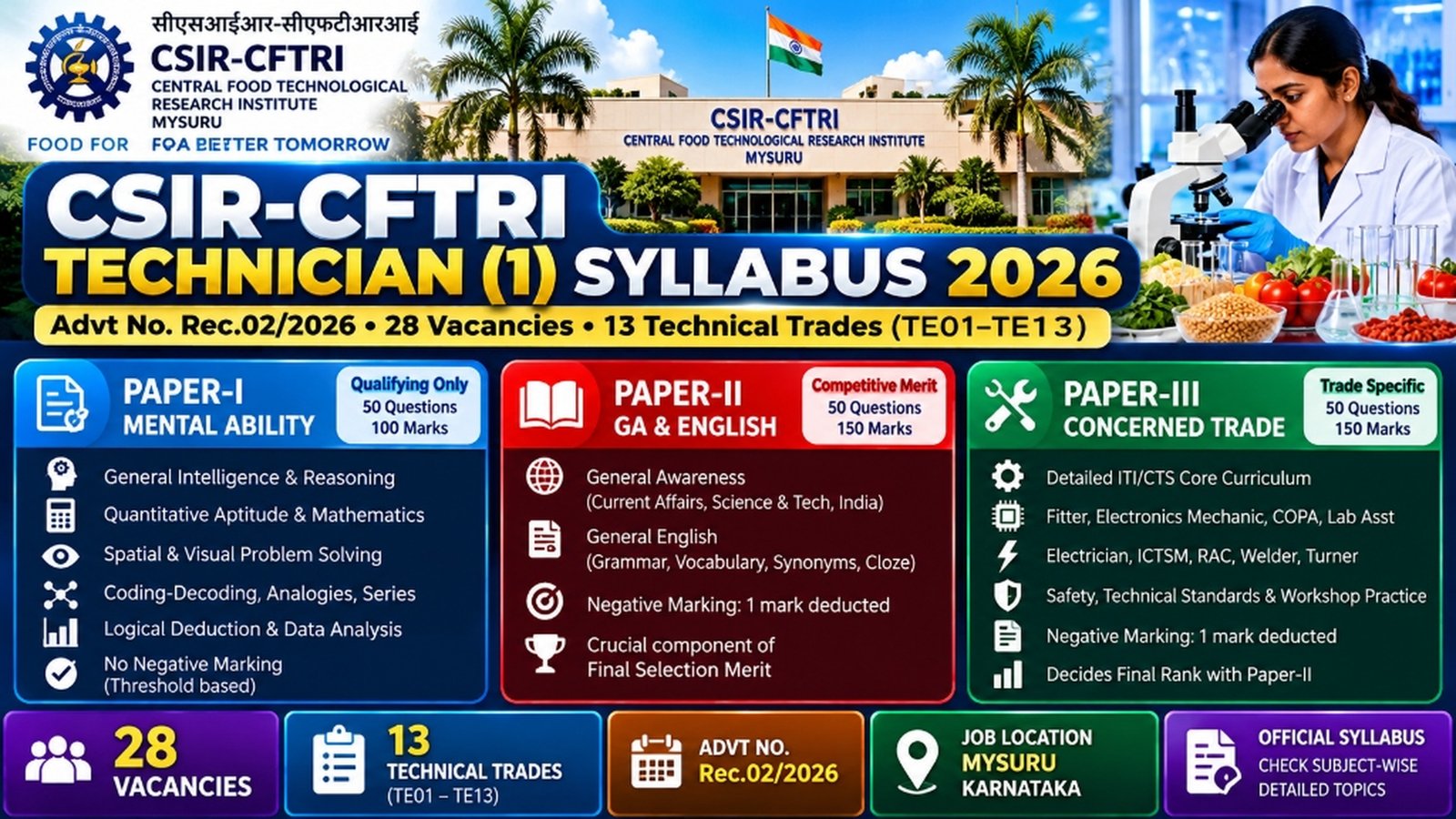
Candidates preparing for CSIR-Central Food Technological Research Institute (CSIR-CFTRI), Mysuru Technician (1) recruitment under Advertisement No. Rec.02/2026 must thoroughly master the officially prescribed syllabus. The recruitment examination encompasses a Qualifying Trade Test followed by a Written Examination consisting of Paper-I, Paper-II, and Paper-III across 13 designated technical trades (Post Codes TE01 to TE13).
Curriculum Blueprint & Merit Weightage
Under CSIR rules, Paper-I (Mental Ability) tests basic aptitude and is qualifying. The final merit ranking is computed strictly from the combined score of Paper-II (General Awareness + English Language) and Paper-III (Concerned Trade Theory), totaling 300 marks.
Paper-I: Mental Ability Test Syllabus (50 Questions)
Paper-I evaluates general intellectual capability, analytical acumen, and numerical problem-solving. There is no negative marking in Paper-I.
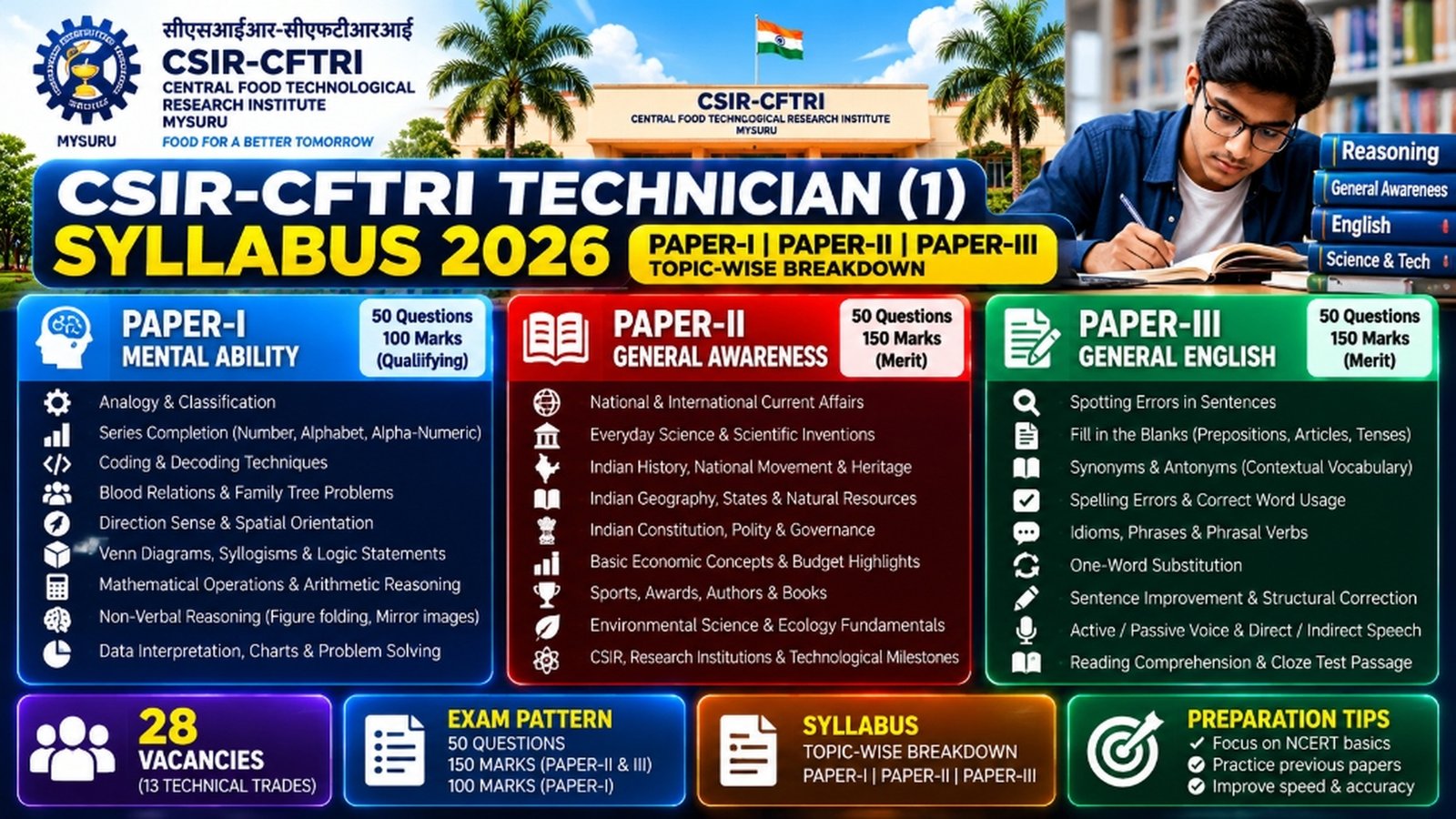
Detailed Topics in Mental Ability:
- Analogy & Classification: Semantic, symbolic, and figural relationships.
- Series Completion: Number series, alphabetical sequences, alphanumeric patterns.
- Coding-Decoding: Matrix coding, substitution, operational decoders.
- Blood Relations: Decoded family tree connections and relationship identification.
- Direction Sense: Distance calculation, cardinal routes, and angular turns.
- Venn Diagrams & Syllogism: Set theory logic, statements and conclusions.
- Arithmetical Reasoning: Basic arithmetic operators, ratio-proportions, percentages.
- Spatial Visualization: Paper folding, cutting, mirror and water reflections.
- Data Sufficiency & Puzzles: Linear, circular seating order, table analysis.
- Problem Solving: Deductive logic, decision making, and quantitative checks.
Paper-II: General Awareness & English Language Syllabus
Paper-II consists of 50 questions (150 Marks, 30 minutes duration) with 1 negative mark per incorrect answer. It directly determines final merit.
Part A: General Awareness (25 Qs - 75 Marks)
- Current Affairs: National and international events of the past 6 to 12 months.
- Everyday Science: Basic scientific principles, chemistry, physics, and biology in daily life.
- History & Culture: Indian freedom struggle, ancient/modern heritage, art and architecture.
- Geography: Physical geography, climate, rivers, minerals, and national infrastructure.
- Polity & Constitution: Fundamental Rights, Parliament, Judiciary, and Panchayati Raj.
- Indian Economy: Basic micro/macro trends, Union Budget overview, banking indices.
- Scientific Research: CSIR laboratories, food science innovations, and technology milestones.
Part B: English Language (25 Qs - 75 Marks)
- Grammar Fundamentals: Subject-verb agreement, tenses, prepositions, and articles.
- Error Detection: Spotting grammatical, syntactical, and idiomatic errors.
- Vocabulary Building: Contextual synonyms, antonyms, homonyms, and word pairs.
- Sentence Correction: Sentence improvement and structural replacements.
- Idioms & Phrases: Common proverbs, figurative meanings, and phrasal verbs.
- One-Word Substitutions: Standard vocabulary descriptions and linguistic terms.
- Comprehension Passages: Direct factual and inference-based reading questions.
Paper-III: Trade-Wise Technical Syllabus (TE01–TE13)
Paper-III tests the candidate’s core technical competence in their designated trade (50 Questions, 150 Marks, 1 Hour duration, 1 negative mark per wrong answer). Syllabus is benchmarked to the Directorate General of Training (DGT / NCVT Craftsmen Training Scheme) curriculum:
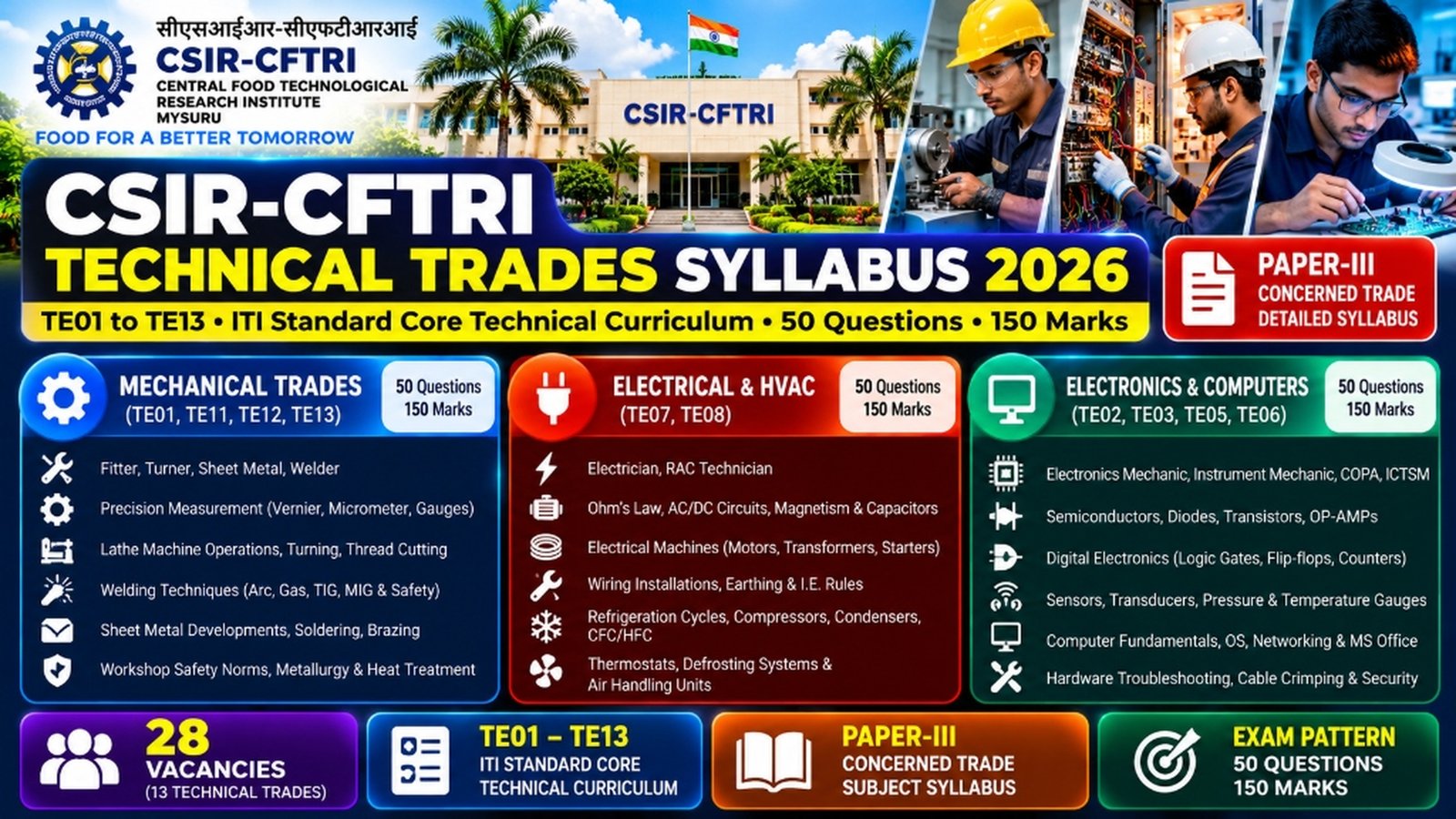
| Post Code | Designated Trade | Key Official Syllabus Curriculum Topics |
|---|---|---|
| TE01 | Fitter | Safety workshop guidelines, marking tools, precision instruments (Vernier calliper, Micrometer, Dial gauges), filing, drilling, reaming, tapping, lathe basics, pipe fitting, bearing assembly, limits, fits and tolerances, maintenance practices. |
| TE02 | Electronics Mechanic | Basic electrical principles, passive components, semiconductors, diodes, transistors, amplifiers, oscillators, OP-AMPs, digital circuits, logic gates, microprocessors basics, SMPS, sensors, soldering/desoldering techniques, PCB design & testing. |
| TE03 | Instrument Mechanic | Principles of measurement, pressure gauges, temperature sensors (RTD, Thermocouples), flow meters, level transmitters, pneumatic & hydraulic controls, PLC/SCADA basics, calibration procedures, control valves, process automation instruments. |
| TE04 | Laboratory Assistant (Chemical Plant) | Laboratory safety, handling of chemicals & glass apparatus, preparation of standard solutions, titration, distillation, filtration, pH measurement, spectroscopy basics, reaction vessels, safety showers, chemical waste disposal protocols. |
| TE05 | COPA | Computer hardware basics, operating systems (Windows/Linux), MS Office suite, Database Management System (DBMS, SQL queries), Networking fundamentals (LAN, WAN, IP addressing), Web technologies (HTML/CSS), Cyber security & Python scripting basics. |
| TE06 | ICTSM | Computer hardware assembly, motherboard architecture, BIOS configuration, OS installation & troubleshooting, networking switches/routers, UTP cable crimping, peripheral repair (printers, scanners), network security, virtualization basics. |
| TE07 | Refrigeration & AC | Refrigeration thermodynamics, vapor compression cycle, refrigerants (eco-friendly types), compressors, condensers, evaporators, expansion valves, AC ducting, psychrometry, window/split AC, deep freezers, cold storage plants, leak testing. |
| TE08 | Electrician | Ohm's Law, Kirchhoff's Laws, AC fundamentals, 3-phase systems, transformers (testing & maintenance), DC motors, induction motors, alternator basics, house & industrial wiring, earthing methods, circuit breakers (MCB, MCCB, ELCB), IE Safety Rules. |
| TE09 | Carpenter | Timber classification, seasoning & preservation, carpentry hand tools, woodworking joints, wood turning lathe, plywood & veneers, laminates, door/window frame manufacturing, modern adhesives, workshop power tools safety. |
| TE10 | Plumber | Plumbing tools, pipe materials (GI, PVC, CPVC, Cast Iron), cutting, threading and jointing, sanitary fixtures, water supply layout, drainage systems, valves & cocks, sewer line maintenance, water treatment basics, leakage troubleshooting. |
| TE11 | Sheet Metal Worker | Sheet metal types, gauges, measuring & marking tools, pattern development, cutting tools (snips, shears), folding & forming machines, riveting, soldering, brazing, duct fabrication, seam joints, ventilation hood design. |
| TE12 | Turner | Lathe machines parts & specifications, cutting tools (HSS, Carbide), chucks & faceplates, plain turning, step turning, taper turning, eccentric turning, thread cutting (metric & imperial), knurling, boring, CNC lathe fundamentals. |
| TE13 | Welder | Welding safety & PPE, Oxy-Acetylene gas welding, Shielded Metal Arc Welding (SMAW), TIG & MIG/MAG welding, electrode types & flux, weld joints (butt, lap, corner), weld defects & inspection methods, pipe welding techniques. |
Stage 2: Qualifying Trade Test Practical Syllabus
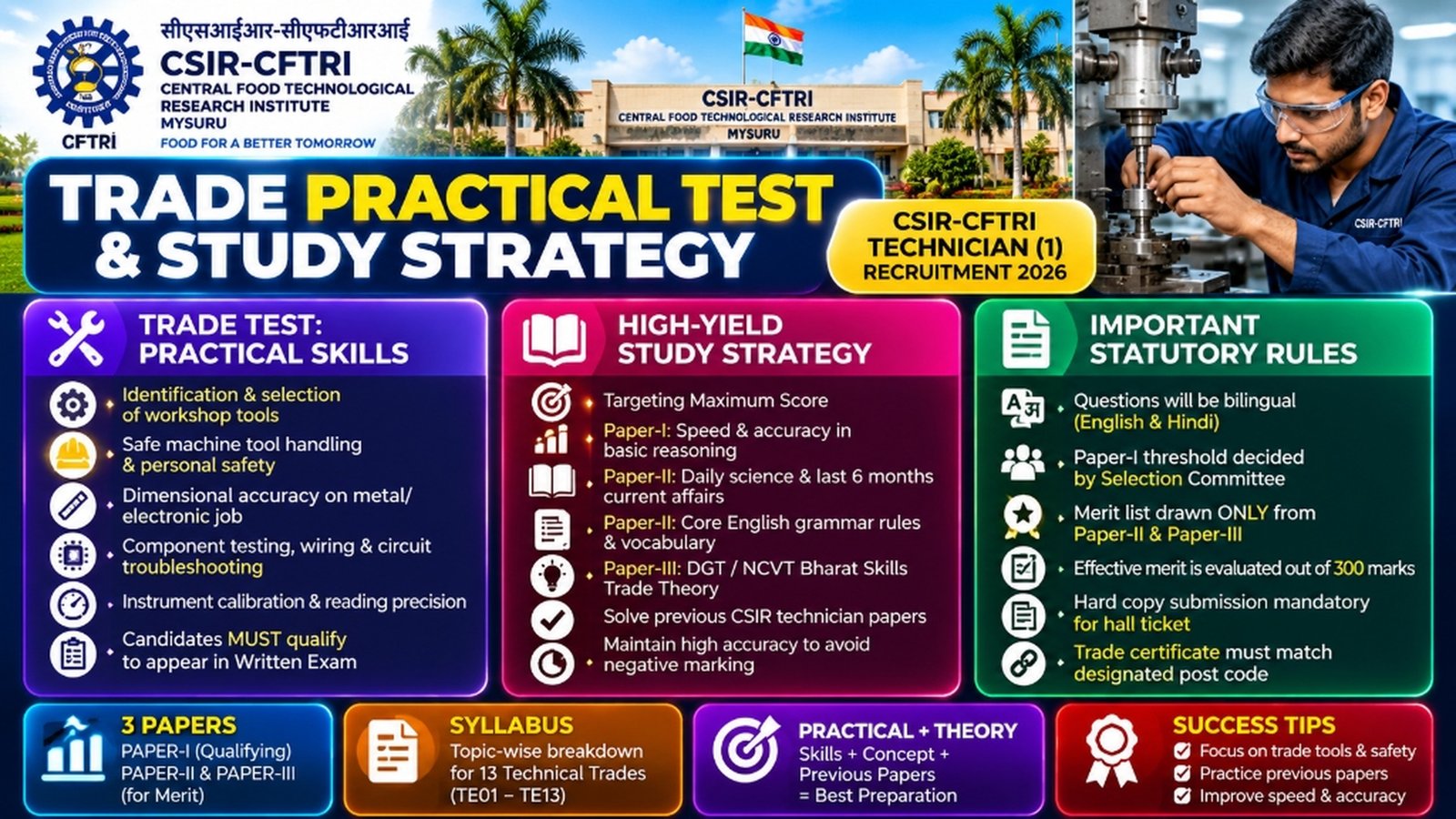
Candidates shortlisted after application screening must appear for the hands-on Trade Test. It evaluates practical proficiency in the workshop environment:
Mechanical Trades
Practical job manufacturing using raw steel/metal within given tolerance limits (±0.02 mm to ±0.05 mm), precision fitting, filing, tapping, or standard lathe job turning.
Electrical & RAC
Wiring circuit execution, motor terminal identification, starter connections (DOL/Star-Delta), refrigerant charging, vacuum testing, and fault diagnosis in electrical boards.
Electronics & IT
Component identification with multimeter, circuit simulation, solder work, RJ-45 crimping, OS configuration, database query execution, and chemical solution preparation.
Recommended Preparation Resources
- Trade Theory: National Instructional Media Institute (NIMI) books and Bharat Skills ITI trade textbooks.
- Reasoning: Non-verbal and verbal reasoning manuals focused on standard speed drills.
- General Science & Awareness: NCERT Class 9th & 10th Science textbooks and last 6 months current affairs capsules.
- English: High School English Grammar and Composition (Wren & Martin / Objective General English).
- CFTRI Pillar Recruitment Guide: Review our comprehensive CSIR CFTRI Technician 2026 Recruitment Post for application rules and mandatory hard copy submission steps.
Source: CSIR-CFTRI Advertisement No. Rec.02/2026 & NCVT/CTS Trade Curriculum.
Disclaimer: Detailed syllabus is structured from the statutory recruitment guidelines and standard Craftsmen Training Scheme (CTS) frameworks approved for CSIR technician posts.